


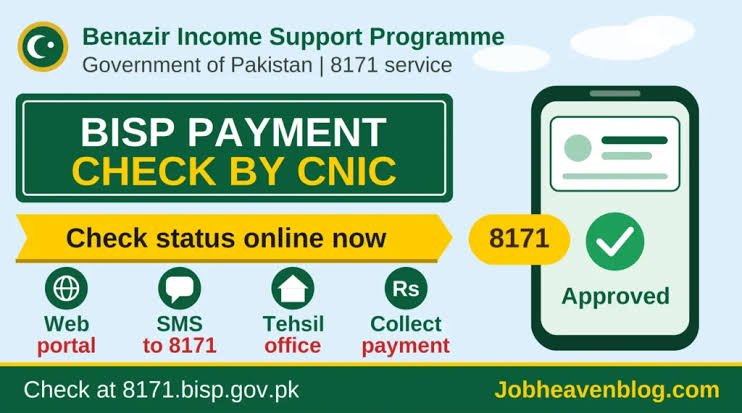
Got a text saying you’ve been approved for BISP cash, or that your payment is ready? Before you act on it, it’s worth checking whether that message is actually from BISP. This guide explains how to verify a BISP payment message, the red flags of a fake one, and what to do if you spot a scam.
The One Rule That Matters Most
All genuine BISP communication comes from the short code 8171, and nowhere else. BISP does not send official messages from regular 10-digit mobile numbers, through WhatsApp, or through email. If a message claims to be from BISP but didn’t come from 8171, treat it as fake.
How to Verify a Message Is Genuine
- Check the sender. Open the message and confirm it was sent from 8171, not a regular phone number or an unfamiliar short code.
- Don’t trust the message alone, check independently. Even if a message looks like it’s from 8171, send your own 13-digit CNIC number (without dashes) directly to 8171 yourself, and compare the reply to what the earlier message claimed.
- Visit the official website. Go to 8171.bisp.gov.pk and check your status there using your CNIC, as a second, independent confirmation.
- Call the BISP helpline if you’re still unsure, and ask them to confirm whether a message or payment notice is genuine.
- Visit your nearest BISP Tehsil Office in person for a final, in-person confirmation if needed.
Red Flags of a Fake BISP Message
- Sent from a random mobile number, not the 8171 short code
- Poor spelling, awkward grammar, or unusual formatting
- Urgent or threatening language, pressuring you to act immediately
- A request for your CNIC details, bank account, OTP, or wallet PIN
- A request to pay a “processing fee,” “registration charge,” or any amount to receive your payment
- A link to click, especially one that doesn’t clearly lead to bisp.gov.pk
- Contact through WhatsApp, claiming to be BISP support
- A number that looks similar to 8171 but isn’t exact, such as 7181 or another lookalike
What Genuine BISP Communication Looks Like
- Comes only from 8171
- Never asks for your OTP, PIN, or bank/wallet password
- Never asks you to pay a fee for registration, verification, or payment release
- Doesn’t operate through WhatsApp for official confirmations
- Matches the information available when you independently check your status on 8171.bisp.gov.pk or by texting your CNIC to 8171 yourself
What to Do If You Receive a Suspicious Message
- Don’t click any links in the message.
- Don’t call back any number included in a suspicious message.
- Don’t share your CNIC details, OTP, PIN, or bank/wallet information with anyone contacting you this way.
- Verify independently through 8171 or the official BISP website before taking any action.
- Report the number to your mobile network operator, and report the scam to BISP through their official helpline.
- If money was taken from your account or wallet, report it to your bank or wallet provider immediately, and consider reporting the fraud to FIA’s Cybercrime Wing.
Why These Scams Target BISP Beneficiaries
BISP beneficiaries are often targeted specifically because scammers assume they’re expecting a payment message and may act quickly without double-checking. Scammers rely on urgency and the hope of receiving money to get people to click links or share sensitive details. Taking a moment to verify independently, rather than reacting immediately, is the simplest way to avoid falling for these schemes.
Frequently Asked Questions
What is the only official number for BISP messages?
8171. Any message claiming to be from BISP that comes from a different number should be treated as fake.
Does BISP ever contact beneficiaries through WhatsApp?
No. BISP does not use WhatsApp for official payment or eligibility communication. Treat any such message as a scam.
Will BISP ever ask me to pay a fee to receive my payment?
No. BISP services, including registration, status checks, and payments, are completely free. Any request for a fee is a scam.
How can I double-check if a BISP message is real?
Send your own CNIC number to 8171 yourself, or check your status directly at 8171.bisp.gov.pk, and compare that result to what the message claimed.
What should I do if I already shared my CNIC or OTP with a scammer?
Contact your bank or mobile wallet provider immediately to secure your account, and report the incident to BISP’s helpline and FIA’s Cybercrime Wing.
Verifying a BISP payment message takes less than a minute: check that it’s from 8171, and if in doubt, confirm it yourself through the official portal or by texting your CNIC directly. That simple habit is enough to keep most scams from working on you.
