


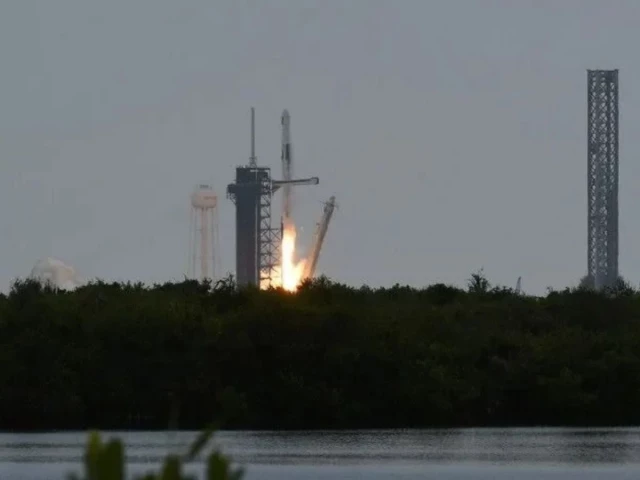
Japan has launched the world’s first mission designed to collect a sample from a Martian moon and bring it back to Earth. The spacecraft, called MMX (Martian Moons eXploration), lifted off on an H3 rocket from the Tanegashima Space Center at 4:41 a.m. Japan time on 20 October 2026 (19:41 GMT on 19 October). Its target is Phobos, the larger of Mars’ two moons. Here is how the mission will work and what scientists hope to learn.
The Launch
According to Space.com, the launch was the 10th flight of the H3 rocket, which was developed by Japan’s space agency JAXA and Mitsubishi Heavy Industries. Liftoff came from Pad 2 at the Yoshinobu Launch Complex. About 71 minutes later, MMX separated from the rocket’s upper stage on schedule and began its journey to Mars. JAXA leads the mission, with NASA, CNES (France), DLR (Germany) and ESA contributing, according to ESA.
Why Phobos?
Phobos has never been sampled by a spacecraft that returns to Earth. Scientists want to know how Mars’ two moons, Phobos and Deimos, formed. Space.com describes two main ideas:
- Giant impact: the moons formed from debris after a huge impact on Mars, much like the leading theory for Earth’s Moon.
- Captured asteroids: the moons were asteroids pulled in by Mars’ gravity, which the moons’ lumpy shapes and makeup seem to support.
The samples could help settle the question and shed light on the early history of Mars and the solar system.
The Mission Timeline
| When | What happens |
|---|---|
| October 2026 | Launch and start of the journey to Mars |
| August 2027 | Arrival at Mars. MMX moves into an orbit around Phobos, with ESA saying orbit around Phobos begins in September 2027 |
| Late 2028 or early 2029 | The IDEFIX rover is released onto Phobos |
| 2030 | Landing on Phobos to collect samples. Space.com says there will be two touchdowns |
| November 2030 | MMX leaves for Earth after flybys of Deimos |
| 2031 | The sample capsule lands in Australia |
Sources differ slightly on the date of the rover release. ESA says early 2029, and Space.com says late 2028 or early 2029.
What It Will Bring Back
MMX plans to return about 10 grams of Phobos material, which is about two teaspoons of soil, according to the published plans. ESA says it will be at least 10 grams. Space.com reports that at least 15% is reserved for NASA study. The capsule is due to land in Australia in 2031.
The IDEFIX Rover
IDEFIX is a 25-kilogram rover built by France and Germany. It will be placed on Phobos’ surface to study the ground and help prepare for the main spacecraft’s landing.
NASA’s Role
NASA is providing instruments including MEGANE, a gamma-ray and neutron spectrometer built by Johns Hopkins APL, and a pneumatic sampler from Honeybee Robotics. It is also providing Deep Space Network support. Space.com says NASA has invested about $87 million in the mission.
What Could Go Wrong
The mission will run for about five years, and every step, including orbit entry, landing and return, must work. Landing on a small moon with very weak gravity is difficult. Japan has experience from its Hayabusa and Hayabusa2 missions, which returned samples from asteroids, but nothing is guaranteed.
Frequently Asked Questions
What is MMX?
Martian Moons eXploration, a JAXA mission to collect and return samples from Mars’ moon Phobos.
When did it launch?
At 4:41 a.m. Japan time on 20 October 2026.
When will it reach Mars?
In August 2027, about 10 months after launch.
How much will it bring back?
About 10 grams of Phobos material.
When will the samples reach Earth?
In 2031, in a capsule landing in Australia.
Which countries are involved?
Japan leads, with NASA, France, Germany and ESA.
MMX will take years to reach its goal. If it succeeds, it will give scientists the first pieces of a Martian moon to study on Earth.
