


Moving abroad starts with paperwork, and one missing stamp can delay your visa for weeks. If you need to attest Pakistani documents for immigration, you must follow a fixed order of steps. This guide explains each step, the latest MOFA rules for 2026, and the fees. It also shows how to avoid the most common mistakes.
What Is Document Attestation and Why Do You Need It?
Attestation is an official check that proves your document is genuine. Immigration offices in other countries cannot verify Pakistani certificates on their own. Therefore, they ask for proof from the Pakistani government.
Pakistan joined the Hague Apostille Convention on 9 March 2023. As a result, the Ministry of Foreign Affairs (MOFA) now issues two types of legalization:
- General attestation: a stamp and seal from MOFA, usually followed by embassy attestation.
- Apostille: a standard certificate accepted by member countries of the Hague Convention.
The right option depends on your destination country. Always ask the embassy or immigration office which one they accept.
How to Attest Pakistani Documents for Immigration: Step by Step
The chain of attestation follows the same pattern for most documents. First, the issuing body verifies the document. Next, MOFA legalizes it. Finally, an embassy may add its own stamp if the destination country requires it.
Step 1: Get the Document Verified by the Correct Authority
MOFA does not attest every document directly. Many documents need verification from another office first. The table below shows the common ones.
| Document | Verify First From |
|---|---|
| Matric and Intermediate certificates | Board, then IBCC |
| University degrees and transcripts | HEC |
| Birth, marriage, and family certificates (NADRA) | No prior step; MOFA attests them directly |
| Experience certificates | Company HR head seal; some trades need a specific body |
| Police character certificate | District Police Officer, routed through the Ministry of Interior |
| Engineering degrees and experience | Pakistan Engineering Council |
| Medical degrees and certificates | Ministry of National Health Services |
Step 2: Prepare Your Documents
Complete files move faster. Keep the following ready:
- The original document and a photocopy.
- Your original CNIC.
- An English version of the document, if it is in another language.
MOFA attests documents only in Urdu or English. Therefore, a translation must keep English in one column on the same page.
Step 3: Apply for MOFA Attestation or Apostille
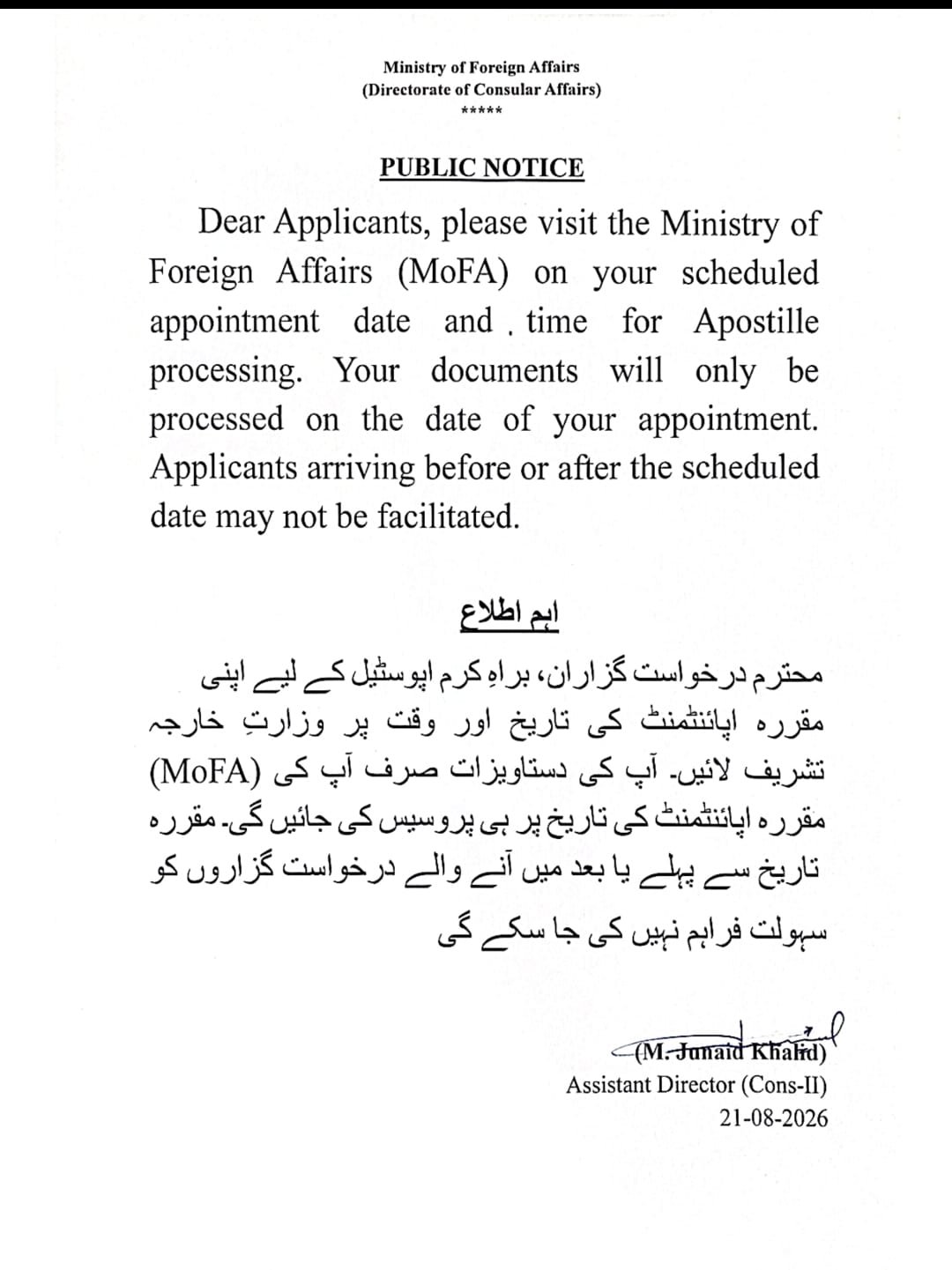
Since 27 July 2026, MOFA does not entertain apostille requests without prior online registration. You must apply on the official apostille portal before you visit any office. The process works like this:
- Create an account on the MOFA apostille portal.
- Upload both sides of your CNIC.
- Create a new application and attach the documents.
- Review everything and submit.
- Wait for approval by email, then pay the challan online, through Easypaisa, or at a bank.
- Visit the selected office on your given date and time.
Please visit only after approval. Moreover, keep checking your email, because staff may ask for extra papers.
Step 4: Choose Where to Submit
You can submit documents at the MOFA office in Islamabad or at its liaison offices in Lahore, Karachi, Peshawar, Quetta, and Gujrat. Alternatively, you can use an authorized courier company. These companies include Gerry’s International, Leopards Courier, ECS, M&P Express Logistics, and TCS. They charge service fees in addition to the government fee.
However, legal papers such as a Power of Attorney or an affidavit need your physical presence. Couriers cannot handle them.
Step 5: Complete Embassy Attestation if Required
Some countries do not accept an apostille alone. In that case, you must submit your MOFA-attested documents to the embassy of the destination country in Islamabad. Embassy rules, fees, and timelines differ from country to country. For this reason, check the embassy website before you start.
MOFA Apostille Fees in 2026
MOFA published the following fee schedule for apostille certification, effective from 8 July 2024:
| Document Type | Fee per Document |
|---|---|
| Personal and educational documents | Rs3,000 |
| Legal documents | Rs4,500 |
| Commercial documents | Rs12,000 |
Courier charges are extra. In addition, fees at HEC, IBCC, and embassies are separate, so confirm them on each official website.
New Online Attestation System
In October 2026, reports said MOFA introduced a digital attestation system. It lets applicants apply online and receive electronic certificates by email after verification. However, not every organization accepts electronic certificates. Therefore, confirm with your immigration office before you rely on one.
Common Mistakes to Avoid
- Skipping the first verification: A degree without HEC verification will not reach MOFA stage.
- Ignoring the destination rules: An apostille may not be enough for some countries.
- Submitting incomplete files: MOFA sends doubtful or incomplete documents back to the issuing authority.
- Visiting before approval: You will be turned away if your online application is not approved.
- Waiting until the last minute: Embassy steps can take several weeks.
Frequently Asked Questions
How long does document attestation take in Pakistan?
MOFA processes most general documents quickly after you reach the counter. Online approval, HEC or IBCC verification, and embassy steps add time. Plan for several weeks in total.
Is an apostille the same as attestation?
No. An apostille is a standard certificate for Hague Convention countries. General attestation is a stamp that often needs an extra embassy step.
Can someone else attest my documents for me?
Yes, a blood relative can submit most documents with proof of the relationship. Power of Attorney and affidavits, however, need the signatory to appear in person.
Do attested documents expire?
Documents of a permanent nature, such as birth certificates, Nikah Nama, and educational certificates, remain valid after attestation. A Power of Attorney is valid for 120 days.
Conclusion
To attest Pakistani documents for immigration, follow the chain in order: issuing authority, HEC or IBCC, MOFA, and then the embassy if needed. Register online first, prepare complete files, and check your destination country’s rules early. Rules and fees can change, so verify them on the official MOFA consular page before you apply. For more guides on public services, keep reading Pakistan Post.
