


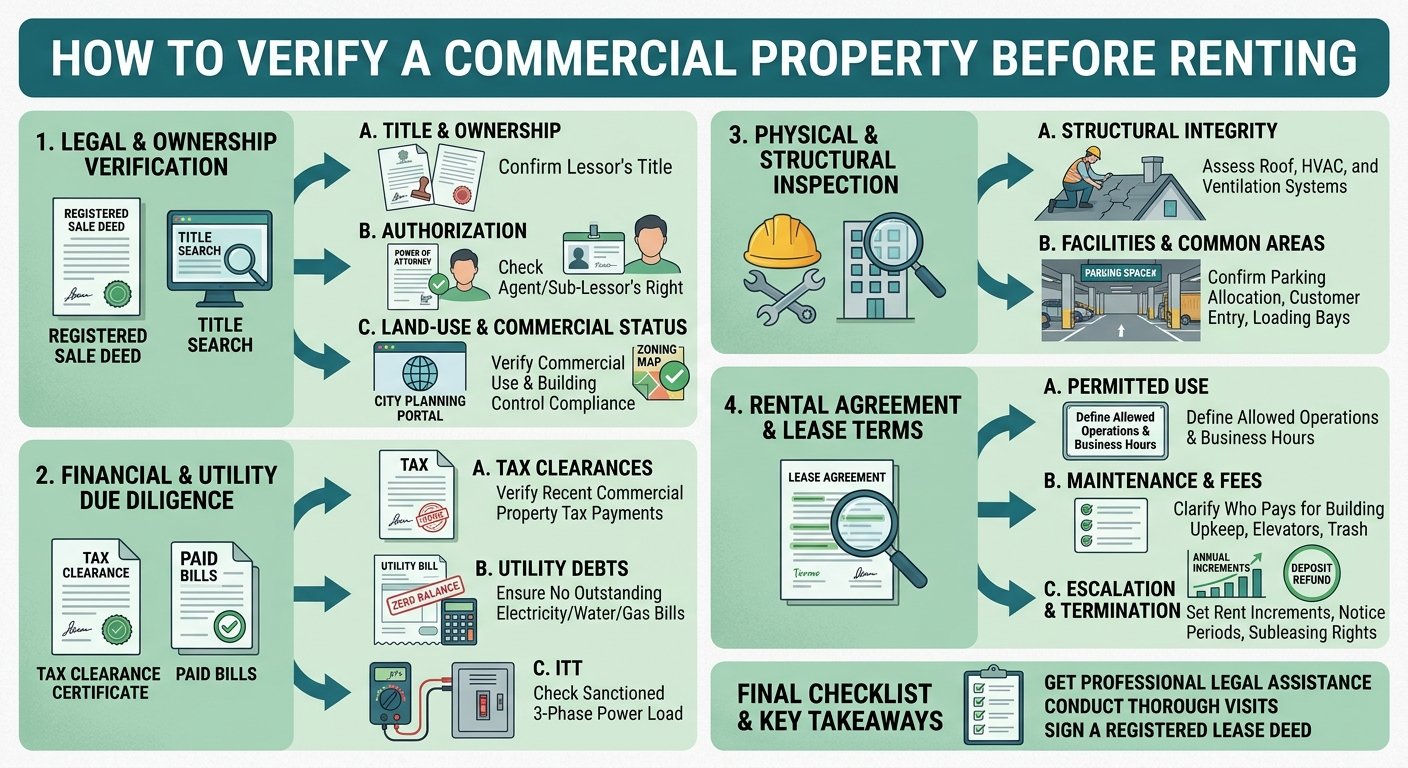
Renting a shop, office, or warehouse is a big commitment. You will spend money on advance rent, fit-out, and signage before you earn a single rupee. If the landlord is not the real owner, or the property cannot legally be used for business, you can lose all of it. This guide explains how to verify a commercial property before renting, step by step.
Why Verification Matters for Commercial Rentals
A commercial tenant faces more risk than a home tenant. You may invest heavily in interior work, stock, and branding. Therefore, a dispute over ownership, a sealed building, or unpaid dues can shut your business down. A few checks before you sign can prevent most of these problems.
Step 1: Verify the Landlord Owns the Property
Never take the landlord’s word for it. Ask for the ownership papers and match them with the person in front of you.
| Document | What It Shows | Where to Verify |
|---|---|---|
| Latest land record (fard or equivalent) | Who is the recorded owner today | Provincial land record office or portal |
| Registry or sale deed | How the owner acquired the property | Sub-Registrar office |
| Allotment letter or society record | Ownership in a housing society or authority scheme | Society office or development authority |
| Landlord’s original CNIC | That the landlord matches the record | Check in person |
| Power of attorney (if an agent rents it) | That the agent has the owner’s authority | Check the date and scope; confirm with the owner |
Always ask for a fresh record, not an old copy. Also check that the owner’s name and CNIC match the person you are dealing with. If someone else collects the rent, ask why and verify their authority.
Step 2: Check for Mortgages, Disputes, and Court Cases
- Ask whether the property was ever mortgaged. If so, ask for a bank NOC.
- Check the land record for any charge, stay order, or disputed-ownership note.
- Ask neighbours and nearby shopkeepers about any dispute or recent court notice.
- Consider a short consultation with a property lawyer for a high-value lease.
Step 3: Confirm the Property Can Be Used for Business
This step is specific to commercial renting. A building in a residential zone may not be allowed to run a shop or office. Check these points:
- Approved land use: Is the plot or building approved for commercial use by the local authority or housing society?
- Building plan and completion: Ask for the approved building plan and proof that the building is complete and legal.
- Business permits: Find out which licences your business needs, such as a trade licence or a food licence, and whether the location allows them.
- Signage and parking: Ask what rules apply to boards and customer parking.
If the authority has sealed or warned the building in the past, the landlord must tell you. Ask directly, and get the answer in writing.
Step 4: Check Utilities and Outstanding Dues
Unpaid dues can become your problem. Before you sign:
- Ask for recent electricity, gas, and water bills.
- Check whether the meters are commercial or domestic, and whose name they are in.
- Ask for property tax receipts to confirm that tax is current.
- Find out about society maintenance charges and who pays them.
Step 5: Inspect the Premises in Person
Visit the property at different times of the day. Look at the following:
- Electrical wiring, load capacity, and a generator or backup, if you need one.
- Fire exits, extinguishers, and general safety.
- Water supply, drainage, and signs of leakage or damp.
- Access for customers and deliveries, and parking space.
- The condition of floors, shutters, and walls.
Take dated photos of everything. They protect your security deposit when you leave.
Step 6: Sign a Proper Tenancy Agreement
A verbal arrangement is the biggest source of rental disputes. In Punjab, the Punjab Rented Premises Act 2009 requires a written tenancy agreement that is presented to the Rent Registrar for registration. Other provinces have their own laws, such as the Sindh Rented Premises Ordinance 1979. Under the Registration Act 1908, agreements longer than one year also need registration.
Make sure the agreement covers:
- Full names, CNICs, and addresses of both parties.
- An exact description of the premises, including floor and area.
- The purpose of the rent, which should say commercial use.
- Rent amount, due date, annual increase, and payment method.
- Security deposit, notice period, and how it is returned.
- Who pays for repairs, utilities, and maintenance.
- Rules on subletting, renewal, and termination.
Use e-stamp paper of the correct value, register the agreement, and keep the registration receipt. Local police may also require tenant registration in some areas, so ask the nearest police station.
Step 7: Understand Tax and Payment Rules
Businesses that pay rent may have tax duties, such as deducting withholding tax. The rules depend on your business type, so ask your accountant before you finalise the amount. Pay rent by bank transfer where possible, and keep every receipt.
Red Flags to Watch For
- The landlord asks for a token or advance before you see the property.
- The seller or landlord refuses to show original documents.
- The name on the documents differs from the person you are dealing with.
- The rent is far below the market rate for the area.
- The landlord refuses to register the agreement.
- The building has sealed shops or notices on its walls.
Frequently Asked Questions
How do I check who owns a commercial property?
Ask for a fresh land record and the registry, then verify them with the land record office or Sub-Registrar. Match the owner’s CNIC with the landlord.
Do I need to register a commercial tenancy agreement?
In Punjab, the Rented Premises Act requires a written, registered agreement. Agreements longer than one year need registration under the Registration Act in all provinces.
Should I pay an advance before viewing?
No. Never pay a token or advance before you visit the property and verify the documents.
Can I rent a residential building for a shop?
It may not be allowed. Check the approved land use with the local authority or housing society first.
What should I check before paying a security deposit?
Verify the landlord, inspect the premises, take photos, and write the deposit terms into the registered agreement.
Conclusion
To verify a commercial property before renting, confirm the landlord’s ownership, check for disputes and dues, make sure the property can be used for business, inspect it in person, and sign a registered agreement. These steps take little time but protect your money and your business. Rules differ by province, so confirm the latest requirements with the local authority. For more guides on property and public services, keep reading Pakistan Post.
