

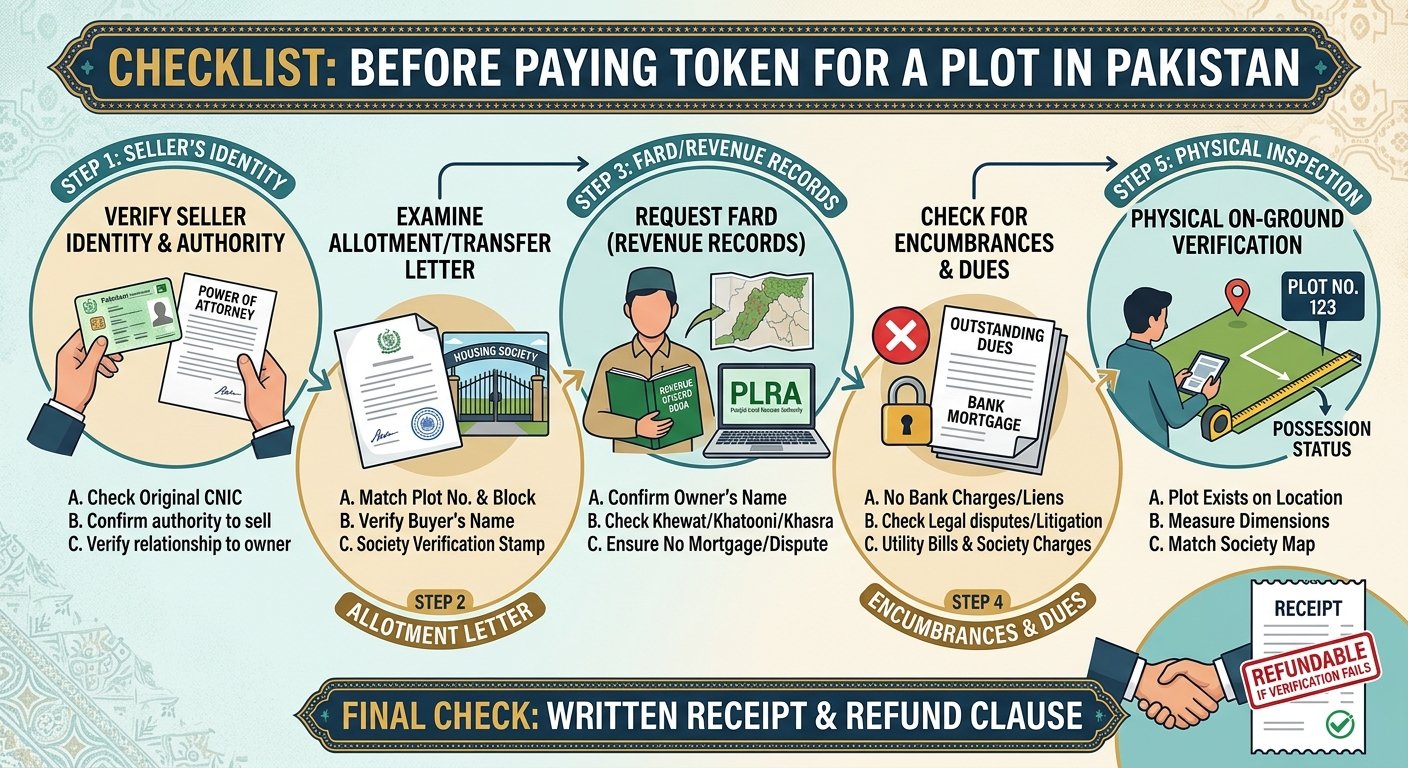
You like a plot, the dealer says three other buyers are interested, and he asks for token money today. Stop. In Pakistan, the token is often paid under pressure, and it is the step where many buyers lose money. This guide lists what to check before paying token money for a plot, the red flags to watch for, and what a safe token receipt should say.
This is general information, not legal advice. Rules differ by city and housing authority, so use a property lawyer for your own deal.
The Golden Rule: Verify First, Pay Later
Several property guides say the same thing: token money should come after basic verification, not before it. Do not pay a token just to “hold” the plot while you check. A real owner will let you verify the documents first.
The Pre-Token Checklist
1. Know What You Are Buying
Is it a registry plot with a registered title, or a file (an allotment or booking document in a society)? They are different. A registry plot is checked in government land records. A file is checked at the society or authority office. Never treat the two the same way.
2. Get a Fresh Fard and Check the Owner
For registry land in Punjab, pull a fresh Fard from the Punjab Land Records Authority (PLRA) or an Arazi Record Centre. Match the owner’s name and CNIC on the Fard with the person selling to you. Do not accept an old photocopy. One 2026 guide for Rawalpindi also says to check the record of deeds on the PLRA portal by CNIC or registry number.
3. Check the Seller’s Identity and Authority
- Match the seller’s original CNIC with the owner on the record.
- If someone is selling “on behalf” of the owner, ask for a power of attorney (PoA). It should be registered, current, and genuinely signed by the owner. Verify it with the issuing authority.
- For a deceased owner, ask for inheritance papers and the consent of all legal heirs.
- For a company or society, ask for written authorisation.
4. Verify the Housing Scheme and Its NOC
Check the scheme, not just the plot. Look up the exact society name, phase, and block on the official site of the relevant authority, such as LDA, RDA, CDA, or SBCA. Make sure it holds a valid NOC. A guide warns: “NOC applied for” is not the same as “NOC approved”. Also watch out for an NOC that does not name your exact phase or block.
5. Check the Approved Layout Plan
Ask for the stamped layout plan and confirm your plot number is inside it. Marketing maps are not enough. Some plots shown in brochures do not exist on the approved layout, or fall on land meant for roads, parks, or green belt.
6. Visit the Site
Go to the plot yourself, or send a trusted person. Check that it exists on the ground, that its size matches, and that someone else is not using it. If you live abroad, get a trusted representative or lawyer to do this.
7. Check Dues and Transfer Rules
For a society plot, ask for written confirmation of transfer rules and an up-to-date clearance of dues for that block. Unpaid dues can become your problem after you buy.
8. Look for Hidden Claims
Make sure the plot has no mortgage, court case, or attachment on it. Ask the seller to prove this, and have your lawyer check.
9. Understand Registry and Mutation
A registry records the sale, and a mutation updates the ownership record. Check the history of both. Guides say a fresh Fard that matches the seller, plus a confirmed registered deed and mutation, helps stop a double sale, where the same plot is sold to more than one buyer.
10. Pay Safely and Put It in Writing
Use a bank transfer or a crossed cheque, not large cash payments. A digital money trail is strong evidence if there is a dispute. Do not hand over cash without a signed receipt.
What a Token Receipt Should Say
- Date, and the full names and CNIC numbers of the buyer and seller
- Exact plot details: number, block, phase or scheme, size, and location
- The token amount, and how it was paid
- The total price, the balance, and when it must be paid
- The date by which the deal will be completed
- What happens if either side backs out, including refund and penalty terms
- Names and signatures of witnesses
Guides say token money should always be documented. Ask your lawyer to review the receipt or agreement to sell before you sign.
Red Flags to Walk Away From
| Red Flag | Why It Matters |
|---|---|
| Pressure to pay a token today | It is a classic way to stop you from checking |
| Seller will not meet at the society office or record centre | The paperwork may not hold up |
| Approval is “under process” but ads say “NOC approved” | The scheme may not be approved yet |
| The plot appears on a marketing map but not the approved layout | The plot may not legally exist |
| Price far below the market | It can mean a forged file or a disputed plot |
| Seller only has a photocopy, or a PoA you cannot verify | A forged or cancelled PoA is a known scam |
| Cash only, no receipt | You will have no proof of payment |
Buying From Abroad
Most checks, such as the Fard, society status, dues, and approval, can be done remotely with scanned documents and a trusted representative on the ground. If you give someone a power of attorney, one guide says it should be registered and verified by the Pakistani Embassy or Consulate in your country. Keep it limited to the specific deal.
Budget for Costs
Token money is only the start. Budget for stamp duty, registration fees, taxes, and society transfer fees, and ask your lawyer what applies in your city.
Frequently Asked Questions
Should I pay token money before checking documents?
No. Verify the Fard, the seller, and the approval first. Guides say token payment should follow verification.
Is a society’s approval enough?
No. A society can be approved while your specific phase, block, or plot is not. Check the exact plot against the approved layout.
Is token money refundable?
Only if your written agreement says so. Write the refund and penalty terms in the receipt.
Can I pay in cash?
It is risky. Use a bank transfer or crossed cheque, and always get a signed receipt.
Do I need a lawyer?
Guides strongly recommend one, especially for power of attorney deals, inheritance, and society files.
A few hours of checking can save you from losing your savings. Verify the Fard, the seller, and the approval, write everything down, and only then pay the token.
