

OpenAI says an unreleased internal AI model has cracked one of mathematics’ most famous unsolved puzzles — the Navier-Stokes existence and smoothness problem — a question that’s carried a $1 million prize and stumped mathematicians for roughly 90 years. If the result holds up, it would be the most significant mathematical proof ever produced by an AI system.
What the Problem Actually Asks
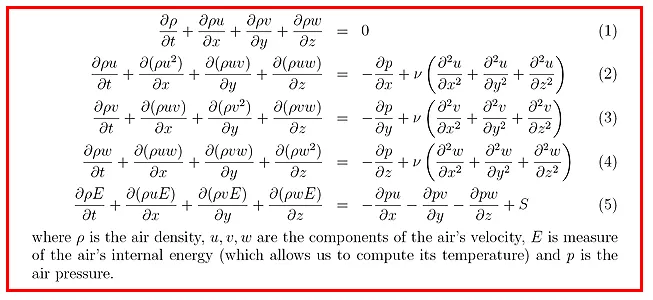
The Navier-Stokes equations describe how liquids and gases move — they’re the mathematical foundation behind everything from weather forecasting to aircraft design. The unsolved question, one of seven Millennium Prize Problems named by the Clay Mathematics Institute in 2000, asks whether smooth, well-behaved fluid motion in three dimensions can suddenly break down into a mathematical singularity — a point where the equations stop producing sensible results — even when starting from perfectly smooth conditions.
OpenAI’s model reportedly found that the answer is yes: it described a scenario where a vortex tightens and spins faster and faster in finite time — a “singularity” — while the fluid’s overall energy stays mathematically bounded throughout, satisfying the specific conditions the prize problem requires.
How OpenAI Says It Got There
According to OpenAI, the effort was run by an internal model described as “significantly more capable” than its GPT-6 Astra system, with training that began August 28 and was still ongoing at the time of the announcement. The company deployed roughly 10,000 AI agents working in parallel, which arrived at a proposed solution in about 88 hours. GPT-6 Astra then spent a further 17 hours helping formalize and verify the proof using Lean, a programming language mathematicians use to machine-check that a proof’s logic is airtight.
The scale of the effort was substantial — OpenAI says the agents exchanged nearly 4.9 million messages and generated roughly 300 billion output tokens, with the total compute cost running into the millions of dollars.
A Race That Started With a Rumor
The announcement comes with a genuinely messy backstory. OpenAI says it began its push on September 1, after hearing rumors that two outside mathematicians — Levent Alpöge of Harvard, who works at Anthropic, and Tristan Buckmaster of NYU — were closing in on a related result, reportedly using a mix of Anthropic’s Claude and OpenAI’s own models. OpenAI CEO Sam Altman reportedly acknowledged the company was, in part, motivated by curiosity about whether its own systems could match what Anthropic’s models had apparently helped achieve.
After completing its proof and Lean verification on September 6, OpenAI reached out to Alpöge and Buckmaster to propose a joint announcement — only to learn the two researchers had actually solved a related but distinct problem, involving the forced Euler equations rather than Navier-Stokes itself. Separately, a Caltech team led by Anima Anandkumar released a solution to a simplified, zero-viscosity version of the fluid equations around the same time, using a different AI approach altogether. The overlapping timing has fueled a credit dispute, with Buckmaster among those publicly questioning how OpenAI characterized the sequence of events.
Not Officially Solved — Yet
Despite the announcement, the Clay Mathematics Institute still lists Navier-Stokes as unsolved. Under the institute’s rules, a proposed solution must be published in a qualifying journal, remain in print for at least two years, and gain broad acceptance from the mathematical community before any prize consideration — a deliberately slow, conservative bar designed to filter out proofs that later turn out to be flawed.
OpenAI has said it doesn’t intend to claim the $1 million prize itself, framing the announcement instead as a demonstration of how quickly its most advanced systems are progressing, rather than a formal submission for recognition.
Why This Moment Matters Beyond the Proof Itself
Regardless of how the credit dispute settles, the episode marks a notable shift: multiple AI labs, independently, appear to have made genuine progress on a problem mathematicians hadn’t cracked in nine decades, within the same week. It also raises a pointed question for the research community — what happens when the AI companies providing scientists with research tools can also mobilize far greater computing resources to chase the same breakthroughs themselves, potentially racing ahead of the human researchers using their own tools.
Final Thoughts
Whether or not this specific proof survives the scrutiny of the broader mathematical community, the events of this week — three separate groups converging on major fluid-dynamics results within days of each other — suggest AI-assisted mathematics has crossed into genuinely new territory. The real verdict, however, won’t come from a press release; it’ll come from mathematicians spending the next two years combing through the proof line by line.
