


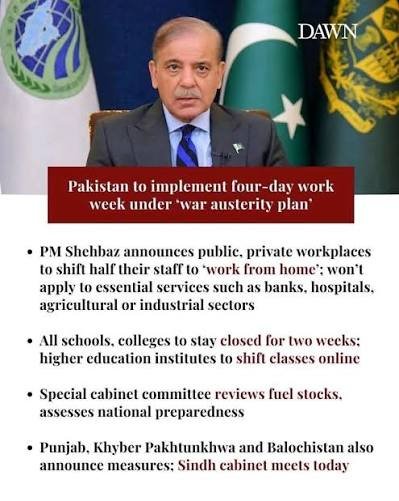
A notification claiming Pakistan’s government had officially adopted a four-day work week — with Friday, Saturday, and Sunday off — has been circulating on social media this week. The Ministry of Information and Broadcasting says it’s completely fake, but the confusion isn’t entirely random: it landed just a day after real discussions about reviving austerity measures.
What the Ministry Said
The Ministry of Information and Broadcasting’s fact-check account addressed the notification directly on X on Thursday, calling it fake and warning the public against sharing it further. “The public is advised not to believe or share such misleading content and to rely only on official government channels for authentic notifications and announcements,” the ministry’s post read.
According to the ministry, the fake notification was dated September 16 — specifically one day after real government statements about the possibility of reviving austerity measures.
Why This Fake Notification Spread So Easily
This hoax landed at a moment when the underlying premise wasn’t actually far-fetched. Information Minister Attaullah Tarar had said on Monday that the government was genuinely considering reviving austerity measures first introduced during an earlier fuel conservation drive, in response to renewed hostilities in the Middle East. That real announcement gave the fake notification just enough plausibility to travel — people who’d already heard the government was weighing austerity steps were primed to believe a specific-sounding “four-day work week” announcement might be the next real detail.
What the Real Austerity Measures Actually Included
To be clear about what’s genuine here: Pakistan’s government did announce austerity measures back on March 9, aimed at mitigating the economic impact of the ongoing US-Iran war. Those real measures included:
- A 50% cut in fuel allowances for official government vehicles
- Salary cuts for lawmakers
- A partial work-from-home policy across the public sector
Notably, a four-day work week with three consecutive days off was never part of that original package — which is exactly why the ministry moved quickly to knock down the fake notification circulating this week.
The Bigger Picture: Why Austerity Is Back on the Table
The renewed discussion around austerity ties directly into the escalating Middle East conflict, particularly recent Houthi attacks on Saudi energy infrastructure and rising global oil prices — developments that have already pushed Pakistan to raise petrol and diesel prices multiple times in recent days. With energy costs climbing and regional tensions showing no sign of easing, the government’s austerity conversation is a real, active policy discussion — just one that, as of this week, has not resulted in any four-day work week decision.
How to Verify Government Notifications Yourself
- Check the Ministry of Information and Broadcasting’s official fact-check account before sharing any circulating “notification”
- Look for the notification on official government department websites, not just social media screenshots
- Be skeptical of notifications that surface right after real government statements on a related topic — that timing overlap is exactly what makes fake versions more believable and shareable
- Official notifications typically carry specific reference numbers, letterheads, and issuing-authority signatures — verify these details rather than taking a screenshot at face value
Final Thoughts
No four-day work week has actually been adopted — what’s real is that Pakistan’s government is genuinely weighing a revival of March’s austerity measures amid worsening regional energy pressures. The fake notification’s success in spreading says less about any real policy shift and more about how a plausible-sounding detail, timed right after a genuine government statement, can travel fast on social media before official channels catch up to correct it.
