


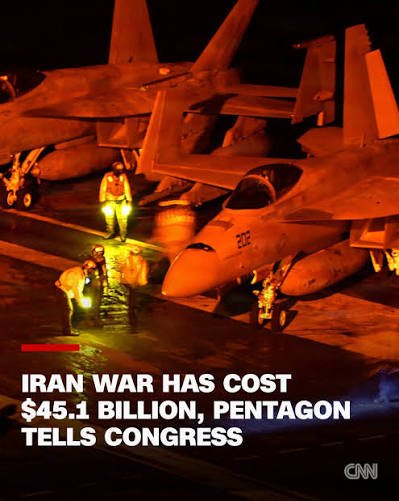
The US war with Iran has cost $45.1 billion, the Pentagon told Congress on Friday — the highest official estimate yet, and one that arrives just as American public support for the war continues to slide ahead of November’s midterm elections.
Breaking Down the Number
| Component | Amount |
|---|---|
| Cost as of September 3 | $43.6 billion |
| Additional fuel costs | $1.5 billion |
| Total reported to Congress | $45.1 billion |
Within the $43.6 billion baseline figure, the Pentagon broke costs into two categories: $11.2 billion already spent on operating expenses — fuel, combat pay, aircraft, medical care, spare parts, and similar day-to-day costs — plus $32.4 billion in unfunded replacement costs for munitions, damaged aircraft, and other military assets used or lost during the conflict.
How This Compares to Earlier Estimates
| Source | Estimate | Period Covered |
|---|---|---|
| Pentagon (initial briefing) | $11.3 billion | First 6 days of the war |
| Defense Secretary Hegseth (July testimony) | $37.5 billion (projected) | Through end of September |
| Pentagon Inspector General | $33.4 billion | Through June |
| Congressional Budget Office (CBO) | $38.1 billion | Through July/August 1 |
| Pentagon (latest, to Congress) | $45.1 billion | As of September 3, plus fuel costs |
The trajectory is clear and consistent: every successive estimate has come in higher than the last, and the current figure has already overtaken Hegseth’s own July projection for where costs would land by the end of September — with weeks still to go before that deadline.
What This Estimate Doesn’t Include
Even at $45.1 billion, the Pentagon itself has acknowledged this isn’t the full picture. The estimate doesn’t include an assessment of the cost to repair US military facilities damaged during the war — potentially billions of dollars in damage spread across eight Middle East countries. The Pentagon also reportedly did not provide Congress with the detailed breakdown of indirect military operation costs that lawmakers had specifically requested. Separately, the CBO’s own estimate has its own gaps: it excludes diplomatic operations, foreign aid, costs tied to killed or injured personnel, future veterans’ healthcare and disability compensation, and the long-term maintenance costs of military assets used in the conflict. In short, essentially every official estimate so far understates the war’s true total cost to some degree.
Where This Fits Politically
This cost disclosure lands at a genuinely sensitive political moment. Polling shows Americans increasingly oppose the war, with its economic impact cited as one specific driver of that shift — and the issue is becoming a bigger factor as the November midterm elections approach. Against that backdrop, the Pentagon has separately requested $67.1 billion in supplemental spending from Congress, partly aimed at recouping costs already incurred — a request that puts real pressure on lawmakers to weigh in on the war’s financial burden just as voters are paying closer attention to it themselves.
The Bigger Picture: A War That Keeps Getting More Expensive
Zooming out, the cost curve tells its own story. The war reportedly burned through roughly $5.6 billion worth of munitions in just its first two days, and $11.3 billion within its first six days — a pace that has continued to compound over the months since. With costs now approaching $45 billion and still climbing, and with billions more in facility damage and long-term costs not yet even factored in, the full financial toll of the conflict remains, by the Pentagon’s own admission, still an incomplete picture.
Final Thoughts
Every official accounting of the Iran war’s cost — from the Pentagon, its own Inspector General, and the Congressional Budget Office — has landed at a different number, but they all point in the same direction: higher, and rising. With $45.1 billion now the latest figure, real damage-repair costs still unaccounted for, and a $67.1 billion supplemental request sitting before Congress, the war’s price tag looks set to keep climbing well past what’s currently on the books — a financial dimension of the conflict that’s increasingly shaping the political conversation around it heading into the midterms.
