


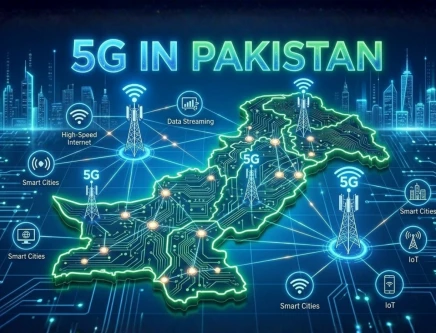
After years of delays, false starts, and being left behind by regional neighbors, Pakistan’s 5G era is finally here. Since the country’s landmark spectrum auction earlier this year, 5G in Pakistan has moved from announcement to actual rollout, with over a thousand live sites now running across major cities. Here’s a complete, up-to-date look at where things stand.
How Pakistan Finally Got Here
Pakistan’s 5G journey formally began with the Next Generation Mobile Services (NGMS) Spectrum Auction held on March 10, 2026. Three telecom operators — Jazz, Zong, and Ufone — competed for a total of 597.2 MHz of spectrum across six frequency bands (700, 1800, 2100, 2300, 2600, and 3500 MHz). The auction, conducted through a secure electronic system and broadcast live for full public transparency, ultimately raised approximately $507–510 million for the government, selling 480 MHz of the available spectrum. Just over a week later, on March 19, 2026, PTA formally issued 5G licenses, and Jazz and Zong launched commercial services almost immediately in major cities.
Where 5G Actually Works Right Now
According to PTA’s own data, Pakistan had deployed 1,136 5G sites across 23 cities as of early August 2026. By September, Jazz alone had crossed 1,000 live 5G sites — a genuinely significant milestone for the operator leading the rollout race. Here’s how deployment breaks down by operator and city:
| Operator | Approx. Site Share | Rollout Focus |
|---|---|---|
| Jazz | ~60% of deployed sites | Leading site count nationally, targeting roughly 1,000 sites in this initial phase |
| Zong | ~30% of deployed sites | Aggressive push in Karachi and Lahore, backed by China Mobile’s deployment experience |
| Ufone (PTML) | ~10% of deployed sites | Slower initial pace, expected to accelerate in Q4 2026 following Telenor Pakistan merger |
By city, the heaviest concentration of 5G sites is currently in Lahore (241 sites), Karachi (257 sites), Islamabad (192 sites), and Faisalabad (131 sites), with additional coverage extending to Rawalpindi, Peshawar, Quetta, Multan, Gujranwala, Hyderabad, Sukkur, Sahiwal, and Rahim Yar Khan.
What Kind of Speeds Are People Actually Getting?
While 5G technology is theoretically capable of speeds between 1 and 10 Gbps, real-world performance in Pakistan currently averages between 100 and 400 Mbps — still a dramatic improvement over Pakistan’s historical average mobile broadband speeds, which had hovered around 4 Mbps for years under the country’s previous spectrum constraints. PTA Chairman Hafeez ur Rehman has stated that average internet speeds are expected to rise significantly as rollout matures, while officials have also emphasized keeping 5G packages affordable for everyday users.
The Ufone-Telenor Merger Adds a New Player Dynamic
One of the more significant structural shifts happening alongside the 5G rollout is Ufone’s merger with Telenor Pakistan, now operating under the entity PTML, majority-owned by UAE-based Etisalat (e&). Once fully integrated, the combined company will hold 292.4 MHz of spectrum across low, mid, and high frequency bands — more than any single competitor, and notably double the 3.5 GHz spectrum held by its closest rival. While Ufone’s site rollout pace has lagged behind Jazz and Zong so far, its underlying spectrum position gives it real long-term capacity to compete once deployment accelerates, which industry observers expect to happen more visibly in the final quarter of 2026.
Parliament Is Watching Closely
The rollout hasn’t been without scrutiny. In September 2026, Pakistan’s National Assembly Standing Committee on IT and Telecommunication publicly called out operators over inconsistent service quality and pushed for faster expansion into rural and peri-urban areas — a clear signal that lawmakers want genuine nationwide coverage, not just visible progress limited to major urban centers. Expect continued pressure from PTA on quality-of-service benchmarks and compliance deadlines as the rollout moves into its next phase.
What You Need to Access 5G
To use 5G in Pakistan, you’ll need a 5G-compatible smartphone and to be within an operator’s active coverage zone — both Jazz and Zong publish coverage maps on their official websites so you can check whether your area is currently covered. It’s worth noting that 4G networks will continue operating in parallel for years to come; 5G is expanding gradually alongside existing 4G infrastructure, not replacing it overnight.
What’s Next
Several developments are worth watching in the coming months: Ufone’s expected Q4 2026 acceleration following its Telenor integration, Q3 2026 smartphone import data (due in October) that will reveal how quickly affordable 5G-capable handsets are reaching Pakistani consumers, and early enterprise use cases, including potential industrial 5G private networks in manufacturing hubs like Faisalabad’s textile sector, which some industry watchers expect to emerge by early 2027.
Frequently Asked Questions
When did 5G officially launch in Pakistan?
5G was officially launched on March 19, 2026, after PTA issued licenses to Jazz, Zong, and Ufone following the March 10 spectrum auction.
Which cities have 5G coverage in Pakistan right now?
Coverage is currently concentrated in major cities including Karachi, Lahore, Islamabad, Rawalpindi, Faisalabad, Peshawar, Quetta, Multan, Gujranwala, Hyderabad, Sukkur, Sahiwal, and Rahim Yar Khan, with Jazz currently leading in total site count.
What speeds can I expect from 5G in Pakistan?
Real-world speeds currently average between 100 and 400 Mbps, well below 5G’s theoretical maximum but a significant improvement over Pakistan’s historical mobile broadband speeds.
Do I need a new phone to use 5G in Pakistan?
Yes, you’ll need a 5G-compatible smartphone. Your existing 4G phone will continue to work normally, as 4G networks remain fully operational alongside the expanding 5G rollout.
Pakistan’s 5G rollout has genuinely moved from promise to reality in 2026, but with coverage still concentrated in major cities and parliament pushing for faster rural expansion, the real test of this rollout’s success will be how quickly that progress reaches beyond Pakistan’s biggest urban centers.
