


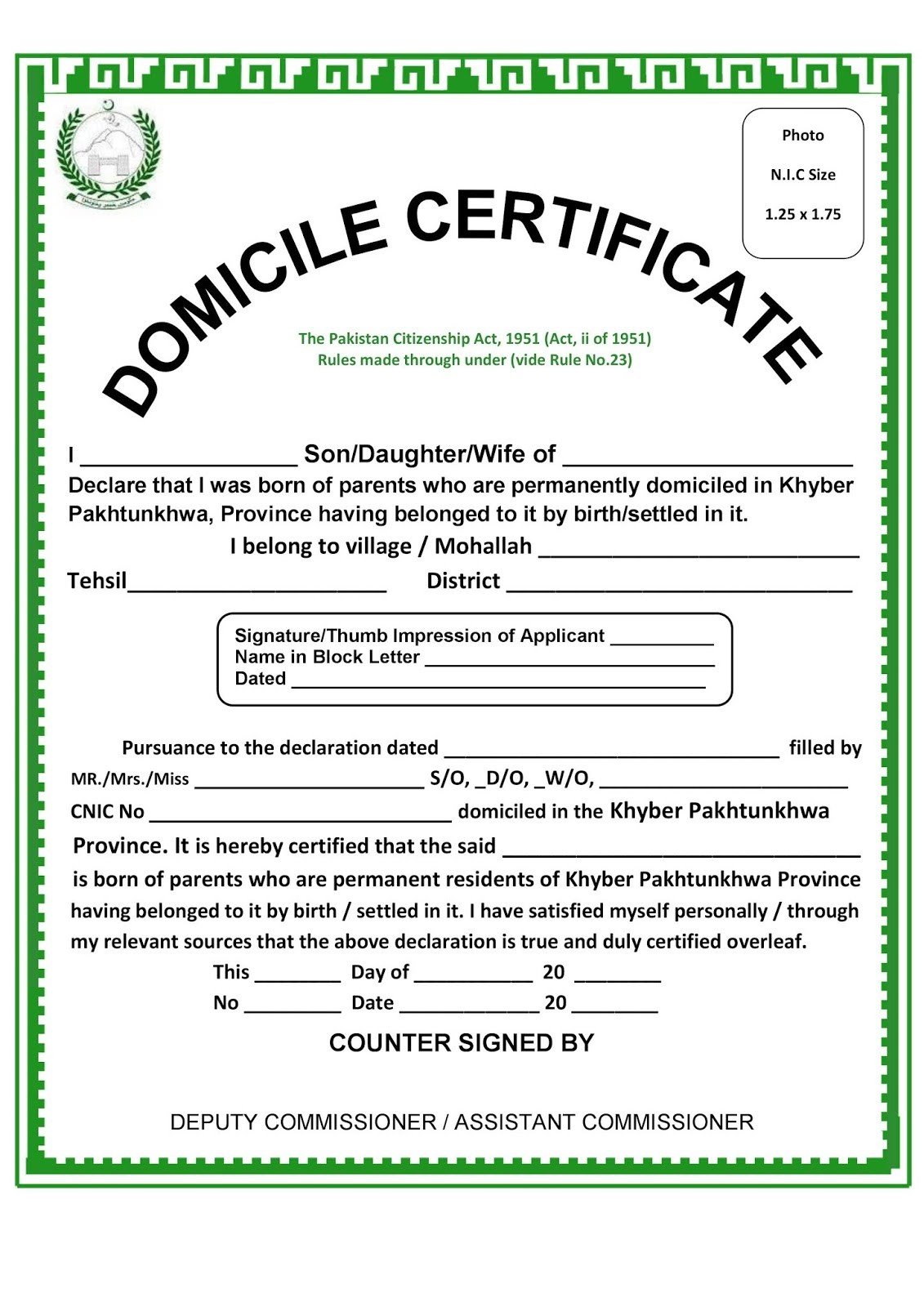
A domicile certificate proves your permanent residence in a particular district of Sindh, and you’ll need one for government jobs, university admissions on provincial quotas, and various official processes. This guide explains how to apply for a domicile certificate in Sindh, the documents required, and what the current fee looks like.
What Is a Domicile Certificate?
A domicile certificate is official proof that you permanently reside in a specific district. In Sindh, it’s often processed together with a Permanent Residence Certificate (PRC), since both are commonly needed for the same purposes, such as job quotas, admissions, and scholarships tied to your home district.
Who Can Apply?
- Individuals born in Sindh
- Children of parents who already hold a Sindh domicile certificate
- Women who have married a man holding a Sindh domicile, in certain cases
- Long-term residents of a district who can prove permanent residence there
Documents You Need
- Original CNIC
- CNIC of your head of family, parent, or spouse
- CNIC of husband/wife, if applicable
- Computerized Nikah Nama, for married applicants
- Birth certificate or B-Form
- Educational certificates, from Matriculation/O-Levels onward
- Voter list entry, certified by the Election Commission
- Residence certificate or rental agreement
- A recent utility bill (electricity, gas, or water)
- Any other document proving your permanent residence in the district
An important detail: the CNIC addresses of you and your relevant family members generally need to show the same district you’re applying for domicile in. Mismatched addresses across your documents are a common reason applications get delayed.
How to Apply: Step by Step
Step 1: Gather Your Documents
Collect all the documents listed above in original form, since they’ll need to be submitted for scanning.
Step 2: Apply Online or Visit Your District Office
Sindh now offers an online route through the Sindh Domicile and PRC Portal at sindhdomicileportal.gos.pk, or through the official “Sindh Domicile” mobile app, which handles Domicile, PRC-D, and PRC-C certificate applications. Alternatively, especially in Karachi, you can apply in person through your district’s Deputy Commissioner or Commissioner office.
In practice, Sindh’s system works as a hybrid: you can start your application online, but you’ll likely still need to submit your original documents in person for scanning, along with your photograph and biometric verification, before your certificate is processed.
Step 3: Fill Out the Application Form
Complete the domicile/PRC application form with your personal and family details.
Step 4: Pay the Application Fee
Pay the domicile fee, commonly cited at around Rs. 600 for Karachi districts, covering both the domicile and PRC together. Sindh’s fee payment often uses the 32-A challan form rather than an online PSID, though this can vary by district, so confirm the exact payment method shown for your application.
Step 5: Submit Your Documents for Scanning
Submit your original documents in person to be scanned, along with your photograph and biometric information.
Step 6: Wait for Processing
Once your case is submitted, it’s typically processed within about 3 working days, though this can vary slightly by district and current workload.
Step 7: Collect Your Certificate
Collect your domicile and PRC certificate once ready, either in person or through courier delivery if that option is offered, usually for an additional charge.
Domicile Fee and Processing Time
| Detail | Information |
|---|---|
| Fee (Karachi districts) | Around Rs. 600 for domicile and PRC together |
| Processing Time | Around 3 working days |
| Courier Delivery | Optional, additional charge |
Fees can vary slightly by district and are periodically revised, so confirm the exact current amount shown on your district’s payment challan or the official portal before paying.
Common Mistakes to Avoid
- Submitting CNICs with mismatched district addresses among family members
- Missing a required document, such as the Nikah Nama for married applicants or the voter list entry
- Applying in a district where you can’t actually prove permanent residence
- Assuming the entire process is fully online when original document submission and biometrics are still required in person
Frequently Asked Questions
Is the domicile certificate application fully online in Sindh?
Not entirely. While Sindh offers an online portal and app to start your application, original documents generally still need to be submitted in person for scanning, along with your photograph and biometrics.
How much does a domicile certificate cost in Sindh?
Around Rs. 600 for Karachi districts, covering both domicile and PRC together. Confirm the exact fee for your district before paying.
How long does it take to get a domicile certificate in Sindh?
Typically around 3 working days once your complete application and documents are submitted.
Do I need a separate PRC application, or is it combined with domicile?
In Sindh, domicile and PRC are commonly processed together in the same application.
What if my CNIC shows a different district than the one I’m applying in?
This is a common reason for rejection or delay. Your CNIC and your family’s CNIC addresses generally need to match the district you’re applying for domicile in.
Applying for a domicile certificate in Sindh is quicker than it used to be, with online tools now supporting much of the process. Keep your documents consistent across the same district, and you should have your certificate within about three working days of submission.
