


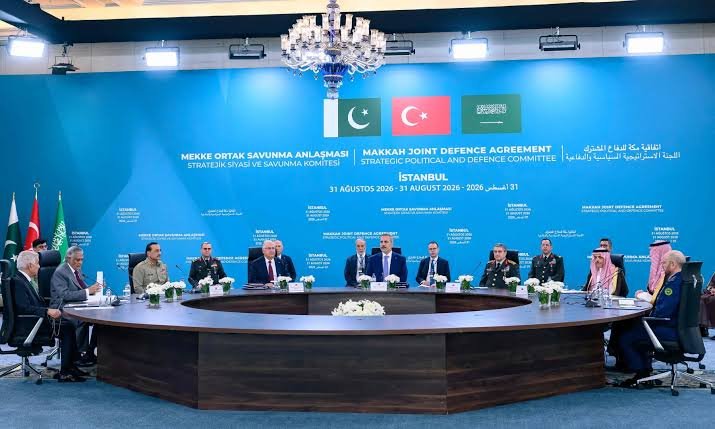
The Makkah alliance, officially the Makkah Joint Defence Agreement, links Pakistan, Saudi Arabia and Turkiye in a mutual defence pact. Under it, an armed attack on one member is treated as an attack on all three, and no member may leave for the first 10 years. The pact was signed in Makkah on 7 August 2026. Dawn reports that its details are now drawing attention as Turkiye moves towards ratification. Here is what is known and what remains unclear.
What the Pact Says
According to Dawn, which cites the text seen by Reuters:
- An armed attack on one member is regarded as an attack on all. Dawn compares this clause to NATO’s Article 5 and refers to Article 51 of the UN Charter on self-defence.
- Members agree to use “all necessary means” to counter threats to one another’s territorial integrity, sovereignty or internationally recognised borders.
- The pact takes effect when ratification documents are deposited with its secretariat in Riyadh.
- It has no fixed end date, and no member may withdraw during the first 10 years.
- It also covers defence-industry cooperation, intelligence sharing, logistical support and the fight against terrorism, including at the operational level.
The Express Tribune says the pact builds on the Strategic Mutual Defence Agreement between Pakistan and Saudi Arabia, signed on 17 September 2025.
Timeline
| Date | What happened |
|---|---|
| 17 September 2025 | Pakistan and Saudi Arabia sign a mutual defence agreement |
| 7 August 2026 | Makkah Joint Defence Agreement signed by Pakistan, Saudi Arabia and Turkiye |
| 31 August 2026 | First meeting of the alliance’s Strategic Political and Defence Committee in Istanbul |
| 5 October 2026 | Emergency committee meeting in Riyadh decides on deploying agreed forces to Saudi Arabia |
| 21 October 2026 | A separate defence-industry memorandum, involving Turkiye, Qatar, Pakistan and Indonesia, was expected to be signed in Doha |
Who Leads the Secretariat
Arab News reports that the secretariat is based in Saudi Arabia and will initially be headed by a secretary-general from Pakistan for three years. The Express Tribune says Pakistan appointed Lt Gen (retd) Nauman Mahmood as the first secretary-general.
Activation in October
The Tribune reports that on 5 October, the alliance’s committee held an emergency meeting in Riyadh and decided on the immediate deployment of “the agreed military forces and capabilities to the Kingdom in response to security threats.” The deployment will follow approved arrangements and each country’s national laws. The meeting followed Saudi Arabia’s conflict with the Houthis of Yemen.
Arab News Pakistan reports that Pakistan’s military spokesman, Lt Gen Ahmed Sharif Chaudhry, told CNN: “I can confirm that we, the forces of Pakistan, are already there.” He said Pakistani forces were serving “in multiple capabilities and domains” and had been in Saudi Arabia for decades. No figures were given for this deployment. The report cites a May Reuters report of 8,000 troops, a fighter squadron and an air defence system deployed under the earlier bilateral agreement.
Ratification: Where Each Country Stands
- Pakistan: Dawn says Pakistan has ratified the treaty, since officials say only the prime minister and cabinet approval is needed.
- Turkiye: It has sent the pact to parliament. Dawn says a committee could debate it as early as Friday, and Turkish law separately requires parliamentary approval to send troops abroad.
- Saudi Arabia: The reports I read do not state its ratification status.
The sources are not fully consistent on how the pact came into force. The Tribune says it was “signed into force” on 7 August, while Dawn says it takes effect on the deposit of ratification documents. Readers should treat the legal status as not fully clear.
What Turkiye Says
Dawn reports that Turkish Foreign Minister Hakan Fidan said the pact is not an “offensive agreement” and that Turkiye would not send troops to attack another country. A Turkish official said Ankara’s contribution would likely be limited to military equipment, intelligence sharing and weapons systems. Turkish presidential communications director Burhanettin Duran called it an important step towards institutionalising strategic cooperation. Arab News says Pakistan and Turkiye describe the alliance as defensive and not aimed at any country.
Could Others Join?
Arab News reports that Fidan said other countries can join, and that a roadmap for joining is being developed. Egypt is not a member. Dawn says its parliament is due to vote on 26 October on authorising possible military support for Saudi Arabia.
Questions Still Open
- How large Pakistan’s contribution is under the Makkah pact. Officials have not published figures.
- When Turkiye’s parliament will complete ratification.
- How the pact interacts with each country’s own laws on using force.
- How the pact will affect wider regional tensions, including the US-Iran dispute that officials have called on all sides to de-escalate.
Frequently Asked Questions
What is the Makkah alliance?
A mutual defence pact between Pakistan, Saudi Arabia and Turkiye.
When was it signed?
On 7 August 2026 in Makkah.
How long does it last?
It has no fixed end date, but no member may withdraw for the first 10 years.
Does an attack on one mean an attack on all?
Yes, the pact says an armed attack on one member is regarded as an attack on all.
Is it aimed at any country?
Pakistan and Turkiye say it is defensive and not aimed at any country.
Can other countries join?
Turkiye’s foreign minister says they can, and a roadmap is being developed.
The pact now has a headquarters, a secretary-general and an active committee. How far it goes in practice will depend on ratification and how each country applies its terms.
