


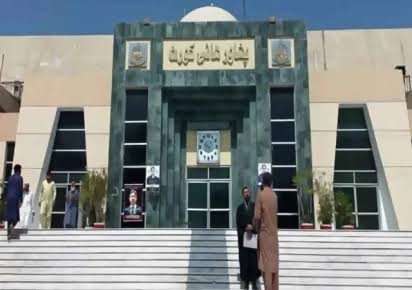
The Peshawar High Court (PHC) has sent notices to the federal and provincial governments over petitions that challenge the emergency and governor’s rule in Khyber Pakhtunkhwa (KP). The court will hear the case again on November 10.
What the Court Did
On Tuesday, a two-member bench of Justice Ijaz Anwar and Justice Muhammad Faheem Wali heard the first arguments. It then issued notices to the federal and provincial governments, and also to the Attorney General for Pakistan and the KP Advocate General. The court said it would release a written order afterwards.
The emergency and governor’s rule were imposed on October 11, after tensions rose between the PML-N-led federal government and the PTI-led KP government.
Who Went to Court
PTI Chairman Barrister Gohar Ali Khan filed his petition on October 14 and asked the court to declare both measures against the Constitution. Several others have filed petitions too:
- PTI leader Shandana Gulzar
- The KP Bar Council
- Leaders of the Tehreek-i-Tahafuz-Ayin-i-Pakistan (TTAP)
- Advocate Qaiser Shah, who supports the emergency but opposes the governor’s rule part
The Main Arguments
| Lawyer or Petitioner | What They Argued |
|---|---|
| Barrister Sameer Khosa (for Gohar) | The provincial assembly’s approval was needed, but it was never taken. The National Assembly and Senate approved the move later |
| Salman Akram Raja (for Gohar) | The measures were declared without meeting the legal rules, and should be cancelled so the assembly can be brought back |
| Advocate Muazzam Butt (for Shandana Gulzar) | An Apex Committee already exists under the National Action Plan to judge the terrorism situation, so the blame cannot be put on the provincial government |
| Advocate Babar Khan Yousafzai (for the KP Bar Council) | He adopted the arguments made in Gohar’s case |
| Advocate Qaiser Shah | Supported the emergency, but not governor’s rule |
The Key Legal Point
Barrister Sameer Khosa said the proviso to Article 232(1) of the Constitution uses the word “shall,” which means the provincial assembly’s approval is a must. He said, “No approval was obtained from the provincial assembly.” He also argued that the situation in KP was not beyond the provincial government’s control.
He pointed to an earlier Supreme Court judgment in the Pir Sabir Shah case. In that case, the court said the chief minister and cabinet keep working even when an emergency is imposed. In this case, he said, the chief minister, the cabinet, and the advocate general have been stopped from working.
What the Petitioners Are Asking For
- Bring back the provincial assembly
- Release chief minister Sohail Afridi and the assembly speaker
The lawyer said Afridi and the speaker “remained missing.” The bench asked if the petition also asked for the two leaders to be brought to court or recovered, and the lawyer said it did. Officials told reporters on October 12 that Afridi and some of his cabinet members were in preventive custody.
What Gohar Told the Court
Barrister Gohar also spoke to the bench himself. He said the PTI-led KP government had always supported the Centre in the fight against terrorism. He claimed that 12 PTI MNAs and 14 PTI MPAs had been “picked up,” and that raids were being carried out on the houses of party members. He also said that on October 11, deputy commissioners and district police officers were changed, and that officers at the advocate general’s office were replaced.
The Government’s Side
The Dawn report on this hearing did not include the government’s arguments, because notices were only just issued. Earlier, Prime Minister Shehbaz Sharif said the government had no other option but to impose the emergency, because it feared bloodshed and a breakdown of law and order. Separately, PPP chairman Bilawal Bhutto Zardari said governor’s rule could end if the opposition works with the Centre on counterterrorism.
What Happens Next
The governments must now reply to the court. The next hearing is on November 10, when the bench will hear more arguments. Until then, the emergency and governor’s rule stay in place.
Final Thoughts
This case is about a simple but important question: could the federal government impose governor’s rule in KP without the provincial assembly agreeing to it? The court has not made any decision yet, and the answer will likely depend on how it reads Article 232 and what the government says in its reply. Everyone will be watching the November 10 hearing.
