


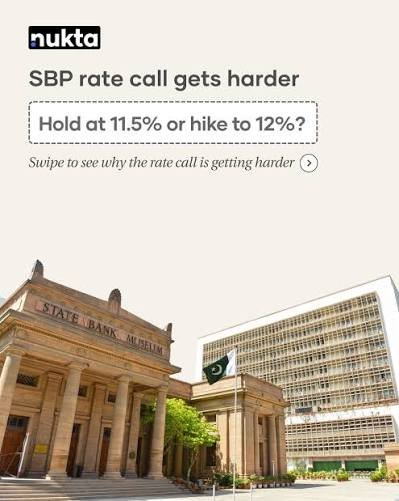
The State Bank of Pakistan (SBP) held its policy rate steady at 11.5% on Monday, even as inflation jumped sharply to 11.1% in August — leaving the real interest rate cushion at its thinnest point in months, as the central bank weighs a fragile domestic recovery against an increasingly volatile Middle East.
The Vote
The Monetary Policy Committee (MPC) approved the hold by a majority of seven of its 10 members, marking the third consecutive meeting the rate has stayed unchanged at 11.5% — a level it’s now held for more than four months. The decision matched market expectations closely, with a Topline Securities survey ahead of the meeting showing 84% of participants predicting a hold.
Why Inflation Jumped So Sharply
| Month | Headline Inflation (YoY) |
|---|---|
| July 2026 | 9.2% |
| August 2026 | 11.1% |
That’s a jump of nearly two full percentage points in a single month. The MPC attributed the surge primarily to intensifying conflict in the Middle East, which has pushed already-elevated global commodity prices even higher while prolonging supply chain disruptions. Core inflation, by contrast, came in at 8.7% — slightly below the committee’s expectations, suggesting the bulk of the August spike was driven by volatile, externally-driven costs like fuel rather than a broader, underlying inflationary trend.
A Razor-Thin Real Rate Cushion
With the policy rate at 11.5% and headline inflation at 11.1%, Pakistan’s ex-post real policy rate — the rate after subtracting inflation — has narrowed to roughly just 40 basis points. That’s an unusually thin cushion, and it’s exactly why some brokerages leaned toward expecting a hike rather than a hold. Arif Habib Ltd. had taken a notably more hawkish view ahead of the meeting, assigning a 60–65% probability to a 50 basis point increase to 12%, citing that narrow real-rate margin directly.
Why the SBP Chose to Hold Anyway
Despite the inflation jump, the MPC judged that recent domestic macroeconomic data remained broadly in line with its expectations, and that the current policy stance was still appropriate for steering inflation back toward its medium-term target range of 5-7%. A few specific factors gave the committee room to hold rather than hike:
- Contained external account pressure — supported by robust workers’ remittances and higher financial inflows
- Record foreign exchange reserves — reserves climbed to $21.4 billion, helped by a $3 billion Eurobond issuance in September and continued SBP foreign exchange purchases
- An improved credit outlook — Moody’s upgraded Pakistan’s sovereign credit rating to B3 with a stable outlook, following a similar upgrade from S&P in July
- Recovering growth — economic activity has begun recovering after moderating in the fourth quarter of FY26
SBP Governor Jameel Ahmed also noted that inflation had actually declined gradually over the first half of the year, averaging 5.5% between July and February, before the Middle East conflict began pushing petroleum and commodity prices — and therefore inflation — higher again from March onward.
The Warning Signs the SBP Flagged
The central bank wasn’t entirely reassuring in its statement. It explicitly warned that uncertainty around the economic outlook had increased, particularly due to the worsening geopolitical environment, and noted that inflation expectations among both businesses and consumers rose further in September, even as overall confidence weakened. Global oil prices trading near $95 a barrel add a direct, tangible risk — if that persists, it could ripple through transport, food, and broader consumer prices in the months ahead.
What’s Next: October and December in Focus
Several brokerages are already flagging the SBP’s next two meetings as genuine decision points rather than routine holds. JS Global said that if geopolitical tensions persist into the December quarter, the next move would likely be an increase rather than another hold. Similarly, Topline Securities noted that if oil prices and food inflation remain sticky, a 50-100 basis point hike could be warranted at the October or December MPC meetings. For now, though, the SBP is projecting average inflation to stay below 9% for FY27, with a real interest rate margin it still considers adequate — around 250 basis points on that forward-looking basis, even if the current ex-post figure looks much thinner.
What This Means for Borrowers and Businesses
With the rate held steady, the benchmark cost of borrowing stays unchanged for now — no immediate relief for borrowers hoping for lower rates, but also no additional squeeze from a hike. For businesses and investors, the message from analysts has generally been to stay cautious rather than aggressively repositioning portfolios; a hold was seen as more likely to support a relief rally than trigger fresh volatility, unlike a surprise hike would have.
Final Thoughts
The SBP’s decision to hold at 11.5% despite inflation jumping to 11.1% reflects a central bank betting that August’s spike is largely a Middle East-driven, externally caused spike rather than the start of a deeper domestic inflation problem — a bet reinforced by record foreign exchange reserves and an improving credit outlook. But with the real rate cushion now razor-thin and multiple brokerages already pricing in a possible hike for October or December, this hold looks less like a settled policy stance and more like a pause the SBP is prepared to reverse if Middle East tensions — and oil prices — don’t ease soon.
