


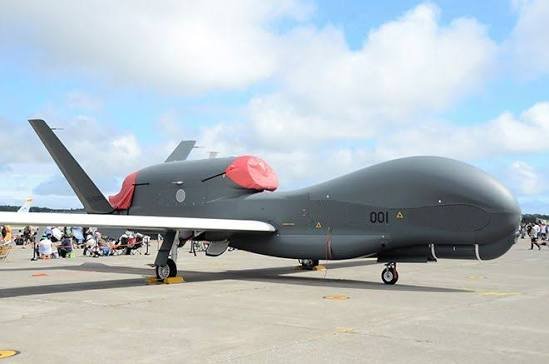
Japan’s Air Self-Defense Force (ASDF) is presumed to have lost one of its three prized Global Hawk surveillance drones after it vanished from radar during what officials described only as a training flight over the Sea of Japan on Tuesday.
What Happened
The RQ-4B Global Hawk took off from Misawa Air Base in Aomori Prefecture at around 10:20am local time. Trouble began roughly two and a half hours later: communications equipment problems started after 12:55pm, and the aircraft’s radar track disappeared entirely by around 12:58pm. Its last known position was over international waters roughly 50 kilometers north of Tottori Prefecture, on Japan’s western coast.
The ASDF launched an immediate search operation using its own aircraft alongside vessels and aircraft from the Maritime Self-Defense Force. The Japan Coast Guard subsequently reported finding floating debris and an oil slick in the area where contact was lost, though officials say it hasn’t yet been formally confirmed that the debris belongs to the missing drone.
What We Know So Far
| Detail | Information |
|---|---|
| Aircraft type | RQ-4B Global Hawk (unmanned surveillance drone) |
| Home base | Misawa Air Base, Aomori Prefecture |
| Contact lost | ~12:58pm local time, Tuesday, Sept 15, 2026 |
| Location | ~50km north of Tottori Prefecture, over international waters |
| Status | Presumed crashed; investigation ongoing |
| Injuries/damage | None reported |
| Approximate cost | ¥17 billion (roughly $120–163 million, depending on exchange rate used) |
Why This Drone Matters to Japan’s Defense Capability
Japan operates just three Global Hawks in total, purchased from US defense contractor Northrop Grumman and first deployed at Misawa Air Base in 2022. These aren’t ordinary drones — the RQ-4B can fly at altitudes of roughly 60,000 feet (18.3 kilometers) and stay airborne continuously for up to 36 hours, giving Japan long-range surveillance reach over the Asian mainland, including North Korea and China. Losing even one aircraft from a fleet of just three represents a meaningful, if not crippling, setback to Japan’s surveillance capacity — if the debris is confirmed to be from the missing drone, Japan would be left with only two operational Global Hawks.
What’s Still Unknown
- The exact cause of the communications failure and presumed crash
- Confirmation that the recovered debris and oil actually belong to the missing aircraft
- The specific nature or purpose of the flight, beyond the ASDF’s description of it as a “training flight”
- Whether mechanical failure, weather, or another factor was responsible
The ASDF has been notably tight-lipped on mission specifics, declining to elaborate beyond the training-flight characterization — a level of reticence that isn’t unusual for military aircraft incidents, particularly ones involving intelligence and surveillance assets operating near sensitive regional airspace.
Final Thoughts
With no injuries reported and the incident occurring over open water, this stands out as a costly equipment loss rather than a humanitarian emergency — but it’s a real dent in Japan’s already-limited long-range surveillance fleet at a time when monitoring capacity over North Korea and China remains a high strategic priority. Confirmation of the debris and a formal cause will likely take time, and the ASDF’s investigation into what brought down one of its three most valuable reconnaissance assets is the detail worth watching next.
