

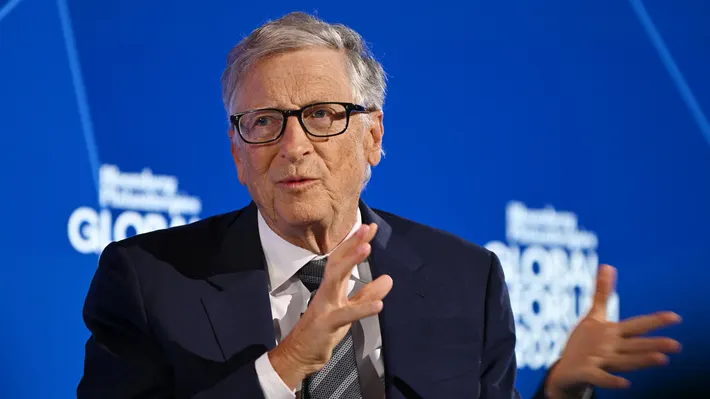
Bill Gates says AI is now powerful enough to help cause a billion deaths if it falls into the wrong hands — one of the strongest warnings yet from a tech leader who has spent most of the past year talking up AI’s benefits.
What Gates Actually Said
In an interview with NBC’s Kristen Welker, set to air on “Meet the Press,” Gates didn’t hold back: “AI is certainly powerful enough to drive events that, you know, cause a billion deaths.” He went further, comparing AI to the most dangerous weapons in history: “Even though it’s pretty hard to get to 100%, there’s never been a weapon as powerful as the combination of people with ill intent using the latest AI tools.”
Gates was clear that self-policing by AI companies isn’t enough. “No one thinks self-regulation is enough,” he said, adding that governments need to step in directly: “You need law enforcement and the politicians to get into the discussion about what safeguards and monitoring look like. And that has to be a required thing.”
Three Things Gates Is Worried About
According to the interview, Gates grouped his concerns into three main areas:
- Safety threats — AI being used for hacking, biological weapons, and large-scale fraud
- Job losses — driven by AI systems and AI-powered robots replacing human workers
- Risks to children — including stunted learning and damaged human relationships from overreliance on AI
These concerns build on an essay Gates published back in August, where he argued AI would either become “the greatest equalizer ever invented, or the worst source of injustice” — and specifically warned that bad actors could use powerful AI tools to attack hospitals, financial institutions, power grids, and government systems.
An Awkward Timing Problem
Here’s the tension in this story: less than two weeks before making these comments, the Gates Foundation pledged $1 billion to expand global access to artificial intelligence — on top of earlier partnerships this year with OpenAI ($50 million) and Anthropic ($200 million over four years) to bring AI tools into clinics, classrooms, and farm programs around the world. In other words, Gates is warning about a technology his own philanthropy is actively paying to spread further. He hasn’t publicly reconciled that tension directly, but it hasn’t gone unnoticed by commentators.
Gates Isn’t Alone in Sounding the Alarm
This warning lands in the middle of a much bigger, ongoing conversation across the AI industry. Just weeks earlier, Anthropic CEO Dario Amodei called for AI companies to slow down development to give safety work more time to catch up. Jacob Coxon, a staffer who quit Anthropic earlier this month, accused both Anthropic and OpenAI of “gambling with our lives” by racing toward super-intelligent AI. Separately, former OpenAI researcher Daniel Kokotajlo has warned that competition between countries and companies could push AI developers to cut corners on safety.
Gates’s comments also arrive just days after AI dominated discussions at the Trump-Xi summit, where both leaders publicly acknowledged how strategically important the technology has become — even as the underlying debate about safety versus speed remains unresolved.
What Regulation Already Exists
Some government action is already in motion. The European Union has had the power to fine AI model providers up to 3% of their global turnover since August, under its AI Act — one of the more concrete examples so far of the kind of binding regulation Gates is calling for more broadly. In the US, Amodei has previously acknowledged a similar concern to Gates’s push for legislation, noting: “Unfortunately, passing laws can take time, and AI is advancing very quickly.” It remains to be seen what, if anything, the US federal government will do on AI regulation given the current political environment in Washington.
Final Thoughts
Bill Gates joining the chorus of tech leaders warning about AI’s most extreme risks carries real weight, given his stature and his usual optimism about the technology’s benefits. But the fact that his own foundation just committed $1 billion to spreading AI further — even as he calls for stronger government controls on it — captures exactly the kind of contradiction running through this entire moment in AI: nearly everyone involved seems to agree the risks are real, while none of the major players, including Gates himself, appear willing to actually slow down.
