


Whether you’re handling a property sale back home while living abroad, or simply authorizing someone to act on your behalf within Pakistan, a Power of Attorney (POA) only becomes legally usable once it’s properly attested. The process is different depending on whether you’re executing the POA inside Pakistan or from another country — here’s exactly how to apply for Power of Attorney attestation in both cases.
If You’re Executing the POA Inside Pakistan
This is the more common case — appointing someone to handle a specific matter on your behalf while you’re physically in Pakistan.
- Draft the document: The POA must clearly state the full name, CNIC number, and address of both the principal (you) and the attorney (the person you’re authorizing), along with the specific powers being granted, the date and place of execution, and signatures of the principal plus two witnesses.
- Prepare it on stamp paper of the appropriate value as required for the type of POA.
- Get it attested before a Notary Public, Oath Commissioner, or Sub-Registrar. This confirms your identity and signature are genuine.
- Register it, if required: If the POA relates to immovable property — sale, lease, gift, or transfer — it must be registered at the Sub-Registrar’s office covering the property’s location. This involves identity verification, witness confirmation, fingerprinting, and payment of registration fees and stamp duty.
- Collect your certified copy once registration is complete; this is what your attorney will use going forward.
For non-property matters — such as operating a bank account or representing you in court — simple notarization by an Oath Commissioner or Notary Public is usually enough, and full registration isn’t required. However, an unregistered POA for a property transaction has no legal standing, so don’t skip registration if real estate is involved.
If You’re Executing the POA From Abroad (Overseas Pakistanis)
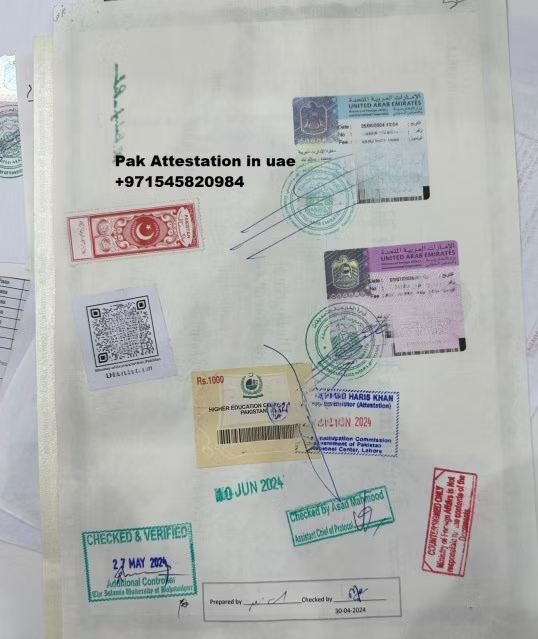
If you’re living outside Pakistan and need to authorize someone back home, the POA must be attested through the Pakistani mission in your country of residence before it has any legal effect in Pakistan.
Step 1: Attestation at the Pakistani Embassy or Consulate
- Prepare the POA on stamp paper, with passport-size photographs of the person granting the power (the executant).
- Visit your nearest Pakistani Embassy or Consulate in person — this cannot be done by mail or online, as the executant’s physical presence is required.
- Bring: the original POA plus copies, a completed attestation application form, your original passport with a copy, your original CNIC or NICOP with a copy, two recent passport-size photographs, and copies of the attorney’s and witnesses’ CNICs.
- Pay the attestation processing fee (amounts vary by country — check your specific mission’s fee schedule beforehand).
- If the POA runs to more than one page, each page must be individually signed.
Step 2: Verification by the Ministry of Foreign Affairs
Once attested abroad, the document — or your attorney in Pakistan — must get it re-verified by Pakistan’s Ministry of Foreign Affairs. The attorney named in the POA is required to appear in person with their original CNIC to complete this step.
Step 3: Registration in Pakistan
For property-related POAs, the attested and MOFA-verified document must then be taken to the Sub-Registrar’s office in the district where the property is located, where it is formally registered, following the same identity and witness verification process as a domestically executed POA.
Important: Mind the Validity Window
According to Pakistan’s Ministry of Foreign Affairs, a Power of Attorney attested by a Pakistani mission abroad is valid for 120 days from the date of attestation and MOFA verification. The registration process in Pakistan needs to be completed within this window — don’t let the document sit once it’s attested, or you may have to repeat the entire process.
Frequently Asked Questions
Can I get a Power of Attorney attested without visiting the embassy in person?
No. Attestation at a Pakistani embassy or consulate requires the executant to appear in person with original identity documents — it cannot be completed remotely or by mail.
Is registration always required for a Power of Attorney?
Only when it involves immovable property — sale, lease, gift, or transfer. For other purposes like banking or court representation, simple notarization is usually sufficient.
What happens if the 120-day validity period expires before registration?
The document loses its validity for use, and you would typically need to go through the attestation process again.
Who needs to be present for the Ministry of Foreign Affairs verification step?
The attorney named in the Power of Attorney — the person authorized to act in Pakistan — must appear in person with their original CNIC.
Getting a Power of Attorney attested correctly, whether inside Pakistan or from abroad, comes down to following the right sequence — attestation, verification, and registration where required — and keeping an eye on the 120-day clock if the document originates overseas.
