


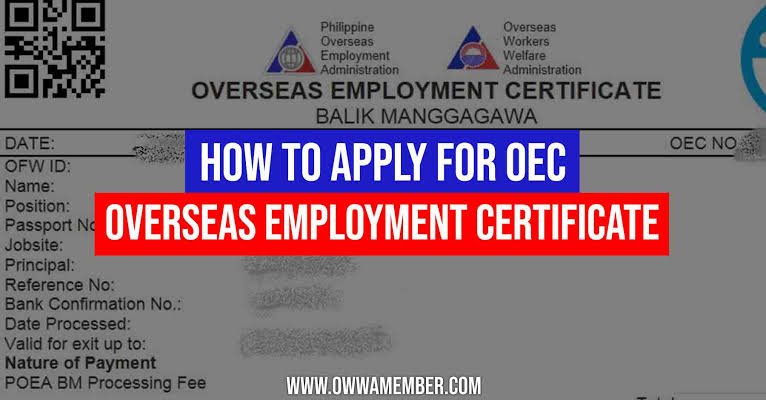
Before any Pakistani citizen can legally fly out for a foreign job, their departure needs to be cleared by the government. This clearance results in an Overseas Employment Certificate (OEC), and without it, you risk being stopped at the airport. This guide explains how to apply for an overseas employment certificate through Pakistan’s Bureau of Emigration and Overseas Employment (BE&OE).
What Is an Overseas Employment Certificate (OEC)?
Under the Emigration Ordinance 1979, every Pakistani citizen leaving the country on a work visa must first be registered as an emigrant with the Bureau of Emigration and Overseas Employment (BE&OE). This process is often called getting your “Protector” clearance, since the Protectorate of Emigrants reviews and countersigns your foreign employment contract. Once cleared, you receive your OEC, and your passport is stamped with a Protector sticker. FIA officers check for this at the airport before allowing departure for work abroad.
This requirement applies whether you found your job yourself (a “direct emigrant”) or through a licensed recruitment agency, officially called an Overseas Employment Promoter (OEP).
Two Ways to Register: Direct or Through an OEP
- Direct Registration: for workers who arranged their own job abroad, without going through a recruitment agency.
- Registration Through an OEP: for workers recruited by a licensed Overseas Employment Promoter in Pakistan. Always confirm the OEP’s licence is valid before paying any fees, since unlicensed agents are a common source of fraud in this process.
Documents You Need
- Valid passport with your work visa
- Original CNIC
- Employment contract or Foreign Service Agreement, signed by your employer
- Insurance certificate
- Protector fee bank slip
- Four passport-sized photographs
- Medical fitness certificate, such as a GAMCA report, if required for your destination country, especially for Gulf countries
- For OEP-based registration: a bank certificate and, where applicable, a Soft Skills Certificate
How to Apply for Your OEC Online Through e-Protector
Since January 2024, BE&OE has offered an online registration option, letting many applicants complete their protector clearance without visiting an office in person.
Step 1: Create an Account on the e-Protector Portal
Visit beoe.gov.pk and access the e-Protector online registration section from any phone or computer.
Step 2: Fill in Your Personal Information
Enter your personal details, the purpose of your visit or stay abroad, and the address of a close relative in Pakistan.
Step 3: Add Employer and Contact Details
Provide your employer’s or organization’s contact details, your designation, and the contact details of a close friend or colleague.
Step 4: Upload Your Documents
Upload clear images of your passport photo page, your valid visa, and your CNIC, along with any other documents requested.
Step 5: Pay the Protector Fee
Pay the required fee through a bank challan, or, where available, through BE&OE’s newer QR-based cashless fee payment option introduced with the National Bank of Pakistan to speed up the process.
Step 6: Submit for Verification
Once submitted, BE&OE verifies your file. In most direct-employment cases, your protector clearance and OEC can be issued without needing to visit a Protectorate office in person.
Applying In Person at a Protectorate of Emigrants Office
If your case needs manual review, or you prefer applying in person, visit your nearest Protectorate of Emigrants office with your documents. Once your registration is processed, a registration number is allotted, a Protector sticker is pasted on your passport, and the Protector of Emigrants officer signs and embosses your passport before it’s returned to you.
Protector Fee
The protector fee is paid through a bank challan as part of your application. Reported fee figures vary between sources, so rather than quote a specific amount that may be outdated, confirm the current official fee directly on the BE&OE website or at your nearest Protectorate office before you pay.
Changing Jobs After Getting Your OEC
If you’re switching employers abroad, even after already having a Protector stamp from a previous job, you’ll need to obtain a new Protector Clearance for the new position from the relevant Protectorate of Emigrants office. As long as your existing job’s terms and conditions remain unchanged, your current protection stays valid, but a new job always requires fresh registration.
Finding Verified Foreign Job Listings
BE&OE regularly uploads verified foreign job openings on its website. Checking listings there, rather than relying solely on informal offers, is a safer way to find legitimate opportunities and avoid recruitment scams.
Staying Safe From Recruitment Fraud
- Only deal with OEPs holding a valid, active BE&OE licence. You can verify this on the BE&OE website.
- Read your contract and visa terms carefully, and cross-check them with the Protectorate of Emigrants before you pay anything.
- Always insist on a receipt for any payment you make.
- Be cautious of anyone guaranteeing a job without proper documentation or who avoids the official registration process.
Frequently Asked Questions
What is the difference between an OEC and Protector clearance?
They refer to the same overall process. “Protector clearance” is the registration and verification step, and the Overseas Employment Certificate is the result, confirmed by the Protector sticker and signature stamped in your passport.
Can I apply for my OEC fully online?
In most direct-employment cases, yes, through the e-Protector portal at beoe.gov.pk. Some cases may still require an in-person visit to a Protectorate office.
Do I need an OEC if I found the job myself, without an agency?
Yes. Direct emigrants still need to register for Protector clearance, following the direct registration process rather than the OEP route.
What happens if I travel for work without an OEC?
Without protector clearance, you aren’t legally recognized as an emigrant, which can mean being stopped at departure, facing legal issues, or lacking official support while working abroad.
Do I need a new OEC if I change employers abroad?
Yes. A new job, even with an existing Protector stamp from a previous position, requires fresh Protector clearance from the Protectorate of Emigrants.
Getting your Overseas Employment Certificate is a mandatory step before working abroad, but the e-Protector system has made much of the process possible from home. Keep your documents ready, verify your OEP if you’re using one, and confirm the current fee before you pay.
