


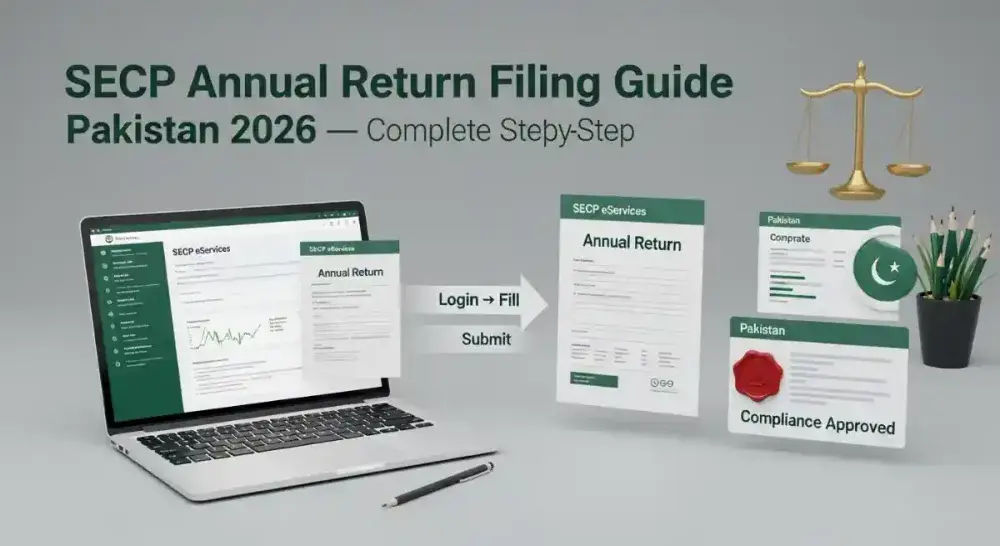
Every company registered with the Securities and Exchange Commission of Pakistan (SECP) must send in a yearly update about who owns and runs it. This update is called the annual return. If you run a private limited company, here is how to file annual returns with SECP: which form to use, when it is due, how to file it online, and what happens if you are late.
What Is an SECP Annual Return?
An annual return is a yearly snapshot of your company. It lists directors and officers, shareholders or members, share capital, and the registered office. The law behind it is Section 130 of the Companies Act, 2017. The form is Form A.
Since the 2024 regulations, Form A and the old Form B have been merged. So companies with share capital and companies without it, such as guarantee companies, now file Form A.
When Is the Deadline?
Form A is due within 30 days of your Annual General Meeting (AGM). The AGM date therefore sets your deadline. A private company must hold its AGM within 120 days of the end of its financial year.
Here is an example for a private company with a financial year ending on 30 June:
| Step | Date |
|---|---|
| Financial year ends | 30 June |
| AGM deadline (120 days) | About 28 October |
| Form A deadline (30 days after AGM) | About 27 November |
If your year ends in September, December, or March, the same 120 + 30 day rule applies. Listed companies have different AGM timelines, so they should check their own deadlines.
What You Need Before Filing
- Your company’s Company Unique Identification Number (CUIN)
- Login details for your SECP eServices account
- The date the AGM was held
- Current list of directors and officers
- Current list of shareholders or members, and their shares
- Details of share capital and the registered office address
- Details of any changes since the last annual return
- A way to pay the filing fee, such as online banking or a 1Link challan
How to File Form A Online: Step by Step
Portal menus can change, so use these steps as a guide and follow the screen in front of you.
- Hold your AGM first. The AGM date starts the 30-day clock.
- Log in to SECP eServices. Go to secp.gov.pk and open the eServices portal (eservices.secp.gov.pk). Sign in with your registered user account.
- Select your company. Use the company’s name or CUIN.
- Choose the annual return filing. Look for Form A under the company’s filings.
- Fill in the details. Enter the AGM date, directors and officers, members and shareholding, share capital, and registered office. Update anything that has changed since last year.
- Check everything carefully. Names, CNIC numbers, and share numbers must match your company records.
- Pay the fee. The portal gives you a way to pay online.
- Submit and save your copy. Download the filed form and the payment receipt for your records.
One guide says the filing usually takes 30 to 60 minutes when your records are in order. Gather your documents first, and it will go much faster.
Other Filings That Go With the Annual Return
- Form 29: Used when directors or officers change, under Section 197. It must be filed within 15 days of the change, and guides say it usually carries no fee.
- Audited financial statements: Companies must also file their audited accounts after the AGM. Most guides say within 30 days of the AGM, though one source gives a shorter period for private companies. Confirm the deadline for your company type before you rely on it.
How Much Does Filing Cost?
Form A carries a filing fee. Fees are set in the Seventh Schedule of the Companies Act, 2017, and the amount depends on the company’s share capital. Check the exact fee on the portal before you pay, since fee schedules can be revised.
What Happens If You File Late?
SECP usually does not charge one flat fine. Instead, it charges an extra filing fee that grows the longer you wait. Guides also warn that officers who wilfully fail to comply can face prosecution, and repeated default can lead to bigger problems for the company. Some older guides quote fixed fines, but amounts differ between sources, so confirm the current figure with SECP.
The simplest fix is to put the AGM and Form A dates on your compliance calendar, and to start preparing at least a month before.
Do You Need to File If Nothing Changed?
Some guides say companies with no changes since the last return may skip re-filing certain details. They also say the annual return itself must still be filed. Rules can differ by company type, so confirm with SECP or a corporate lawyer if you are unsure.
SECP Annual Return vs FBR Income Tax Return
These are two separate yearly duties. Filing one does not replace the other.
| Feature | SECP Annual Return | FBR Income Tax Return |
|---|---|---|
| Law | Companies Act, 2017 | Income Tax Ordinance, 2001 |
| Portal | SECP eServices | FBR IRIS |
| What it covers | Directors, members, share capital, registered office | Income, tax paid, and wealth |
Common Mistakes to Avoid
- Counting the 30 days from the financial year-end instead of from the AGM
- Forgetting to report changes in directors or shareholders
- Mismatched names or CNIC numbers between the form and company records
- Filing the annual return but missing the audited accounts, or the other way around
- Waiting until the last day, when the portal can slow down
Frequently Asked Questions
Which form is used for the SECP annual return?
Form A, filed under Section 130 of the Companies Act, 2017. It replaced the separate Form B for companies without share capital.
What is the deadline for filing Form A?
Within 30 days of the AGM.
Where do I file it?
Online through the SECP eServices portal. Start at secp.gov.pk if the portal link has changed.
What is Form 29?
Form 29 reports changes in directors and officers. It is due within 15 days of the change.
What is the penalty for late filing?
SECP charges an additional filing fee that increases with the delay. Confirm the current amount with SECP.
Filing annual returns with SECP is straightforward when you plan around the AGM. Hold the meeting on time, update your company records, and file Form A within 30 days so your company stays in good standing.
