


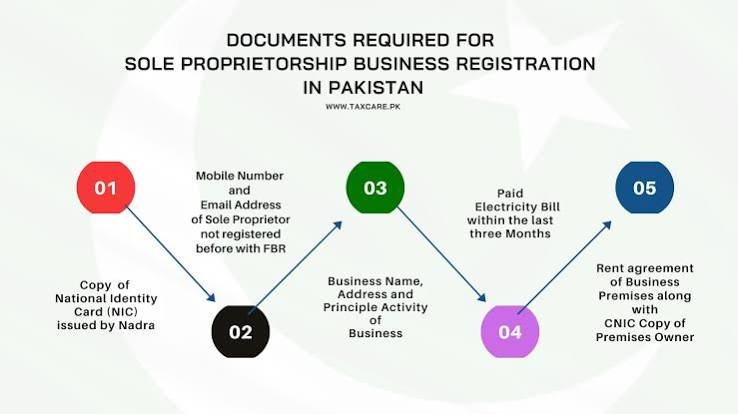
Thinking of starting a small business in Pakistan without the cost and paperwork of a full company? A sole proprietorship is the simplest route, and you don’t need SECP approval to set one up. This guide explains how to register a sole proprietorship in Pakistan, the documents you need, and what comes after your NTN is issued.
What Is a Sole Proprietorship?
A sole proprietorship is a business owned and run by one person, with no legal separation between the owner and the business. This means the owner is personally responsible for all profits, losses, and liabilities, there’s no limited liability protection. It’s sometimes informally called a “sole trader.” Unlike a private limited company, a sole proprietorship is not incorporated under the Companies Act 2017 and does not require registration with the Securities and Exchange Commission of Pakistan (SECP).
What You Actually Need: Just an NTN
There’s no separate “sole proprietorship registration” process or certificate in Pakistan. Registering your sole proprietorship essentially means getting a National Tax Number (NTN) from the Federal Board of Revenue (FBR) and adding your business details to it. If you already have a personal NTN, since your 13-digit CNIC doubles as your NTN once you’re registered with FBR, you’re not creating a brand-new taxpayer profile; you’re adding a business to your existing one.
Eligibility
- You must be at least 18 years old
- You need a valid CNIC
- You need a mobile number and email address not already registered with FBR against another person
Documents You Need
- CNIC copy of the sole proprietor
- Business name and nature of business
- Business letterhead
- Recent electricity bill for the business premises
- Rent agreement or ownership proof for your business address
- A mobile number not already linked to another FBR profile
- An email address not already linked to another FBR profile
How to Register: Step by Step
Step 1: Choose Your Business Name
Since there’s no SECP approval process for a sole proprietorship, you can choose your business name freely. Just make sure it isn’t already trademarked or in active use by another business in your area, since name registration itself isn’t formally reviewed at this stage.
Step 2: Go to the FBR IRIS Portal
Visit iris.fbr.gov.pk, FBR’s official online portal for tax registration.
Step 3: Register or Log In
If you don’t already have an FBR profile, select “Registration for Unregistered Person” and register using your CNIC, mobile number, and email address. If you already have a personal NTN, simply log in instead.
Step 4: Verify Your Mobile Number and Email
FBR sends a one-time code (OTP) to both your phone and email to confirm them.
Step 5: Complete the Registration Form (Form 181)
Fill in your personal details, then add your business information: business name, nature of business, and business address.
Step 6: Upload Your Documents
Upload your CNIC copy, business letterhead, electricity bill, and rent agreement or property proof for your business address.
Step 7: Submit for FBR Review
Once submitted, FBR reviews your application. This typically takes anywhere from 2 to 7 working days.
Step 8: Receive Your NTN Certificate
Once approved, your NTN certificate becomes available for download from your IRIS account, now showing your business name linked to your CNIC. This certificate is effectively your proof of business registration.
Registering for Sales Tax (If Applicable)
If your business turnover exceeds the threshold set by FBR, or if you operate in a category where sales tax registration is mandatory, such as manufacturing, wholesale, retail, importing, or certain services, you’ll also need to register for sales tax (GST) through the IRIS portal, or with your provincial revenue authority if your services fall under provincial sales tax instead.
Opening a Business Bank Account
Once you have your NTN certificate, you can open a business bank account in your sole proprietorship’s name. Banks typically require:
- CNIC
- NTN certificate
- Trade license, if applicable to your business type or local requirement
- Business address proof
Do You Need a Trade License Too?
Depending on your business type and location, you may also need a trade license from your local municipal authority, district commissioner’s office, or the relevant Chamber of Commerce. This is separate from your FBR NTN and is typically required for certain physical business premises, such as shops or warehouses, rather than purely online or freelance work.
Cost and Timeline
| Step | Cost | Time |
|---|---|---|
| NTN Registration (IRIS) | Free | 2 to 7 working days |
| Sales Tax Registration (if applicable) | Free | Varies |
| Local Trade License (if applicable) | Varies by city/authority | Varies |
FBR itself charges no fee for NTN registration. If you hire a tax consultant or lawyer to help, you’re paying for their service, not the registration itself, and since IRIS allows self-registration, hiring one isn’t legally required.
Can Freelancers Register as Sole Proprietors?
Yes. Freelancers in Pakistan commonly register as individuals or sole proprietors on IRIS, declaring their freelance income under their business profile. This is useful for invoicing clients, opening a business bank account, and staying compliant with income tax filing requirements.
Can Foreign Nationals Register a Sole Proprietorship?
Yes, foreign nationals can register a sole proprietorship in Pakistan, generally with a valid work permit or business visa. Non-residents use their passport number in place of a CNIC during FBR registration.
Ongoing Obligations After Registration
- File your annual income tax return, since registering for an NTN alone doesn’t make you a “filer” on FBR’s Active Taxpayer List; filing a return does.
- Keep your sales tax filings current if you’re registered for GST.
- Renew your trade license, if applicable, according to your local authority’s schedule.
Frequently Asked Questions
Do I need to register with SECP for a sole proprietorship?
No. Sole proprietorships are not incorporated under the Companies Act 2017 and don’t require SECP registration. You only need to register with FBR for an NTN.
How much does it cost to register a sole proprietorship?
NTN registration itself is free through FBR’s IRIS portal. Any cost you incur would be for a trade license, if required locally, or for hiring a consultant, which isn’t mandatory.
Can I register my sole proprietorship fully online?
Yes. NTN registration is entirely online through the IRIS portal, with no physical office visit required for this step.
Do I get a separate business NTN?
No. There’s no separate business NTN for a sole proprietorship. Your personal 13-digit CNIC continues to serve as your NTN, with your business details added to the same profile.
How long does registration take?
NTN registration through IRIS typically takes 2 to 7 working days after you submit complete documentation.
Registering a sole proprietorship in Pakistan comes down to one core step: getting your NTN from FBR through the IRIS portal. From there, a business bank account, sales tax registration, and a local trade license are the natural next steps, depending on what your specific business needs.
