


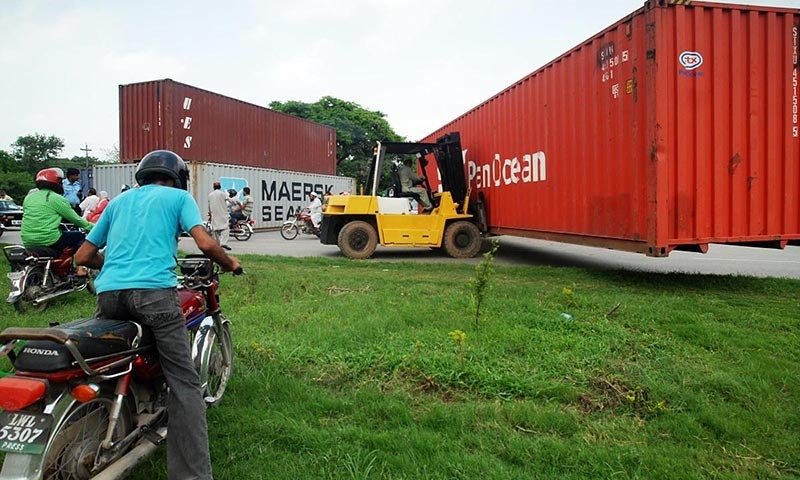
Nearly 1,000 shipping containers have sat stuck in Islamabad for roughly two weeks, and transporters say the financial damage has now piled up to around Rs. 280 million (Rs. 28 crore) — with goods carriers demanding urgent compensation as containers used to block roads ahead of planned political marches keep their cargo, including essential medicines, stranded across the capital.
How the Cost Adds Up
According to the All Pakistan Goods Transport Owners Association, the roughly 1,000 detained containers are losing transporters approximately Rs. 20,000 per container, per day. Over close to two weeks of being parked at intersections across the city, that daily rate has compounded into the current estimated total of around Rs. 280 million.
| Detail | Figure |
|---|---|
| Containers currently stuck in Islamabad | ~1,000 |
| Daily loss per container | Rs. 20,000 |
| Duration stuck | ~2 weeks |
| Estimated total losses so far | ~Rs. 280 million (Rs. 28 crore) |
What’s Actually Inside These Containers
This isn’t just an abstract financial figure — the containers are carrying goods worth millions of rupees, according to advocate Muhammad Owais Chaudhry, who has been vocal on behalf of affected transporters. He specifically called for the immediate release of containers carrying essential medicines and other critical goods, warning that continued delays risk compounding losses well beyond the transport sector itself.
Why the Containers Are Stuck
Although the ProPakistani report doesn’t spell out the cause directly, the timing lines up closely with Islamabad’s use of shipping containers to block roads and control access to the capital — a security measure the government has leaned on heavily amid a string of planned political marches this month, including Jamaat-e-Islami’s demonstration and PTI’s planned September 27 protest. Containers repurposed as roadblocks are typically pulled from commercial transport operations, meaning the same equipment used to move goods around the country ends up parked indefinitely at intersections instead, with cargo still loaded inside.
What Transporters Are Demanding
Chaudhry laid out a clear set of asks on behalf of the transport sector:
- Immediate release of all containers carrying essential goods, particularly medicines
- Direct compensation to affected transporters, rather than the government limiting its response to public announcements
- A clear, transparent compensation mechanism, rather than an ad-hoc or unclear process
- Complete data collection on vehicles detained across different cities, so losses can be properly documented and addressed
- Rs. 20,000 per container, per day as the specific compensation rate transporters are requesting
Chaudhry also called on the government to sit down directly with transporters to negotiate a compensation mechanism, rather than leaving the matter unresolved while losses continue to accumulate daily.
A Tension Worth Noting: Trade Promotion vs. Container Seizures
One particularly sharp piece of public criticism circulating around this issue points to an apparent contradiction: the government has been actively promoting trade and exports, even as containers meant for legitimate commercial transport are being held for security purposes for weeks at a time. Whether or not that framing is entirely fair, it captures a real practical tension facing officials — the same containers essential to keeping goods moving through Pakistan’s economy are also the most readily available tool for controlling access to the capital during periods of political unrest.
Why This Matters Beyond the Transport Sector
With political marches continuing to be planned through the rest of September, this isn’t necessarily a one-time cost. If containers keep getting pulled into road-blockade duty during future demonstrations, transporters could face repeated rounds of these losses — compounding costs that, transporters argue, should be treated as a direct consequence of government security decisions rather than an unavoidable cost of doing business.
Final Thoughts
Rs. 28 crore in losses over two weeks is a striking number, and it puts a concrete price tag on a side effect of Islamabad’s recent security measures that doesn’t usually make headlines alongside the political marches themselves. With transporters now pushing publicly for both release of essential goods and a formal compensation process, how the government responds — and whether this becomes a recurring cost tied to future protests — is worth watching closely in the weeks ahead.
