


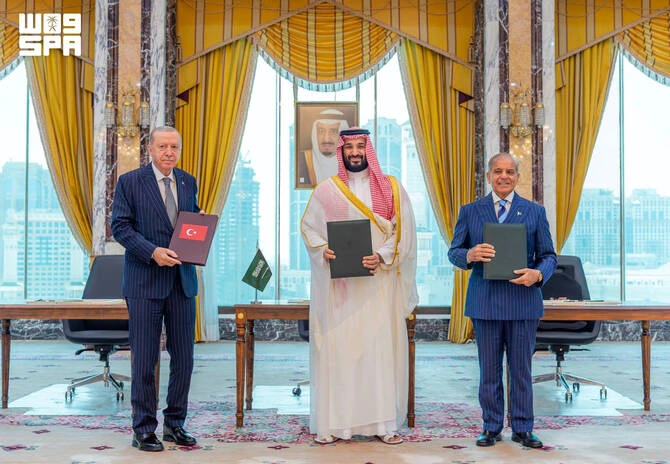
Pakistan’s Defence Minister Khawaja Asif has warned that the newly signed Makkah Defence Alliance between Pakistan, Saudi Arabia, and Turkiye could be triggered into action, following a wave of Houthi attacks on Saudi Arabia that injured 73 people and struck the kingdom’s energy infrastructure.
What Asif Said
Speaking on Geo News’ “Aaj Shahzeb Khanzada Kay Sath,” Asif was directly asked whether the trilateral pact could be operationalized in response to the attacks. He said there was no ambiguity in the matter — the agreement clearly states that aggression against one member state is equivalent to aggression against all three, and Pakistan is bound to honor those terms if the need arises.
Asif clarified that Pakistan had not been in direct contact with Saudi Arabia following the attacks, as far as he was aware, but reiterated that the pact obligates joint defence and collective response in the event of aggression against any member. He described the agreement as defensive rather than aggressive in nature, framing any future response as reactive rather than provocative — activated only if a member state is attacked, not aimed at initiating conflict.
Notably, Asif said the trilateral structure of the pact wasn’t the deciding factor in Pakistan’s posture — he indicated Pakistan would have responded in the same way even if the agreement had been a bilateral one with Saudi Arabia alone.
What the Makkah Defence Pact Actually Says
The Makkah Joint Defence Agreement was signed on August 7, 2026, between Pakistan, Saudi Arabia, and Turkiye, establishing a collective-defence commitment: an armed attack against any one of the three signatories is to be treated as an attack against all three. The pact is built around strengthening deterrence, military coordination, and defence cooperation among the three countries, rather than mandating a specific, automatic military response to every incident.
Importantly, the agreement’s language doesn’t prescribe an identical, pre-set reaction for every kind of attack. Instead, it establishes the underlying principle of collective defence and closer coordination, leaving room for judgment about what response fits the scale and nature of any specific act of aggression.
What Triggered This Test of the Pact
The attacks that prompted Asif’s comments struck the southern Saudi cities of Abha, Khamis Mushait, Jazan, and Najran on September 8, hitting a Saudi airbase, oil facilities, and one of the kingdom’s largest refineries. The strikes injured at least 73 civilians and forced fires that led to a temporary halt in some energy operations, according to Saudi officials.
Pakistan’s Foreign Office separately condemned the attacks, calling them a flagrant violation of Saudi Arabia’s sovereignty and territorial integrity, and reaffirmed Pakistan’s full solidarity with the kingdom against threats to its security.
Is Pakistan Actually Preparing to Intervene Militarily?
Despite the strong rhetoric, there’s currently no indication that Pakistan or Turkiye is preparing to enter Yemen’s conflict militarily alongside Saudi Arabia. Analysts note that the pact’s wording leaves meaningful room between a political statement of solidarity and an actual military deployment — a distinction that matters significantly if the confrontation remains limited to cross-border strikes rather than escalating into a sustained campaign.
Asif himself struck a note of cautious hope during the interview, saying he expects the situation to eventually come under control and de-escalate, and expressed hope that the Houthis would recognize the risks of continuing to widen the confrontation.
Why This Moment Matters
This marks the first real-world test of the Makkah pact since it was signed just over a month ago. How Pakistan, Saudi Arabia, and Turkiye navigate this situation — whether through diplomatic coordination, a show of military readiness, or something more concrete — will likely shape how seriously other regional actors treat the agreement going forward, and whether it functions as genuine deterrence or primarily as a political signal of alignment among the three countries.
Final Thoughts
Khawaja Asif’s comments make clear that Pakistan considers itself legally and politically bound by the Makkah pact’s terms, but stop short of confirming any specific military action is imminent. With Saudi Arabia’s energy infrastructure now directly targeted and the broader Yemen conflict showing signs of spillover, the coming days are likely to reveal whether this newly signed alliance moves from a paper commitment to an operational one.
