


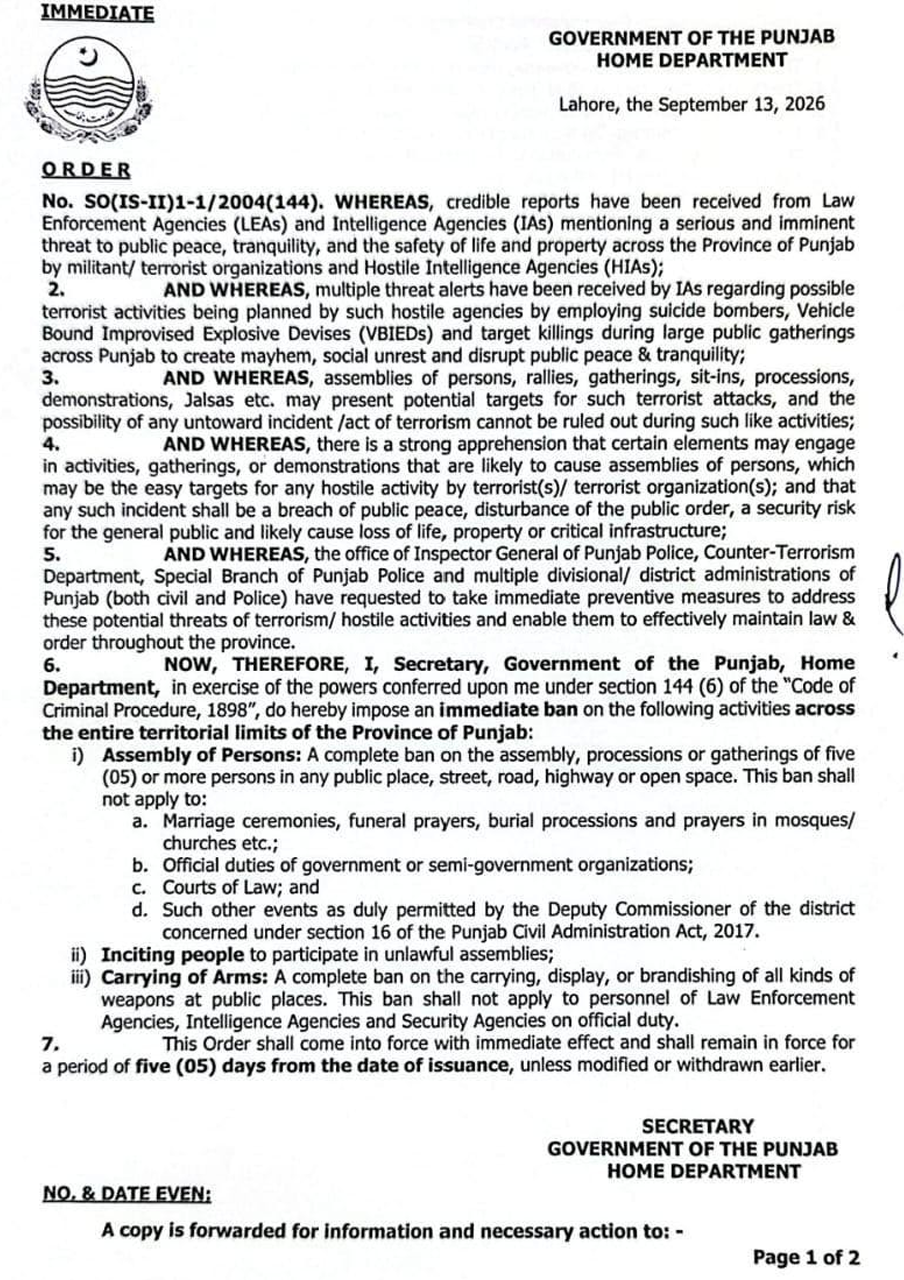
Punjab has banned public gatherings of five or more people across the entire province for five days, after intelligence agencies warned of possible suicide bombings, vehicle-borne explosive attacks, and targeted killings aimed at large public gatherings.
What the Order Actually Covers
The Punjab Home Department issued the notification on Sunday, enforcing restrictions under Section 144(6) of the Code of Criminal Procedure, 1898 — a sub-section that allows authorities to act immediately, without prior notice, when a threat is judged too urgent for standard procedure. The restrictions run from September 13 to September 17 and prohibit:
- Gatherings of five or more people at public places, roads, highways, and open spaces
- Processions, public meetings, sit-ins, and protest demonstrations
- Carrying or displaying any type of weapon in public places
- Inciting or encouraging others to take part in unlawful gatherings
What’s Exempt From the Ban
- Wedding ceremonies
- Funeral prayers and burials
- Mosques and other places of worship
- Court proceedings
- Government institutions and officially permitted events
- Law enforcement, intelligence agencies, and security personnel on official duty
Why the Government Says This Was Necessary
According to the notification, law enforcement and intelligence agencies reported a “serious and imminent threat” to public peace and safety across Punjab from militant and terrorist organizations, as well as hostile intelligence agencies. Officials say multiple threat alerts specifically warned of possible suicide bombings, vehicle-borne improvised explosive devices (VBIEDs), and targeted killings, with concerns that such attacks could be carried out during large public gatherings to cause mayhem and social unrest.
The request for these preventive measures reportedly came directly from the Punjab police chief, the Counter-Terrorism Department (CTD), the Special Branch of Punjab Police, and several district administrations — officials described as needing immediate authority to maintain law and order across the province given the credibility of the reports received.
The Political Backdrop
The order lands at a politically active moment in Punjab. Jamaat-e-Islami’s (JI) nationwide protest campaign against the petroleum levy and inflation was entering its 29th day when the order was issued, while Pakistan Tehreek-e-Insaf (PTI) had separately announced a mobilization drive across Punjab, with Khyber Pakhtunkhwa Chief Minister Sohail Afridi scheduled to visit several cities as part of that effort. This timing places the new restrictions in the same window as the ongoing Islamabad High Court case over PTI’s planned September 27 protest in the federal capital, where a larger bench is separately weighing a petition challenging that demonstration.
The government has not linked the Section 144 order directly to either the JI or PTI activities — officials have framed it purely in terms of security threats reported by intelligence agencies. It’s worth noting, though, that Section 144 orders of this kind inherently restrict all public gatherings during the period they’re in effect, including planned political activities, regardless of the specific rationale cited for imposing them.
What Happens After September 17
According to officials, the situation will be reviewed once the current order expires, with further extensions possible if security agencies continue to report credible threats. Given how frequently Section 144 orders of this type get renewed in similar situations, it’s reasonable for residents and organizers to plan for the possibility of an extension rather than assuming restrictions will lift automatically on the 17th.
Final Thoughts
A five-day, province-wide ban on public gatherings is a significant restriction, and the specific threat details cited — suicide bombings, VBIEDs, targeted killings — point to a genuinely serious security assessment behind the decision. At the same time, the order’s timing alongside active JI protests and PTI’s Punjab mobilization drive, plus the ongoing court case over PTI’s planned September 27 demonstration, means this restriction is likely to be watched closely for its practical effect on political activity in the province, regardless of the security rationale behind it.
