


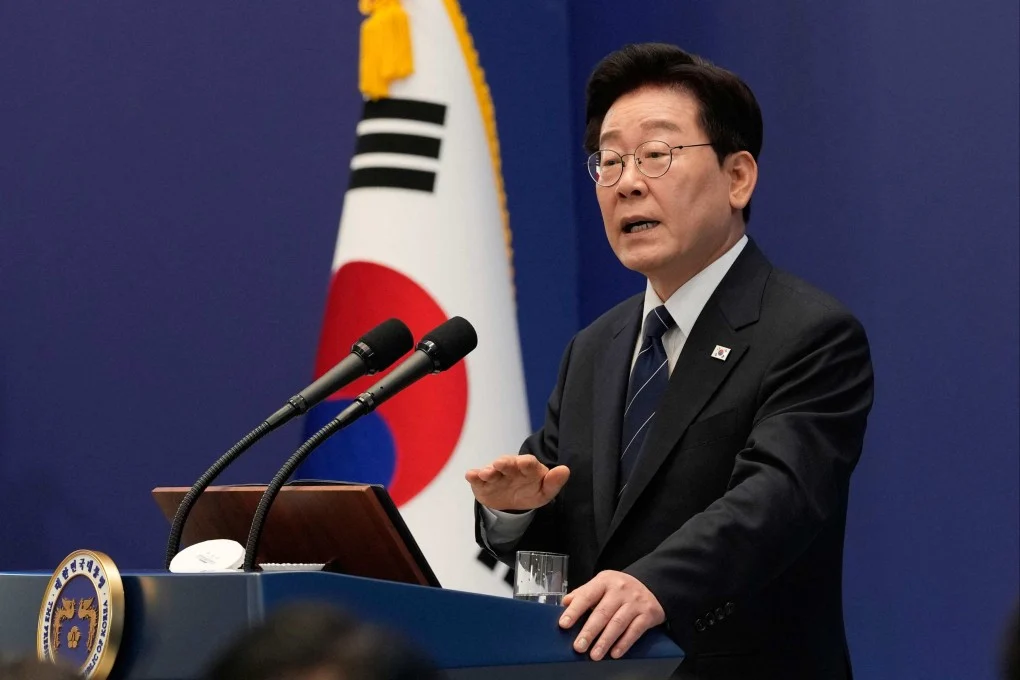
South Korea’s President Lee Jae Myung has made it clear his country will not send troops to help fight in the war on Iran. He also said Friday that US President Donald Trump “clearly” wants to talk with North Korea, and that South Korea is quietly helping set up those talks.
South Korea Says No to Sending Troops
Speaking to reporters, Lee said Seoul will not get involved in the war in any military way. “There will be no involvement or intervention in the war. We will not deploy troops or military assets in that manner,” he said. He repeated this point three separate times, making clear South Korea has stuck to a policy of staying out of the fighting and plans to keep doing so.
Lee’s comments come after reports that South Korea was thinking about sending forces to the Strait of Hormuz, a narrow but very important waterway at the center of the conflict. Instead of joining the fight, Lee said South Korea will only do the “minimum necessary” to protect its own cargo ships and oil supply routes passing through the region.
Why This Matters: Trump Had Asked for Help
This isn’t just South Korea making a routine statement — it’s a direct response to pressure from Washington. Trump complained last month that the US had gotten “very little help” from other countries in the war, and named South Korea specifically as an example. Speaking to Fox News, Trump said he’d simply asked South Korea if it wanted to take part, and recalled their answer plainly: “They all said, ‘No, thank you.’ And I said, ‘I’m going to remember that to myself.'”
That’s a notable moment of friction, since South Korea is one of the US’s closest security partners in Asia — the US currently keeps about 28,500 troops stationed there to help defend against North Korea.
The Other Big Story: Trump and North Korea
Alongside the Iran comments, Lee also talked about efforts to bring Trump and North Korean leader Kim Jong Un together for a meeting. Trump has said he wants to rebuild the relationship he claims to have built with Kim during his first term as president, and said last month he plans to meet Kim later this year.
Lee said it’s “clear” that Trump wants dialogue, and said he’s personally been encouraging Trump to pursue it. South Korea is doing “preliminary coordination work” to help make a meeting happen between the US and North Korea, though Lee admitted it “remains difficult… but is not impossible.”
So far, North Korea itself hasn’t given a clear response to Trump’s outreach. North Korea has gotten strong support from Russia in recent years and has called South Korea its enemy on multiple occasions.
A Strained Alliance in the Background
These comments come at a tense moment for the US-South Korea relationship. The two countries held a shorter version of their yearly Ulchi Freedom Shield military drills last month, after Trump ordered them scaled back. That, combined with Trump’s outreach to North Korea, has raised worries in Seoul that it could get left out of any future nuclear talks involving the North.
There’s also a big money deal still being worked out: South Korea agreed to invest $350 billion in the US last year to avoid the worst of Trump’s tariffs, but the specific projects and final terms are still being negotiated. Lee described those talks as “very complex and difficult,” saying some terms have been hard for South Korea to accept, even though the two sides are reportedly close to a deal.
One More Thing: Lee Rules Out Staying in Power Longer
Separately, Lee said he won’t try to extend his single term in office, which is limited by South Korea’s constitution. This comes after some of his allies had floated the idea of changing the constitution to allow it — an idea that drew criticism. Lee’s approval ratings have dropped to record lows recently, driven by unhappiness over his real estate policies, controversial appointments, and worries about stock market swings.
Final Thoughts
In one set of remarks, South Korea’s president managed to firmly say no to joining the Iran war, confirm he’s quietly working to get Trump and Kim Jong Un talking, and rule out staying in power beyond his current term — all while navigating real strain in the US-South Korea relationship. With Trump publicly airing his frustration over South Korea’s “no” and a $350 billion investment deal still unresolved, this alliance looks set to stay under pressure in the weeks ahead.
