


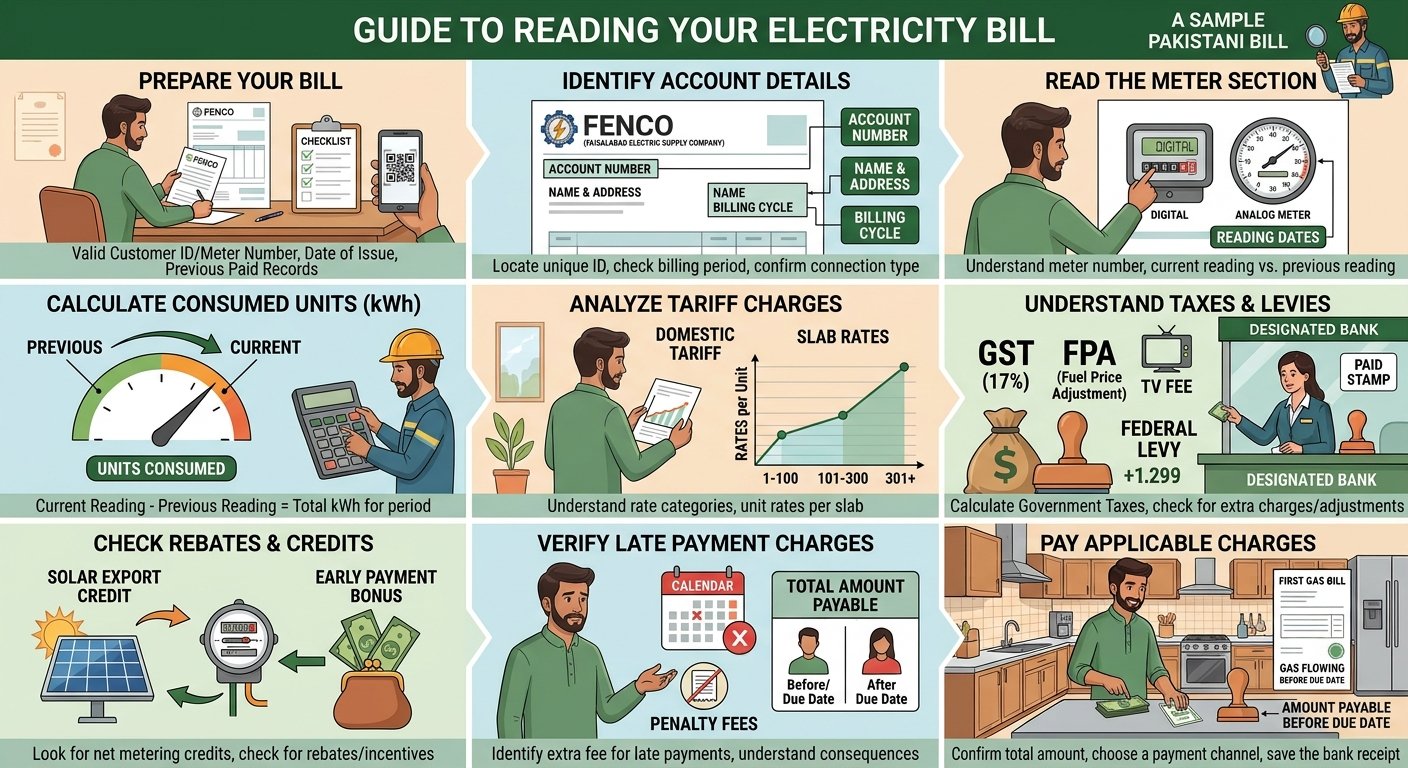
An electricity bill in Pakistan can look confusing, with many lines and taxes. It helps to read it in three parts: the units you used, the charges from your power company (DISCO), and the government taxes. In 2026 there is also a new “fixed charge” for many homes. Here is what each line means, and what the sources say and do not say.
Step 1: Find the Dates and Your Reference Number
A GEPCO bill guide says the bill month is the billing cycle, which may not match the month you pay in. The reading date is when the meter was read, the issue date is when the bill was made, and the due date is the last day before a late surcharge applies. The 14-digit reference number is the one used to look up a duplicate bill. Other DISCOs may lay out these items differently.
Step 2: Check the Units Consumed
The GEPCO guide says units consumed are the present meter reading minus the previous reading. A “Pro-Rata Consumption” label usually means the bill covers a part or adjusted cycle. Compare your units with last month’s on the billing history table at the bottom of the bill.
Step 3: Know Your Category
Your category affects the rate per unit. Profit (7 August 2023) describes three:
- Lifeline: under 100 units a month for 12 months.
- Protected: up to 200 units a month for six months.
- Non-protected (unprotected): anyone above that.
Profit (17 February 2026) describes non-protected consumers as those who exceed 100 units at least once in six months. That is different from the 2023 description, so check your own bill for the status printed on it. The GEPCO guide says tariff category, protected or unprotected status and sanctioned load all affect how you are billed.
Step 4: Read the DISCO Charges
- Cost of electricity: Profit says this is the units used multiplied by the tariff, and it is most of the DISCO charges. If you have a Time of Use meter, you pay separate peak and off-peak rates.
- Fixed charges: A monthly amount that you pay even if you use very little. See the next section.
- FPA (Fuel Price Adjustment): Profit says it recovers the gap between what a DISCO paid for power and what it charged. The GEPCO guide says it can raise or lower your bill, and it may relate to an earlier month.
- QTA (Quarterly Tariff Adjustment): Profit says it works like the FPA but covers a quarter, and is billed for past use.
- Finance cost surcharge: Profit says it helps pay power sector debt. It gave Rs1.43 per unit through June 2024, but does not list it as a standard line on every bill.
- Meter rent: The GEPCO guide lists it as a possible charge.
The New Fixed Charges in 2026
In February 2026 reports said that the National Electric Power Regulatory Authority (NEPRA) approved fixed monthly charges for domestic users. The Power Division said they would raise about Rs101 billion, according to Profit. The Standard says the charges also fund a cut of Rs4.04 per unit in industrial tariffs.
ARY News, The News and Pakistan Observer (11 February and 19 March 2026) gave these monthly amounts:
| Consumer type | Monthly units | Fixed charge |
|---|---|---|
| Protected | Up to 100 | Rs200 |
| Protected | Up to 200 | Rs300 |
| Non-protected | Up to 100 | Rs275 |
| Non-protected | Up to 200 | Rs300 |
| Non-protected | Up to 300 | Rs350 |
| Non-protected | 301 to 400 | Rs400 |
| Non-protected | 401 to 500 | Rs500 |
| Non-protected | Higher | Rs675 |
Lifeline users (up to 100 units) stay exempt, according to The News. Before this change, only non-protected users above 300 units paid fixed charges.
The sources do not fully agree:
- Profit (12 February) gives different amounts, such as Rs400 for non-protected users up to 200 units and Rs550 for 201 to 300 units.
- ARY News (31 March 2026) says the charge is tied to sanctioned load in kilowatts, at Rs200 to Rs675 per kilowatt per month, effective January 2026. It gives an example of a 5 kW home going from Rs1,000 to as much as Rs3,375.
- Pakistan Observer says the charges are being collected from February 2026.
So check the “fixed charges” line on your own bill. I could not find the official notification. Whether your amount depends on units or load is not clear from the sources.
Step 5: Read the Government Charges
Profit (2023) says:
- GST: 18% sales tax on the cost of electricity, QTA, FPA, distribution margins, electricity duty and the finance surcharge.
- Electricity duty: 1.5% on the cost of electricity, QTA, FPA and distribution margins.
- PTV fee: A flat Rs35.
- Income tax: Only for non-filers who are not on the Active Taxpayers List. It does not apply if the bill is below Rs25,000. Above that it is 7.5% of the total.
These rates are from 2023, so they may have changed. Compare them with your bill. The GEPCO guide says the government charges depend on the period and category.
Step 6: Check Arrears and Due Dates
The GEPCO guide says “Current bill” covers this cycle. “Arrears” carries past balances or credits. A positive arrear raises what you pay, and a negative one lowers it. “Payable after due date” is higher because it includes a late payment surcharge.
If Your Bill Looks Too High
The GEPCO guide says to check the tariff slab, FPA, taxes, arrears and adjustments when your units are similar but the amount is much higher. Also see whether the fixed charge appears for the first time. If it still looks wrong, contact your DISCO’s complaint office. That last step is general advice, since I did not find the complaint steps in these sources.
What I Could Not Confirm
- The exact fixed charge rules and amounts, since sources differ.
- The official notification and the date the fixed charges began.
- Current tax rates, since the main tax source is from 2023.
- The per-unit rates for 2026. I did not find a clear table.
- How K-Electric bills are laid out, which may differ.
This is general information. Your own bill is what counts.
Frequently Asked Questions
How are units calculated?
Present reading minus previous reading.
What is the FPA?
The Fuel Price Adjustment, which can raise or lower your bill, and may relate to an earlier month.
What is the QTA?
The Quarterly Tariff Adjustment, billed for past use.
What is a fixed charge?
A monthly charge you pay even with low use. Reports say it applies to most domestic users in 2026.
Who pays no fixed charge?
Lifeline users, according to Profit and The News.
Why is the amount payable after the due date higher?
It includes a late payment surcharge.
Check your units, your category and each charge on your own bill before you pay.
