


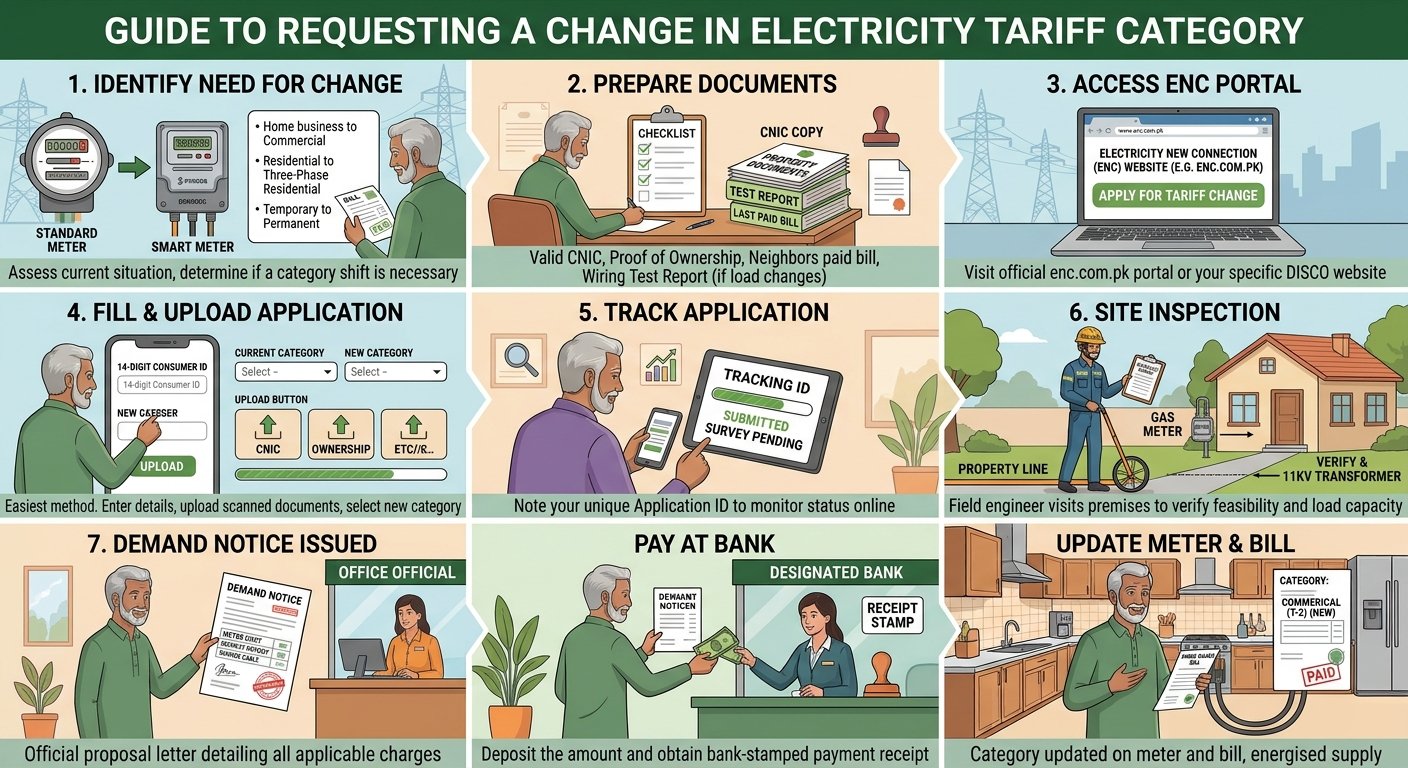
Your electricity bill is charged under a tariff category, such as domestic or commercial. If you start a shop from home, or you close a business and go back to home use, you should ask your power company (DISCO) to change the category. Using the wrong one can lead to extra bills. Here is how the request works, what the rules say and what the sources do not confirm.
When You Need a Tariff Change
- You use part of your home for a shop, salon, clinic or office (domestic to commercial).
- You closed your business and want the domestic rate again (commercial to domestic).
- Your use has changed in another way, such as a business moving into a building.
A tariff change is different from a name change or a load change. CheckBills.pk, a third-party site, says to confirm which one you need before you apply.
What NEPRA’s Rules Say
In a letter dated 21 November 2023, NEPRA amended its Consumer Service Manual (CSM) 2021. It says:
- A tariff change must be processed within ten days after you complete all requirements (Clause 2.15). After that, billing under the new tariff is pro-rated.
- If a consumer on the B-1 commercial tariff draws more than 25 kW, the DISCO must promptly issue a notice to move that consumer to B-2.
- Sanctioning officers handle name, load and tariff changes.
The copy I read is a scanned document, and some clause numbers and headings are garbled. Check the official NEPRA text before you rely on it.
Step 1: Clear Your Dues and Gather Your Papers
CheckBills.pk says to clear any outstanding dues on the meter, and to keep your account number and latest bill ready. Unpaid dues can stall the application.
FESCO’s FAQ lists these documents for a change from domestic to commercial:
- A copy of your CNIC.
- Your last paid electricity bill.
- An affidavit of Rs20.
CheckBills.pk (IESCO) adds business registration (SECP or FBR) for a switch to commercial, and an affidavit of business closure for a switch back to domestic. Its document table did not read clearly. Ask your DISCO what it needs.
Step 2: Submit Your Request
- FESCO: The FAQ says to submit the application to your SDO (sub-division) office.
- IESCO: CheckBills.pk says to log in to the IESCO portal, iesco.enc.com.pk, select the change type, upload your documents and submit. It says files should be JPEG or PDF under 2 MB each. It gives the IESCO helpline as 051-111-786-786. I did not open the portal, and the page is undated. Type the address yourself.
- Other DISCOs: I did not find their steps. Ask your sub-division office or check the website printed on your bill.
CheckBills.pk says you will get a tracking ID by SMS, and the DISCO checks your documents.
Step 3: Pay the Demand Notice, If Issued
CheckBills.pk says a straightforward tariff change “may or may not” carry a fee, and any charge will appear on a demand notice. Pay it at the bank named on the notice. Keep the receipt. I did not find a fee amount from an official source.
How Long Does It Take?
- NEPRA: Ten days after you complete the requirements.
- FESCO FAQ: “At least in two or three days,” which is the only timeframe it gives.
- CheckBills.pk (IESCO): 5 to 15 working days to verify and 10 to 20 working days overall. This is a third-party estimate.
The timings differ. Ask your DISCO for the date and keep your tracking ID.
What If You Do Not Change It?
NEPRA’s amended CSM says missed charges, including a tariff category difference, may be raised within one year, and for a maximum of six months back, through a supplementary bill showing the reason, amount, period and taxes. CheckBills.pk says using the wrong tariff is treated as a billing irregularity and can lead to adjustments, fines or disconnection. So apply as soon as your use changes.
A Recent Example: Punjab Public Schools
Express Tribune (29 March 2026) reported that the Punjab Education Department decided to move the electricity meters of all public schools from commercial to domestic tariff, because of rising costs and taxes on bills. It gives no procedure or start date. This is a department decision for schools, not a rule for the public.
Check Your First Bill
After the change, check that your next bill shows the new category and the right rate. If it does not, call your DISCO and quote your tracking ID. This step is general advice.
Beware of Fixers
- Pay only the amount on an official demand notice, at the bank named on it.
- Do not pay a lineman or agent to “change the tariff” without a record.
- Keep copies of your application and receipts.
What I Could Not Confirm
- The steps for LESCO, GEPCO, MEPCO, K-Electric and other DISCOs.
- The fee, if any.
- How a DISCO decides if your use is commercial. The NEPRA text I read does not define domestic and commercial use.
- The full list of categories beyond domestic and commercial.
- Whether the portal addresses are current.
This is general information.
Frequently Asked Questions
Where do I apply for a tariff change?
At your sub-division (SDO) office, or on your DISCO’s online portal where there is one.
What documents do I need?
Your CNIC, your last paid bill and an affidavit, according to FESCO’s FAQ.
How long should it take?
NEPRA says ten days after you complete the requirements.
Is there a fee?
Not confirmed. A demand notice may be issued.
What if I use my house for business?
You should apply for the commercial tariff. A wrong category can bring back-billing.
How far back can a DISCO bill?
Up to six months, within one year, under NEPRA’s amended manual.
Apply as soon as your use changes, keep your tracking ID and check your next bill.
