


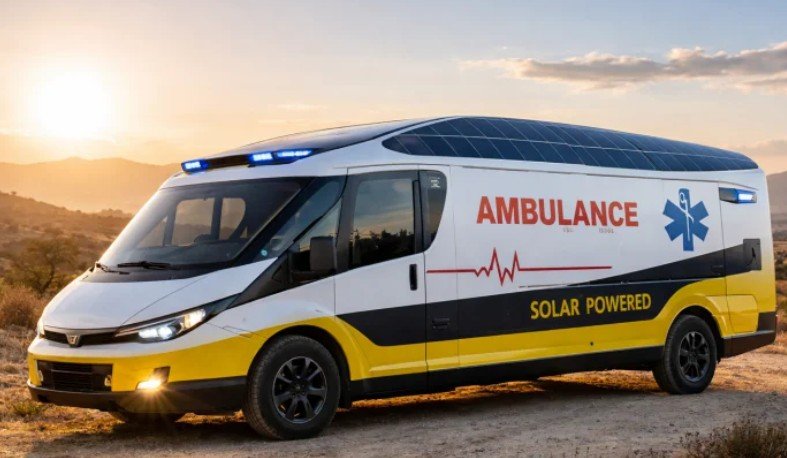
It runs an X-ray machine, an ultrasound scanner, and a vaccine cooler — and it never needs to stop for fuel. A team of Dutch university students just proved that a hospital on wheels, powered entirely by sunlight, can actually work in the real world. The solar-powered ambulance known as Stella Juva completed a successful trial run across Kenya this week, and the results suggest it could reshape how emergency and preventive healthcare reaches the world’s most remote communities.
<!– –>
Meet Stella Juva: More Clinic Than Ambulance
Built by 23 students from Eindhoven University of Technology in the Netherlands, Stella Juva is a striking yellow, black, and white vehicle covered in rooftop solar panels that power both its electric motor and its onboard medical equipment. Unlike a conventional ambulance, whose job is to rush a patient to a hospital, Stella Juva is designed to bring the hospital to the patient — a mobile clinic built for regions where the nearest medical facility can be hours away over difficult terrain.
The vehicle carries tuberculosis testing kits, cooled vaccine storage, an X-ray machine, an ultrasound scanner, and an automated external defibrillator, all powered by 542 solar cells feeding a 50-kWh battery. That battery keeps the vehicle and its equipment running even at night or in cloudy conditions, so care doesn’t stop when the sun does.
The Numbers That Make It Work
On a sunny day, Stella Juva has a range of roughly 715 kilometers, can reach a top speed of 120 kilometers per hour, and is built to handle off-road terrain — a critical requirement given how many of the communities it’s designed to serve sit well beyond paved roads. During testing in Kenya, the two-seat vehicle logged more than 800 kilometers across Nakuru, Narok, and Kajiado counties, including a visit to a health clinic in the Narok region that currently lacks reliable power for equipment like ultrasounds.
Perhaps the most telling result: while stationary and running all of its onboard medical equipment simultaneously, Stella Juva generated more energy than it consumed — proof that it can operate fully independent of fuel or grid charging infrastructure, exactly as designed.
Why This Matters for Maternal and Child Health
The trial was conducted in partnership with Amref Health Africa, an NGO focused on maternal and child health across the continent. According to Amref’s program staff, the lack of reliable power at rural clinics directly affects expectant mothers, who often lack easy access to basic diagnostic tools like ultrasounds. Across the two-day Kenya trial, the team estimates the vehicle’s equipment could have treated approximately 200 people, had it been used on real patients during testing.
Geoffrey Sadera of Amref Health Africa, which partnered on the project, described the vehicle as a genuine game changer for reaching communities that currently fall through the cracks of conventional healthcare infrastructure.
A Year in the Making
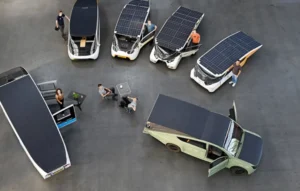
The project is the work of Solar Team Eindhoven, a student group that has run yearlong sustainable vehicle projects since 2013. Many team members put their studies on hold for roughly a year to bring Stella Juva from concept to a working, field-tested prototype — a level of commitment team member Isabella Wanningen described as central to the project’s success, calling the Kenya trial a runaway success after testing both the vehicle’s off-road capability and its ability to actually deliver care.
What Comes Next
Stella Juva remains a research prototype rather than a commercially available vehicle, but its open engineering approach is designed to give healthcare organizations and vehicle manufacturers a real-world starting point for future off-grid medical transport. The team behind the project has said their broader goal is to inspire the wider industry, healthcare organizations, and other innovators to apply sustainable technology to genuine real-world problems, rather than keeping the concept limited to a single prototype.
Frequently Asked Questions
What is Stella Juva?
Stella Juva is a solar-powered ambulance built by 23 students from Eindhoven University of Technology in the Netherlands, designed to function as a mobile medical clinic for remote communities rather than a vehicle that transports patients to hospitals.
How far can the solar ambulance travel?
On a sunny day, Stella Juva has a range of approximately 715 kilometers (about 444 miles), and its battery allows it to continue operating even at night or in cloudy weather.
Where was Stella Juva tested?
The vehicle was tested across Kenya in partnership with Amref Health Africa, covering more than 800 kilometers across Nakuru, Narok, and Kajiado counties, including visits to remote health clinics.
Is Stella Juva available for use yet?
No. It remains a research prototype following a successful field trial. The team hopes the project will inspire healthcare organizations and manufacturers to develop similar solar-powered medical vehicles for wider use.
From a university workshop in the Netherlands to dirt roads in rural Kenya, Stella Juva’s successful trial run offers a genuinely hopeful glimpse of what’s possible when clean energy engineering is pointed directly at one of healthcare’s oldest problems: reaching the people who need it most, wherever they are.
