


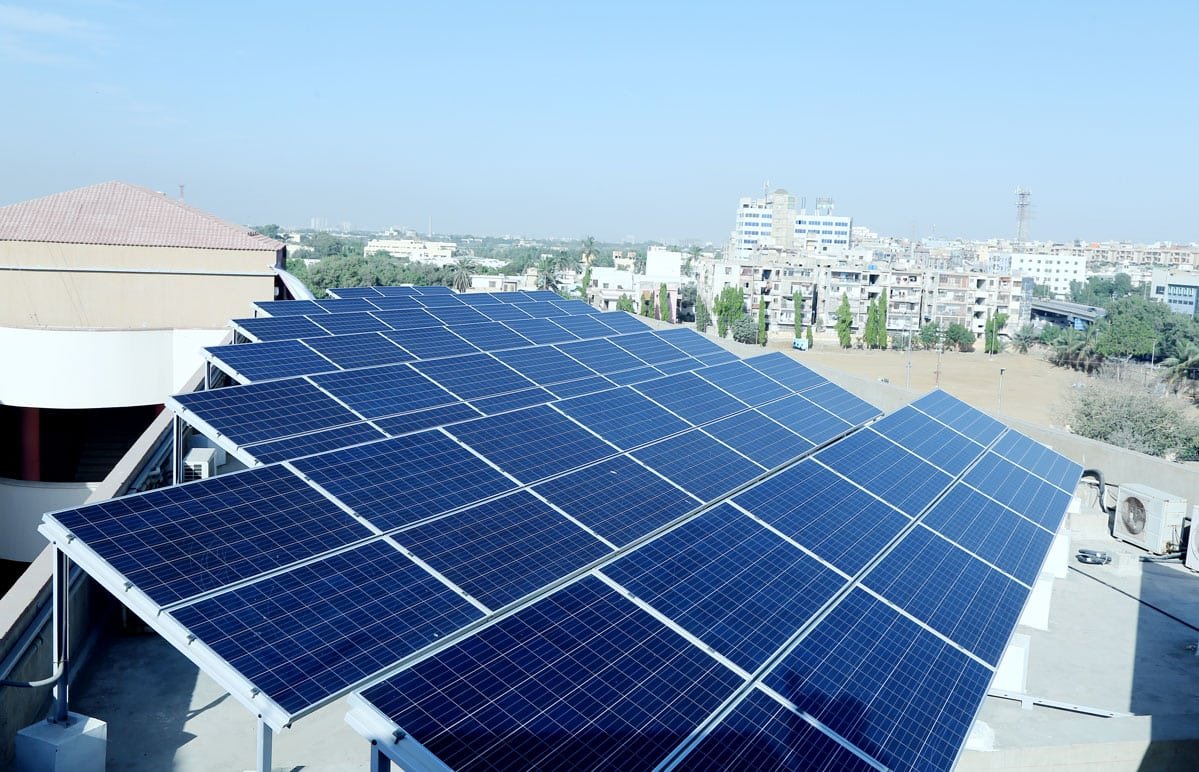
Walk into almost any solar dealership in Pakistan today and one number keeps coming up: 585W. It’s become the default panel size for new residential and commercial installations. But behind the attractive headline prices lies a market going through its biggest policy shakeup in a decade — and buyers who only compare price-per-watt are missing half the picture.
Why 585W Became Pakistan’s Default Panel Size
585W panels sit in a sweet spot: large enough to keep the cost-per-watt competitive, but still practical for standard residential rooftop mounting and inverter pairing. A typical 5kW inverter accepts roughly 5.5kW of DC input, meaning six 585W panels (3.51kW) fit comfortably within that headroom without triggering inverter clipping, while going up to eight panels risks oversizing beyond what the inverter can efficiently use.
Not All 585W Panels Are the Same Panel
This is where “cheap today” can quietly turn into “costly tomorrow.” Two 585W panels priced differently aren’t necessarily the same product underneath.
| Feature | Standard P-Type Monofacial | N-Type / Bifacial (TOPCon, HJT) |
|---|---|---|
| Typical price (585W–720W) | Rs. 24,000 – 28,000 | Rs. 30,500 – 35,000 |
| Annual degradation | ~0.45% per year | <0.25% per year |
| Temperature coefficient | −0.35%/°C | −0.29%/°C |
| Low-light performance | Standard | Better |
| Extra energy yield | Baseline | +10–25% (bifacial, on reflective surfaces) |
The premium panel costs 12–18% more upfront, but degrades more slowly and holds output better in Pakistan’s summer heat — which matters over a 25-year warranty period. A panel that’s cheaper today but degrades faster ends up producing meaningfully less electricity by year 10, quietly erasing the initial savings.
The Real-World Output Gap
Headline wattage numbers can also be misleading on their own. A 585W panel is rated under lab-standard test conditions (STC), but real-world output — accounting for heat, soiling, wiring loss, and inverter clipping — typically runs at 82–87% of that rating. In practice, a 585W panel delivers closer to 480–505W of average daily AC output during a Lahore summer. That gap is a normal part of system design, but it also means comparing panels purely on a “price per rated watt” basis can be misleading without factoring in real-world derating.
The Bigger “Costly Tomorrow”: Pakistan’s Net Metering Overhaul
The panel itself is only one part of the equation — the rules around what you earn for the electricity you export have changed dramatically, and that shift is arguably the real “costly tomorrow” in this story.
| Old Net Metering (Pre-Feb 2026) | New Net Billing (2026 Onward) | |
|---|---|---|
| Exchange basis | One-to-one unit credit | Sell at national average purchase price, buy at full consumer tariff |
| Buyback rate | Up to ~Rs. 27/unit | Cut to roughly Rs. 10–13/unit for new users |
| Existing users | — | Retain old terms until contract expiry, if system isn’t modified |
| System expansions | — | Lose old-rate protection if modified after Feb 9, 2026 |
| Typical payback period | 3–5 years | Extended, due to lower export value |
Under the previous framework, Pakistan’s net-metered solar capacity exploded from around 50MW to more than 6GW, driven by a simple, predictable one-for-one credit system. NEPRA has since replaced that decade-old framework with the Prosumer Regulations 2026, citing utility revenue losses, grid instability from reverse power flows, and cross-subsidy concerns — reportedly shifting an estimated Rs. 159 billion in grid costs onto non-solar consumers under the old system.
What This Means If You Already Have Net Metering
If you installed your system before the cutoff and haven’t modified it, you keep your original billing terms until your contract expires — but that protection is fragile. Expanding or modifying your existing system moves it under the new net billing rules, losing the older, more favorable rate. For anyone considering adding panels to boost capacity, it’s worth understanding that upgrading isn’t a free improvement anymore — it comes with a real trade-off against your current rate protection.
What This Means If You’re Installing for the First Time
New installations now fall under net billing by default, with self-consumption — using your own solar power directly rather than exporting it — now worth significantly more than exporting to the grid. That changes the smart sizing strategy:
- Size your system closer to your actual daytime consumption rather than your total monthly bill
- Shift heavy loads (AC units, water pumps, geysers) to daylight hours to use solar power directly
- Consider battery storage to capture excess daytime generation for night-time use, since exported units now earn roughly half of what self-consumed units save
Buying Checklist for 585W Panels
- Confirm whether the panel is P-type or N-type, and monofacial or bifacial — this affects both price and long-term output
- Ask for the manufacturer’s actual performance warranty (typically 25 years), not just a local dealer warranty
- Check for salt-mist and ammonia resistance certification (IEC 61701 / IEC 62716) if you’re in a coastal or industrial area
- Confirm your inverter’s DC input capacity before finalizing panel count, to avoid oversizing losses
- Factor in non-refundable net metering application and inspection fees (typically Rs. 8,000–15,000, varying by DISCO)
Final Thoughts
The 585W panel itself isn’t the risk — how it’s bought and how the system is sized under Pakistan’s new net billing rules is where “cheap today” can turn into “costly tomorrow.” A slightly higher upfront cost for a better-quality panel, paired with a system sized around self-consumption rather than grid export, is increasingly the more financially sound path under the current policy landscape.
