


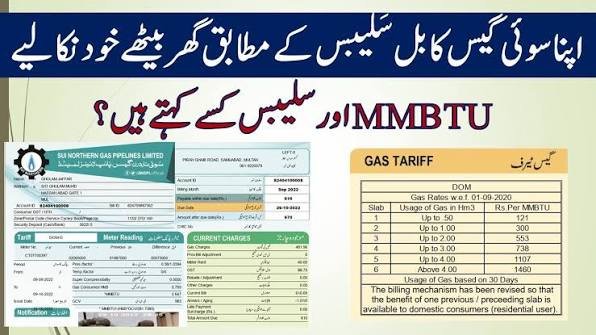
Ever wonder why your gas bill jumps so sharply in winter, even when your usage only goes up a little? The answer is Pakistan’s slab-based pricing system. This guide explains how to calculate your gas bill in Pakistan, using the current OGRA-approved rates for SNGPL and SSGC, with real worked examples.
Who Sets Gas Prices in Pakistan?
Natural gas in Pakistan is supplied by two companies: Sui Northern Gas Pipelines Limited (SNGPL), serving Punjab and Khyber Pakhtunkhwa, and Sui Southern Gas Company (SSGC), serving Sindh and Balochistan. Both operate under a common domestic tariff schedule set by the Oil and Gas Regulatory Authority (OGRA), which reviews and approves rates annually, effective from July 1 each year.
Protected vs. Non-Protected: Which Category Are You?
Your bill depends heavily on which category you fall into:
- Protected consumers are households whose average consumption during the four winter months (November to February) is 90 m³ (0.9 hm³) or less per month. This category is reviewed every year based on your actual winter readings, and it comes with significantly lower rates.
- Non-protected consumers are everyone above that winter average, and they pay considerably higher slab rates.
If your winter average rises above 90 m³ in a given year, you’ll be reclassified as non-protected for the following billing year, even if your usage later drops.
Current Domestic Slab Rates (FY 2025-26)
Pakistan uses a marginal slab system, similar to income tax brackets. You don’t pay the highest rate on all your units, only on the units that fall within each higher band.
Protected Consumer Rates
| Monthly Consumption | Rate per m³ |
|---|---|
| 0–50 m³ | Rs. 11 |
| 51–90 m³ | Rs. 22 |
| Above 90 m³ | Rs. 42 |
Fixed monthly charge: Rs. 600, plus meter rent.
Non-Protected Consumer Rates
| Monthly Consumption | Rate per m³ |
|---|---|
| 0–50 m³ | Rs. 30 |
| 51–100 m³ | Rs. 44 |
| 101–200 m³ | Rs. 80 |
| 201–300 m³ | Rs. 112 |
| 301–400 m³ | Rs. 132 |
| Above 400 m³ | Rs. 156 |
Fixed monthly charge: Rs. 1,500 if consumption is up to 150 m³, or Rs. 3,000 if it exceeds 150 m³, plus meter rent.
These m³ figures are a widely-used approximation. Your official bill actually measures consumption in MMBTU (Million British Thermal Units), converted from your meter’s cubic-metre reading using your area’s Gas Calorific Value (GCV), so your exact bill may vary slightly from a simple m³ calculation.
How to Calculate Your Bill: Step by Step
- Find your monthly consumption. Subtract your previous meter reading from your current one to get your total m³ used.
- Split your consumption across the slabs. Apply each slab’s rate only to the units that fall within that band.
- Add up the energy charge for each slab to get your total energy charge.
- Add the fixed monthly charge that applies to your category and consumption level.
- Apply 18% GST to the combined total of the energy charge and fixed charge.
The result is your estimated bill, before any arrears, late payment surcharges, or prior adjustments your gas company may add separately.
Worked Example 1: Protected Consumer Using 120 m³
| Slab | Units | Rate | Amount |
|---|---|---|---|
| 0–50 m³ | 50 m³ | Rs. 11 | Rs. 550 |
| 51–90 m³ | 40 m³ | Rs. 22 | Rs. 880 |
| Above 90 m³ | 30 m³ | Rs. 42 | Rs. 1,260 |
| Energy Charge | 120 m³ | Rs. 2,690 | |
| Fixed Charge | Rs. 600 | ||
| Subtotal | Rs. 3,290 | ||
| GST (18%) | Rs. 592.20 | ||
| Estimated Total | Rs. 3,882.20 |
Worked Example 2: Non-Protected Consumer Using 200 m³
| Slab | Units | Rate | Amount |
|---|---|---|---|
| 0–50 m³ | 50 m³ | Rs. 30 | Rs. 1,500 |
| 51–100 m³ | 50 m³ | Rs. 44 | Rs. 2,200 |
| 101–200 m³ | 100 m³ | Rs. 80 | Rs. 8,000 |
| Energy Charge | 200 m³ | Rs. 11,700 | |
| Fixed Charge | Rs. 1,500 | ||
| Subtotal | Rs. 13,200 | ||
| GST (18%) | Rs. 2,376 | ||
| Estimated Total | Rs. 15,576 |
What Else Can Show Up on Your Bill?
- Meter rent: a small additional monthly charge for the gas meter, also subject to GST.
- Late payment surcharge: added if you miss the due date printed on your bill.
- Previous arrears: any unpaid amount carried forward from earlier bills.
- Prior period adjustments: corrections from a meter replacement or an earlier estimated reading.
Your bill separates the current amount from any arrears, so check both lines carefully, especially if a bill looks unexpectedly high.
Why the 150 m³ and 90 m³ Thresholds Matter So Much
Crossing certain thresholds doesn’t just raise your per-unit rate, it can also raise your fixed charge. A non-protected household that goes just over 150 m³ jumps from a Rs. 1,500 fixed charge to Rs. 3,000, on top of paying a higher marginal rate. Likewise, a protected household that creeps past a 90 m³ winter average risks being reclassified as non-protected entirely for the next year, which is a far bigger jump than any single slab increase.
Ways to Lower Your Gas Bill
- Fix gas leaks promptly. Even a small leak can waste significant gas without any benefit.
- Use a pressure cooker to cut cooking time and gas use.
- Install a solar water heater to reduce gas used for heating water.
- Get your stove and geyser serviced regularly, since clogged burners waste gas.
- Cook with lids on pots to retain heat and shorten cooking time.
- Insulate hot water pipes and your geyser to reduce heat loss.
- Set your geyser to around 55–60°C instead of maximum heat.
- Track your meter reading monthly so you can catch a spike, or a possible meter fault, early.
Frequently Asked Questions
How do I know if I’m a protected or non-protected consumer?
Check your monthly gas bill, which states your category, or contact your gas company. Protected status depends on your average consumption during November to February being 90 m³ or less per month.
Why did my bill jump so much even though my usage barely increased?
You likely crossed a slab boundary or a fixed-charge threshold. For non-protected consumers, going from 149 m³ to 151 m³, for example, doesn’t just add a small amount for those 2 extra units, it also raises your fixed charge from Rs. 1,500 to Rs. 3,000.
Is gas billed in cubic metres or MMBTU?
Your meter measures cubic metres, but your official bill converts this to MMBTU using your area’s Gas Calorific Value. The m³-based rates used for quick estimates are a close approximation, not the exact formula on your bill.
Can I apply to become a protected consumer?
If you believe you qualify, you can apply for reclassification at your nearest SNGPL or SSGC customer service centre with your CNIC, a recent bill, and proof of your income or residence. The company may conduct a field verification visit.
What should I do if I think my bill has an error?
Call the gas complaint helpline at 1199 or visit your nearest customer service centre with your consumer number and bill details. Pay the undisputed portion of your bill while the issue is investigated to avoid disconnection.
Once you understand the slab system, your gas bill stops being a mystery. Track your monthly consumption, watch for the 90 m³ and 150 m³ thresholds, and small changes in habits can meaningfully lower what you pay each month.
