


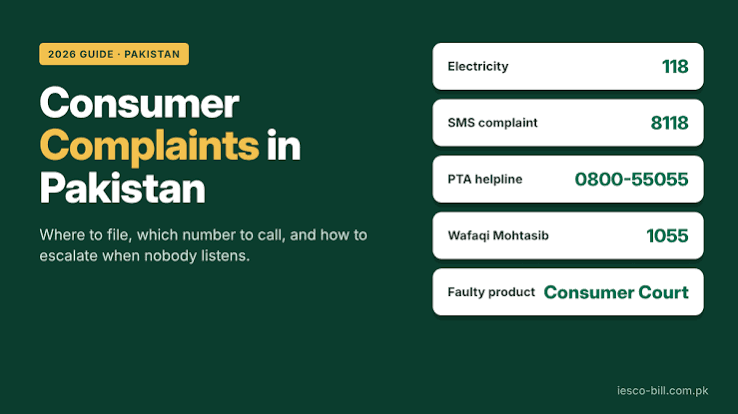
If a shop sells you a faulty product or a company gives poor service, you can complain to the seller first and then take the matter to a Consumer Court. In Punjab, the first step is a 15-day legal notice on plain paper. Filing in the Consumer Court is free there, and you do not need a lawyer. Each province has its own Consumer Protection Act, so the details differ. Here is how the process works, what to include and where else you can complain.
Step 1: Collect Your Evidence
- The receipt or any proof of purchase.
- The product, its packaging and photos of the defect with the date.
- Messages or emails with the seller, including WhatsApp chats.
- A copy of your CNIC.
The Centre for Research and Consumer Protection (CRCP) guide lists a CNIC copy, the receipt and proof of the product. A commoner-law guide adds packaging, photos and chats, and an expert opinion if one applies.
Step 2: Complain to the Seller
Try to settle the matter with the seller first. Write down what you asked for and when. This also helps when you send the legal notice.
Step 3: Send a 15-Day Legal Notice
The CRCP guide and Pakistan Observer (22 April 2025) say that in Punjab you must send a 15-day legal notice before filing a claim in the Consumer Court:
- Write it on plain paper to the manufacturer, seller or service provider.
- Say you expect them to fix the problem and pay compensation within 15 days of receiving the notice.
- Send it by registered post, or mail with acknowledgement, and keep the proof.
The CRCP guide calls the notice a prerequisite for filing a claim. A commoner-law guide says it is also “non-negotiable” in Sindh and Khyber Pakhtunkhwa, and that a petition without it is usually dismissed. The same page does not state the rule for Balochistan or Islamabad, so check the law that applies to you.
Step 4: File in the Consumer Court
If the seller does not settle the matter, file your complaint. The Consumer Court is headed by a District and Sessions Judge or an Additional District and Sessions Judge, according to the CRCP.
- Where: The District Consumer Court. The commoner-law guide says to file in the district where you live or where you bought the item.
- How: A plain-paper application with your documents. You can file it yourself or use a lawyer.
- Attach: Your notice and any reply from the seller, along with your evidence.
Time Limits
The sources differ:
- Pakistan Observer says to file within the 15 days after the notice period ends.
- The CRCP guide says the complaint must be filed within 30 days from when the cause of action arose.
I could not settle this from the Act itself. File as soon as you can, and ask a lawyer or the court office about the deadline in your province.
Fees
Pakistan Observer and the CRCP both say no court fee is charged in Punjab. The commoner-law guide says fees are roughly Rs200 to Rs1,000 depending on the province but does not give exact amounts. Ask the court office what applies in your province.
What Can You Get?
- Pakistan Observer says damages can be claimed for suffering or loss, with no stated limit. It also says violators can face up to two years in prison, a fine of up to Rs100,000, or both.
- The commoner-law guide lists a refund, replacement, repair, compensation and punitive damages where there was deception.
The commoner-law guide says most cases take about four to six months and that hearings are usually two to four. The CRCP guide gives no decision time. Treat the time as an estimate.
Appeals
Pakistan Observer says a party can appeal to the Lahore High Court within 30 days of the final order. Other provinces appeal to their own High Courts.
Complaints About Misleading Ads or Unfair Competition
The commoner-law guide says the Competition Commission of Pakistan (CCP) deals with deceptive marketing, such as false ads or claims, and anti-competitive conduct under the Competition Act 2010. It does not hear individual disputes about faulty goods or poor service, which go to the provincial Consumer Courts. The page says you can file online at the CCP’s website, with no filing fee, and attach the advertisement and your receipts. The page is undated, so check the CCP portal for the current process.
Other Places to Complain
Many sectors, such as telecom, banking and electricity, have their own regulators. I did not find sources on them in this research, so check the regulator’s own website for the complaint steps and keep your seller or provider complaint number.
Tips
- Act soon, since time limits are short.
- Keep everything in writing and save the postal receipt.
- Be clear about what you want, such as a refund or repair.
- Do not accept a verbal promise without a written note.
Stay Safe From Scams
- Use only official court offices and regulators.
- Do not pay agents who promise a quick result.
- Do not share your OTP or card details with anyone claiming to help with a complaint.
What I Could Not Confirm
- The exact time limit for filing.
- The fee in each province.
- The notice rules for Balochistan and Islamabad.
- The value limit for the Consumer Court.
- The complaint steps for sector regulators.
This is general information, not legal advice.
Frequently Asked Questions
Do I need a lawyer for a consumer court case?
No. You can file on plain paper yourself, according to the CRCP.
Do I have to send a legal notice first?
In Punjab, yes. It is a 15-day notice.
Is there a court fee?
Not in Punjab, according to the CRCP and Pakistan Observer. Other provinces may differ.
How long do I have to file?
Sources differ, with 15 days after the notice period or 30 days from the cause of action.
What if the ad was misleading?
You can complain to the Competition Commission of Pakistan.
Where do I appeal?
To the High Court, within 30 days in Punjab.
Collect your proof, send the notice and file quickly. Ask the court office or a lawyer about deadlines in your province.
