


After a death in the family, one question comes up quickly: who are the legal heirs? Banks, insurers, and property offices all want official proof. A legal heir certificate in Pakistan provides that proof. This guide explains what the certificate is, which document you actually need, and how to get it through NADRA.
What Is a Legal Heir Certificate in Pakistan?
A legal heir certificate is an official document that names the people entitled to the property of a deceased person. It also records each heir’s share. Only a legal heir can apply for it, and the death must be registered first.
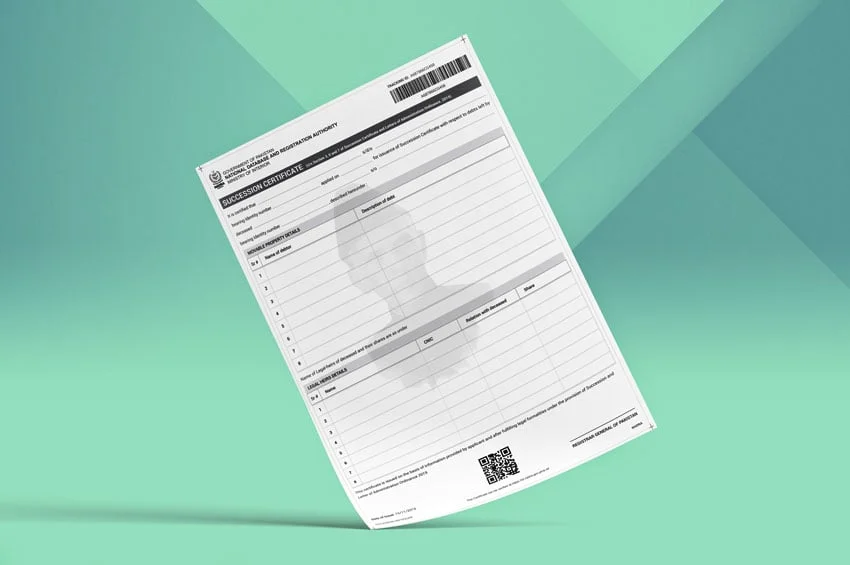
Pakistan has no single document with this exact name. In practice, the same purpose is served by a succession certificate, also called a Wirasat Nama or heirship certificate. NADRA or a civil court can issue it.
Which Document Do You Need?
Different offices ask for different papers. The table shows the common cases.
| Purpose | Document Usually Asked For |
|---|---|
| Claiming bank balances and savings | Succession certificate from NADRA or a court |
| Transferring inherited property | Succession certificate or Wirasat Nama, FRC, and heirs’ CNICs |
| Insurance claims | Legal heir or succession certificate |
| Family pension of a government employee | Legal heir certificate and the pension office’s own forms |
| Proving family relationships | NADRA Family Registration Certificate (FRC) |
Each office sets its own rules. Therefore, ask the bank, insurer, or pension office exactly which paper it accepts before you apply.
Documents Required to Apply
Under the Letters of Administration and Succession Certificates Act 2021, the application needs the following:
- The death certificate of the deceased.
- A list of all legal heirs, with copies of their CNICs.
- The CNIC of the deceased.
- An authorisation from all other heirs, if one heir applies for the group.
- The Family Registration Certificate (FRC), which shows the family tree.
- A guardianship certificate, if any heir is under 18.
How to Get a Legal Heir Certificate From NADRA
- Register the death. Get the death certificate and keep the CNIC of the deceased ready.
- Check family records. Make sure all heirs, such as the spouse and children, have updated NADRA records.
- Visit a NADRA centre with a Succession Facilitation Unit. NADRA said in August 2025 that the service is available at such centres nationwide, regardless of where the property is located.
- Submit the application. One heir files it, with the authorisation of the others, and pays the fee.
- Complete biometric verification. All heirs verify their identity at a NADRA centre or through the PakID app.
- Collect the certificate. It lists all heirs and their shares.
NADRA charges Rs20,000 if the assets are worth more than Rs100,000, and Rs10,000 if they are worth less. Reports put the processing time at roughly 15 to 30 days. Confirm the current fee and timeline with NADRA before you apply.
How Are Inheritance Shares Decided?
For Muslim families, the certificate follows Islamic inheritance law. As a general rule under Sunni law:
- A wife receives one-eighth if the deceased left children, and one-quarter if there were none.
- A husband receives one-quarter if the deceased left children, and one-half if there were none.
- Each parent usually receives one-sixth if the deceased left a child.
- Sons receive twice the share of daughters.
These rules are only a summary. The actual shares depend on which relatives survive and on the applicable law. NADRA calculates them from the family records, so do not divide the property on your own before you get the certificate.
When Should You Go to Court?
The NADRA route works best when all heirs agree. If heirs dispute each other’s claims, or the case is complicated, a civil court is the safer choice. The court process takes longer and involves court fees and lawyer charges. Also, if a dispute arises after NADRA issues the certificate, the matter moves to court.
Tips to Avoid Problems
- List every legal heir, including daughters, the spouse, and the parents.
- Check that names and CNIC numbers match across all documents.
- Do not pay agents who promise a certificate without biometric verification.
- Make several certified copies, because banks and offices may each keep one.
- Agree on the division of assets in writing, as the certificate records only legal shares.
Frequently Asked Questions
Is a legal heir certificate the same as a succession certificate?
In everyday use, yes. Both prove who the legal heirs are. Ask your bank or office which name and issuer it accepts.
Who can apply?
Only a legal heir can apply, with the authority of the other heirs.
Can overseas heirs get it?
Yes, but the application starts in Pakistan. Heirs abroad can complete biometric verification at a Pakistani mission or through the PakID app.
How much does it cost?
NADRA’s fee is Rs10,000 or Rs20,000, depending on the asset value.
What if one heir is a minor?
You will need a guardianship certificate for the minor heir.
Conclusion
A legal heir certificate in Pakistan is usually a NADRA or court-issued succession certificate. Collect the death certificate, the CNICs, and the FRC, then complete biometric verification for every heir. Check with the office that needs the paper, and confirm current fees before you apply. For more guides on public services, keep reading Pakistan Post. You can also visit the NADRA succession portal for official details.
