


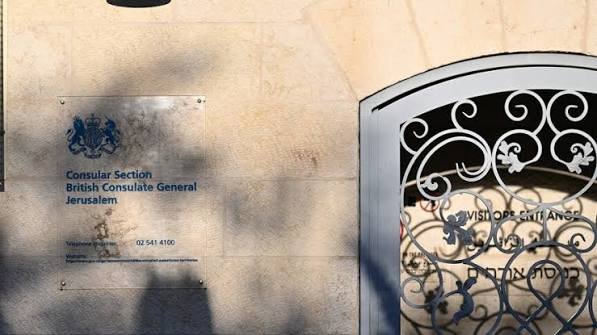
Israel has ordered Britain’s consulate in East Jerusalem to close within 30 days, escalating a diplomatic rupture that began after the UK announced sweeping sanctions on Israeli settlements in the occupied West Bank.
What Israel Announced
Israeli Foreign Minister Gideon Sa’ar said the British consulate — located in Jerusalem’s Sheikh Jarrah area and accredited to deal with Palestinian affairs — must shut down, with diplomats there losing their accreditation once the 30-day window lapses. British representatives at the US-led Civil-Military Coordination Center in southern Israel, along with UK diplomats based in Ramallah, were given just seven days to leave. Sa’ar also announced entry bans targeting several British MPs, including former Labour leader Jeremy Corbyn and a group of other Labour and Green Party lawmakers, and said longstanding British involvement in training Palestinian security forces in the West Bank would end.
Justifying the move, Sa’ar said Jerusalem is under Israel’s full sovereignty and that any foreign diplomatic activity there must go through channels Israel has agreed to, rather than operate independently.
What Triggered This
The retaliation followed UK Foreign Secretary Ed Miliband’s announcement in the House of Commons of a ban on imports from Israeli settlements in the occupied West Bank, along with sanctions on companies and individuals involved in settlement expansion, and additional sanctions targeting Israeli settlers accused of inciting or carrying out violence against Palestinians. Britain’s announcement went further rhetorically too — Miliband said the UK government considers what’s happening in the West Bank to amount to “ethnic cleansing of Palestinians,” carried out by what he called “settler terrorists.”
Britain wasn’t acting alone. France and Canada joined the UK in banning imports from settlement goods, and a total of 11 other Western countries have signed on to the broader sanctions push. France and Sweden also maintain their own consulates in Jerusalem accredited to the Palestinian Authority, similar to Britain’s.
The Legal Backdrop
Roughly 750,000 Israeli settlers live across 194 settlements and around 400 outposts in the occupied West Bank, including East Jerusalem, according to Palestinian estimates. Israel has occupied the West Bank, including East Jerusalem, since the 1967 war. The international community — including the UK, EU member states, and the UN — considers Israeli settlements in occupied territory illegal under international law, a position the Israeli government rejects.
Reactions From Inside Israel
The response inside Israel has split along familiar lines. Finance Minister Bezalel Smotrich went further than Sa’ar, calling for the British ambassador to be expelled entirely, while Jerusalem Deputy Mayor Arieh King pushed for enforcement action against Britain’s diplomatic presence in the city. Matteh Binyamin Regional Council head Israel Ganz framed the dispute in historical terms, arguing that Britain’s era of influence over the region ended with the British Mandate decades ago.
Not every Israeli voice welcomed the retaliation. The Israeli anti-settlement movement Peace Now was among those that publicly welcomed Britain’s sanctions rather than Israel’s response, arguing that sanctions targeting settlements specifically — rather than Israel as a whole — draw an important distinction between sovereign Israel and settlement activity beyond the Green Line, and that this distinction works in Israel’s long-term interest.
A Notable Detail: Washington’s Silence
One detail drawing particular attention is the muted response from Washington. According to reporting citing US officials and Western diplomats, the Trump administration chose not to oppose the UK-led sanctions push, despite the United States’ historically close alignment with Israel — a signal, according to that reporting, of frustration in Washington with the Netanyahu government’s settlement policy in the West Bank.
What Happens Next
Israel’s government was reportedly set to meet to formalize its broader response to the countries that joined Britain’s sanctions effort. With the consulate given a firm 30-day deadline and diplomatic postings in Ramallah given just seven days, the practical wind-down of Britain’s diplomatic presence tied to Palestinian affairs is likely to begin almost immediately, even as the underlying dispute over settlement policy remains far from resolved.
Final Thoughts
This marks one of the sharpest diplomatic breaks between Israel and a major Western ally in recent memory, triggered directly by Britain’s decision to formally brand West Bank settler violence as ethnic cleansing and act on it with sanctions. With a dozen countries now aligned behind the UK’s position and Washington notably declining to push back, the coming weeks are likely to test how isolated — or how firm — Israel’s stance on settlement policy proves to be among its traditional allies.
