


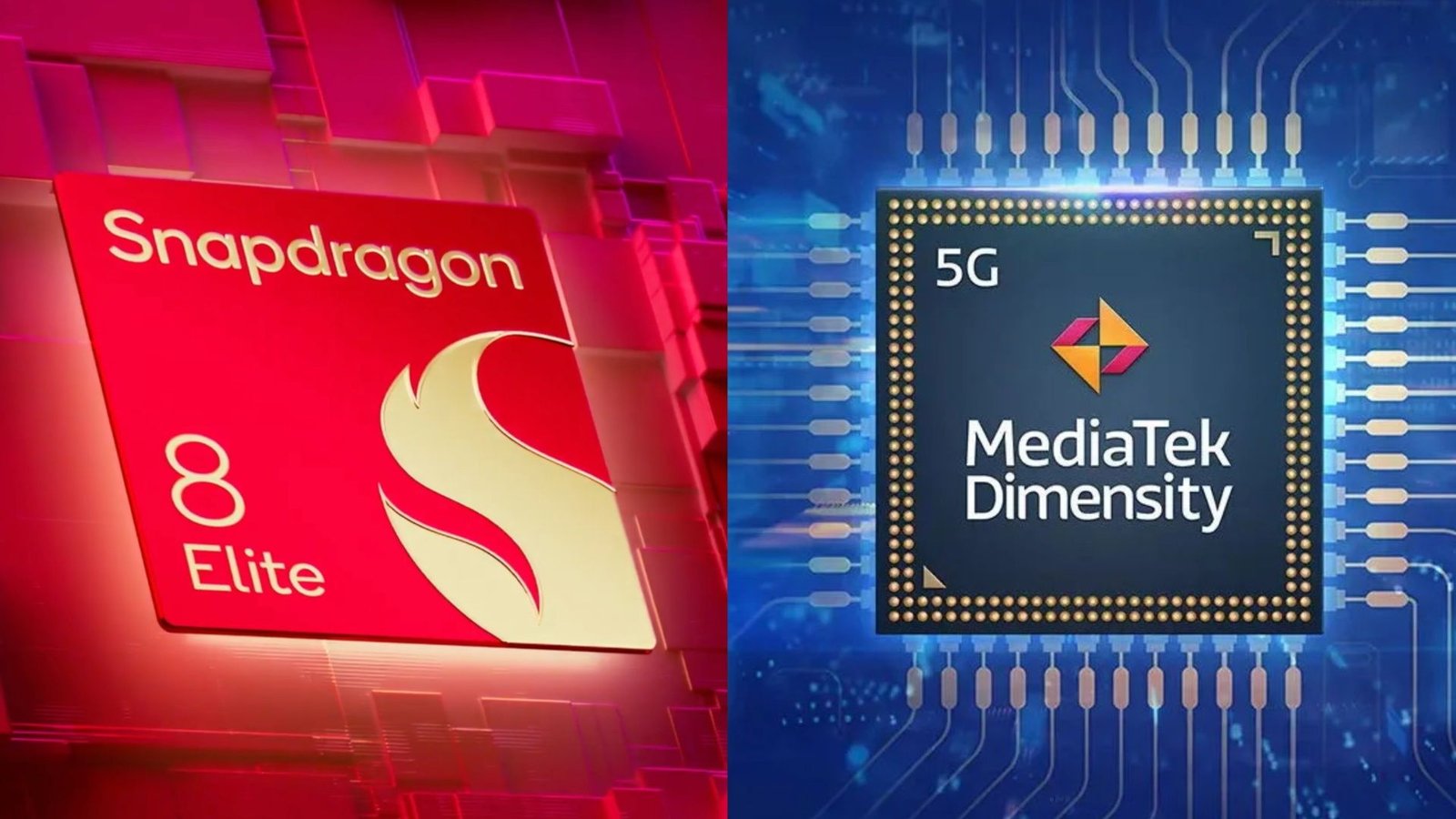
Smartphone processors have become one of the most important factors when choosing a new mobile phone. They affect everything from app performance and gaming to battery life, camera processing, artificial intelligence (AI), 5G connectivity and overall responsiveness.
Two of the biggest names in the Android chipset market are Qualcomm Snapdragon and MediaTek Dimensity. Both companies now offer powerful flagship processors, as well as chips designed for premium, mid-range and budget smartphones.
As of September 2026, the flagship competition has moved into a new generation. Qualcomm has introduced the Snapdragon 8 Elite Gen 6 and Snapdragon 8 Elite Extreme Gen 6, while MediaTek has introduced the Dimensity 9600 Pro, its new 2nm flagship smartphone chipset.
Snapdragon vs MediaTek: What Is the Difference?
Snapdragon is Qualcomm’s family of mobile platforms, while Dimensity is MediaTek’s smartphone chipset family. Both integrate several important components into a single system-on-chip (SoC), including the CPU, GPU, AI processing hardware, image processor, modem and connectivity technologies.
The difference between the two brands is not simply about which logo appears on the processor. Different generations and models use different CPU architectures, GPUs, manufacturing processes, AI engines, modems and software technologies.
Therefore, comparing a specific Snapdragon processor with a specific Dimensity processor is more useful than saying that one company is always better than the other.
Latest Snapdragon Mobile Chipsets in 2026
Qualcomm’s latest premium smartphone generation is the Snapdragon 8 Elite Gen 6 family. On September 22, 2026, Qualcomm announced both the Snapdragon 8 Elite Extreme Gen 6 and Snapdragon 8 Elite Gen 6 for next-generation flagship smartphones.
The Snapdragon 8 Elite Gen 6 is built around Qualcomm’s custom Oryon CPU, a redesigned Adreno GPU and a Hexagon NPU for AI processing. Qualcomm says the platform is designed for advanced on-device AI, gaming, imaging and connectivity.
The previous Snapdragon 8 Elite Gen 5 remains important because it is already used in flagship smartphones. It introduced third-generation Oryon CPU technology, advanced Adreno graphics, enhanced AI processing and the X85 5G modem. Qualcomm lists CPU speeds of up to 4.74 GHz for applicable versions and peak cellular download speeds of up to 12.5 Gbps.
Latest MediaTek Mobile Chipset in 2026
MediaTek’s newest flagship smartphone processor is the Dimensity 9600 Pro, officially announced on September 15, 2026.
One of its most notable features is its 2nm manufacturing process. The chipset uses a 2+3+3 all-big-core CPU configuration consisting of two Arm C2-Ultra cores and six C2-Pro cores. MediaTek states that the CPU can reach up to 4.55 GHz on the Ultra cores.
The Dimensity 9600 Pro also introduces dual-NPU architecture, LPDDR6 memory support and UFS 5.0 storage support. MediaTek says its new NPU 1090 is designed for generative and agentic AI workloads, while a separate Super Efficient NPU is intended for lower-power, always-on AI tasks.
Snapdragon 8 Elite Gen 6 vs Dimensity 9600 Pro
| Feature | Snapdragon 8 Elite Gen 6 | MediaTek Dimensity 9600 Pro |
|---|---|---|
| Generation | 2026 flagship generation | 2026 flagship generation |
| CPU | Custom Qualcomm Oryon CPU | Arm C2-Ultra and C2-Pro all-big-core design |
| Process | 2nm | 2nm |
| AI | Hexagon NPU and on-device AI technologies | Dual-NPU architecture and Dimensity Agentic AI Engine |
| GPU | Next-generation Adreno GPU | Arm Mali-G2 Ultra NX |
| Memory | Platform-dependent | LPDDR6 and LPDDR5X |
| Storage | Platform-dependent | UFS 5.0 |
| 5G | Advanced Qualcomm modem-RF system | Integrated 5G Advanced modem |
| Wi-Fi | Advanced Wi-Fi connectivity | Wi-Fi 7 |
Note: Smartphone manufacturers can implement different memory, storage, cooling, camera and connectivity configurations. Therefore, the specifications of the final phone may differ from the maximum capabilities of the chipset.
Snapdragon vs MediaTek for Gaming
Gaming performance depends on more than CPU clock speed. The GPU architecture, thermal design, sustained power consumption, memory bandwidth, software optimization and game-engine support all affect the experience.
Qualcomm’s Snapdragon flagship platforms use Adreno GPUs and include technologies aimed at high-end mobile gaming. The Snapdragon 8 Elite Gen 5, for example, supports advanced Unreal Engine 5 features, mesh shading and hardware-accelerated ray tracing technologies.
MediaTek is also targeting high-end gaming with its Dimensity flagship processors. The Dimensity 9600 Pro uses the Mali-G2 Ultra NX GPU and MediaTek’s Neural Graphics Architecture, which combines GPU and AI processing. MediaTek reports up to 27% higher peak GPU performance, 24% better peak-performance power efficiency and 18% faster ray tracing compared with its previous flagship generation.
For gamers, the actual phone is therefore just as important as the chipset. A smartphone with a large vapor chamber and good sustained cooling can perform differently from another phone using the same processor.
Snapdragon vs MediaTek for AI
AI has become a major part of modern smartphone processors. Current flagship SoCs are designed to run increasingly sophisticated AI tasks directly on the device rather than relying entirely on cloud processing.
Qualcomm’s latest Snapdragon 8 Elite generation combines its Oryon CPU, Adreno GPU and Hexagon NPU to support on-device AI workloads. Qualcomm also highlights AI-assisted graphics, camera processing and personalized AI experiences as major capabilities of its latest platform.
The Dimensity 9600 Pro takes a different architectural approach by combining a high-performance NPU 1090 with a Super Efficient NPU. MediaTek says the NPU 1090 provides higher token-generation efficiency and supports complex on-device AI applications, while the secondary NPU is designed for lower-power background AI processing.
Snapdragon vs MediaTek for Camera Performance
A smartphone’s camera quality cannot be judged by the chipset alone. The camera sensor, lens, optical stabilization, image-processing algorithms and manufacturer’s tuning are also critical.
However, the ISP and AI hardware inside the SoC play an important role in computational photography. Qualcomm’s latest flagship platforms include advanced Spectra imaging technology, while MediaTek’s Dimensity 9600 Pro uses the Imagiq 1290 ISP together with its AI Imaging Fusion Architecture.
The Dimensity 9600 Pro supports features including 8K video capture, 4K120 video and up to 4K240 slow-motion capture, depending on the device implementation. MediaTek also highlights AI-assisted subject tracking and advanced HDR imaging capabilities.
Which Is Better for Battery Life?
Battery life depends on the entire smartphone design rather than the processor alone. Display resolution, refresh rate, battery capacity, modem usage, cooling, software optimization and application behavior can all have a major effect.
Modern flagship chips from both companies are increasingly focused on performance-per-watt rather than raw performance alone. The Dimensity 9600 Pro uses a 2nm process and includes dedicated efficiency-focused AI hardware, while Qualcomm’s latest Snapdragon generation also emphasizes power efficiency alongside performance and AI capabilities.
For buyers, it is therefore better to check independent battery tests of the exact smartphone rather than selecting a phone solely because it has a Snapdragon or Dimensity processor.
Snapdragon vs MediaTek in 5G and Connectivity
Connectivity is another major component of a modern mobile SoC. Qualcomm’s Snapdragon flagship platforms integrate advanced modem-RF technology and Wi-Fi connectivity. The Snapdragon 8 Elite Gen 5, for example, includes the Qualcomm X85 5G Modem-RF system and FastConnect 7900.
The Dimensity 9600 Pro integrates a 5G Advanced modem supporting sub-6 GHz carrier aggregation and also supports Wi-Fi 7. MediaTek lists up to 7.3 Gbps Wi-Fi data rates and 5G capabilities designed for high-speed connectivity.
Network performance in Pakistan or another specific country can still vary because supported bands, carrier aggregation, modem configuration and network infrastructure depend on the individual smartphone and mobile operator.
Snapdragon vs MediaTek: What About Mid-Range Phones?
The Snapdragon vs MediaTek comparison is not limited to flagship smartphones. Both companies offer processors across multiple price categories.
Qualcomm’s Snapdragon family includes different series designed for premium, mid-range and entry-level smartphones. MediaTek similarly offers Dimensity processors across flagship, premium and mainstream devices.
For a mid-range smartphone, the exact chipset model is especially important. A newer mid-range processor can outperform an older flagship processor in some workloads while offering newer connectivity, AI or efficiency features.
When comparing phones, buyers should therefore compare the complete processor model and generation instead of simply looking for the words Snapdragon or MediaTek.
How to Choose Between Snapdragon and MediaTek
There is no universal answer because the best processor for a particular user depends on the smartphone and intended workload.
- For heavy gaming: Compare GPU performance, sustained performance, thermal management and game optimization.
- For AI features: Look at the NPU, supported AI models and the manufacturer’s software implementation.
- For photography: Compare the ISP capabilities, camera sensors and actual camera reviews.
- For battery life: Check independent battery tests and the phone’s overall hardware configuration.
- For 5G: Check the exact modem, supported bands and carrier compatibility in your country.
- For long-term use: Consider software updates, storage, RAM, cooling and the manufacturer’s support policy in addition to the processor.
Are Snapdragon Phones Always Better Than MediaTek Phones?
No. The brand name alone does not determine smartphone performance.
Both Qualcomm and MediaTek produce high-end processors capable of supporting demanding gaming, advanced AI, high-resolution cameras and fast connectivity. The actual experience depends on the processor generation, smartphone design, cooling system, software optimization and other hardware components.
For example, the current flagship competition includes Qualcomm’s 2nm Snapdragon 8 Elite Gen 6 family and MediaTek’s 2nm Dimensity 9600 Pro, showing how closely the two companies are competing at the top end of the smartphone market.
What Should You Check Before Buying a Phone?
Instead of choosing a smartphone only because it has Snapdragon or MediaTek branding, check these specifications:
- Exact chipset model and generation
- CPU architecture and clock speeds
- GPU and gaming features
- AI/NPU capabilities
- 5G modem and supported bands
- RAM type and capacity
- Storage type
- Battery capacity and charging technology
- Cooling system
- Software update policy
This approach provides a much more accurate picture of real-world smartphone performance than comparing processor brands alone.
Final Thoughts
The Snapdragon vs MediaTek competition has become increasingly close at the flagship level. In September 2026, Qualcomm’s latest Snapdragon 8 Elite Gen 6 family and MediaTek’s Dimensity 9600 Pro represent the newest generation of high-end smartphone silicon, with both companies focusing heavily on AI, gaming, efficiency, imaging and advanced connectivity.
For consumers, the most important lesson is simple: do not choose a phone based only on the chipset brand. Compare the exact processor, phone cooling system, camera hardware, battery, software optimization, network compatibility and price together.
As mobile processors continue moving toward smaller manufacturing nodes and more powerful on-device AI, the difference between flagship Snapdragon and Dimensity platforms is increasingly determined by individual implementations and the features that matter most to the user.
Frequently Asked Questions
Is Snapdragon better than MediaTek?
Neither brand is universally better. Both Qualcomm Snapdragon and MediaTek Dimensity include processors ranging from entry-level to flagship tiers. The exact chipset generation and smartphone implementation are more important than the brand name.
What is the latest Snapdragon chipset in 2026?
As of September 23, 2026, Qualcomm’s latest announced flagship mobile platforms are the Snapdragon 8 Elite Extreme Gen 6 and Snapdragon 8 Elite Gen 6, announced on September 22, 2026.
What is the latest MediaTek Dimensity chipset?
As of September 23, 2026, MediaTek’s latest announced flagship smartphone chipset is the Dimensity 9600 Pro, which was introduced on September 15, 2026.
Is MediaTek good for gaming?
Yes. MediaTek’s current flagship Dimensity processors include high-performance GPUs, ray-tracing capabilities and gaming optimization technologies. The Dimensity 9600 Pro, for example, uses the Mali-G2 Ultra NX GPU and supports advanced gaming features.
Is Snapdragon good for gaming?
Yes. Snapdragon’s flagship platforms use Adreno GPUs and include technologies designed for demanding mobile gaming, including advanced graphics, ray tracing and Unreal Engine support.
Does the processor affect battery life?
Yes, but it is only one factor. Display technology, battery capacity, software optimization, modem usage, cooling and applications can significantly affect actual battery endurance.
Should I buy a Snapdragon or MediaTek phone?
Compare the exact phones and processors rather than choosing solely by brand. Look at performance, gaming, battery life, cameras, connectivity, software support and price to determine which device fits your requirements.
