


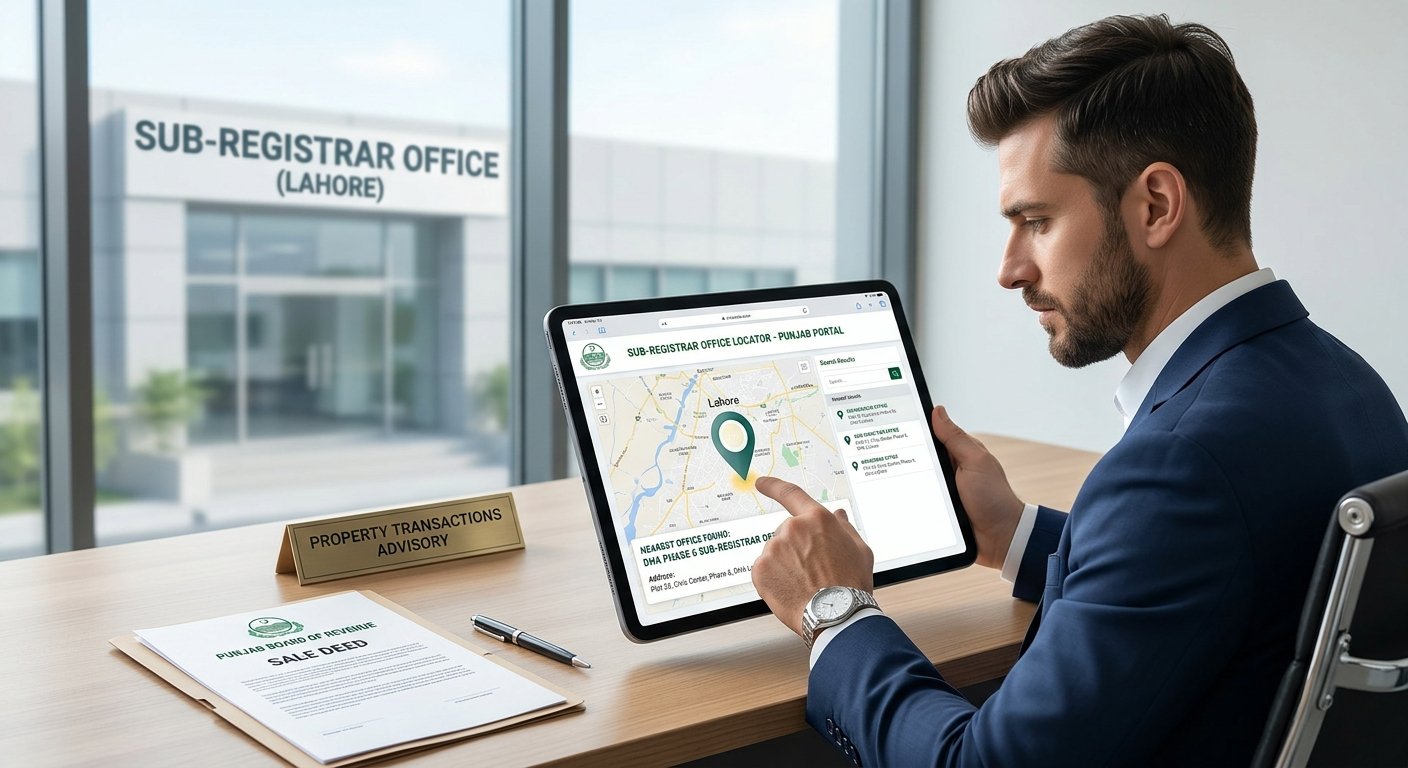
Finding the correct Sub-Registrar Office is an important step when buying, selling, gifting, mortgaging or transferring property in Pakistan. Submitting a deed to an office that does not have jurisdiction over the property can cause delays and may require you to visit another office.
In most ordinary property-registration cases, the relevant office is identified by the location of the property, not by the buyer’s or seller’s home address. However, registration arrangements differ across provinces and territories. Always confirm the exact jurisdiction with the local registration authority before preparing your final visit.
What Is a Sub-Registrar Office?
A Sub-Registrar Office (SRO) is a government office responsible for registering documents covered by the registration laws, including many instruments that create, transfer, declare or extinguish rights in immovable property. Depending on the area, the office may be organised by a sub-district, tehsil, town, revenue estate or another notified jurisdiction.
Property registration and land-record services are related but are not always handled by the same office. For example, an Arazi Record Centre in Punjab provides land-record services, while deed registration follows the relevant registration process and the jurisdiction of the registering officer.
Which Sub-Registrar Office Has Jurisdiction Over Your Property?
Section 28 of the Registration Act, 1908 provides the general rule for documents relating to land: a document affecting immovable property is ordinarily presented at the office of the Sub-Registrar within whose sub-district the whole or some part of the property is situated. The applicable provincial amendments, rules, notifications and administrative arrangements should also be checked.
This means that the property’s actual location is the starting point. A person living in Lahore who buys a property in Faisalabad should not automatically assume that the Lahore Sub-Registrar Office can register the deed. The relevant office will generally be the one whose notified jurisdiction covers the Faisalabad property.
How to Find the Relevant Sub-Registrar Office
1. Identify the exact location of the property
Collect the complete property address and identifying details before searching. Depending on the type of property and location, these may include:
- Province and district
- Tehsil, town or sub-district
- Village, mauza or deh name
- Housing society, sector, block and plot number
- Khasra, khata, khewat or survey number, where applicable
- Existing registry or ownership-document details
A society name or postal address alone may not be enough. Revenue identifiers such as mauza, deh, khasra or survey number can help the registration office establish the correct jurisdiction.
2. Check the property documents
Review the previous sale deed, registered conveyance, allotment or transfer documents, fard, mutation record and other available ownership papers. Look for the district, tehsil, revenue estate, registration office name, book or document number and date of registration.
An earlier deed can provide a useful clue, but do not rely on it as the only proof of the current office jurisdiction. Administrative boundaries and office arrangements can change, and a previous document may have been registered under an earlier arrangement.
3. Contact the local District Registrar or registration branch
Contact the District Registrar, the relevant registration branch of the district administration, or the office of the Sub-Registrar serving the property’s area. Provide the complete address and revenue identifiers and ask this specific question: “Which Sub-Registrar Office currently has jurisdiction to register a deed for this property?”
Ask the official to confirm the office name, address, working hours, required appointment or online process, and whether the deed must be initiated through a provincial e-registration system. Where possible, obtain the information from an official government website, written response or published notification.
4. Use the relevant provincial or territorial government portal
Online services can help you identify the correct department, check land records or understand the registration process. Their functions are not identical: a land-record search portal may not provide a definitive SRO jurisdiction decision for every property.
- Punjab: Visit the Punjab Land Records Authority (PLRA) website for land-record and registry services. Its service-centre locator helps users find Arazi Record Centres. Confirm separately which Sub-Registrar has jurisdiction over the property and do not assume an Arazi Record Centre is the deed-registration office.
- Sindh: Use the Sindh Zameen portal of the Board of Revenue for available land records, registry-related services, registration checklists and active-centre information. If the portal does not clearly identify the SRO for your property, confirm with the relevant Sub-Registrar or Board of Revenue office.
- Khyber Pakhtunkhwa: Check the KP e-Stamping and E-Registration system and contact the relevant district registration authorities for the current office and process. Availability of online services may vary by location.
- Islamabad Capital Territory: The ICT Administration deed-registration guidance currently directs applicants to the Sub-Registrar Office at F-8 Markaz, Islamabad. Confirm the latest instructions and requirements with ICT Administration before visiting.
- Balochistan and other areas: Contact the district administration, Board of Revenue or local registration authority to confirm the notified Sub-Registrar jurisdiction and current registration arrangements. Do not rely on an office list for another province.
5. Verify the office before paying fees or signing the final deed
Before paying substantial transaction costs, arranging witnesses or taking time off work, contact the office and confirm that it accepts deeds for the property’s exact location. Share the plot number and revenue identifiers, not just the name of the housing society.
Also ask whether the deed needs an online application, e-stamp, challan, tax payment, no-objection certificate or any other location-specific document. Requirements can differ according to the property type, transaction and local rules.
Information to Keep Ready When Contacting the Office
Keep the following details available so the official can identify the property accurately:
- Full property address and plot or house number
- District and tehsil or town
- Mauza, deh, village or revenue estate, if applicable
- Khasra, khata, khewat or survey number, if available
- Copy or details of the previous registered deed
- Housing society name and allotment or transfer details, where relevant
- Nature of the transaction, such as sale, gift, mortgage or lease
You may initially ask for jurisdiction guidance without sending sensitive identity documents through unofficial channels. Provide CNIC copies or original documents only through the officially required process.
Example: Finding the Office for a Property in Faisalabad
Suppose a buyer lives in Lahore but is purchasing a house in a housing society in Faisalabad. The buyer should first identify the property’s exact district, tehsil, revenue estate and plot details. The buyer should then contact the relevant Faisalabad registration branch or District Registrar and ask which Sub-Registrar Office covers that specific location.
Searching only for “Sub-Registrar Office Faisalabad” may show several offices or general government locations. It does not necessarily prove which office has jurisdiction over a particular plot. The property identifiers must be checked against the current notified jurisdiction.
Are the Sub-Registrar Office and Land Record Centre the Same?
No. Their responsibilities can be connected, but they are not automatically interchangeable. A Sub-Registrar registers documents under the applicable registration law. A land-record centre may provide services such as ownership-record searches, fards, mutations or other revenue-record functions, depending on the province and service arrangement.
In Punjab, for example, PLRA operates Arazi Record Centres and provides digital land-record and registry-related services. You should still confirm where the deed-registration step for your specific property is handled. Visiting the nearest land-record centre does not, by itself, establish that it is the correct Sub-Registrar Office.
Can You Register Property at Any Sub-Registrar Office?
Generally, no. Section 28 of the Registration Act, 1908 sets the location-based rule for documents relating to land. Section 30 gives a Registrar certain powers to receive and register documents that could be registered by a subordinate Sub-Registrar and, in specified circumstances, to register a document without regard to the property’s location if the Registrar is satisfied that sufficient cause exists.
These provisions should not be treated as permission to choose any convenient office. Whether an exception applies is a matter for the competent Registrar under the applicable law and current local procedure. Confirm the correct route with the registration authority or a qualified property lawyer.
Common Mistakes to Avoid
- Choosing the office nearest to your home: The buyer’s or seller’s residence does not normally determine the property’s registration jurisdiction.
- Relying only on Google Maps: A map can show an office location, but it cannot reliably establish its legal jurisdiction over a particular plot.
- Confusing an Arazi Record Centre with an SRO: Land-record services and deed registration may be handled through different offices or steps.
- Using an old office list: District boundaries, office names and administrative arrangements can change.
- Providing an incomplete address: A society or block name may not be enough to identify the relevant revenue estate or sub-district.
- Assuming an old registry settles the question: Use previous documents as supporting information, then verify the current jurisdiction.
Frequently Asked Questions
How do I find the Sub-Registrar Office for my property?
Identify the property’s district, tehsil, revenue estate and plot details. Then check the relevant provincial portal and confirm the current jurisdiction with the District Registrar or local registration branch.
Is the Sub-Registrar Office selected according to the buyer’s address?
Ordinarily, no. For documents relating to land, Section 28 of the Registration Act, 1908 generally links the registration office to the sub-district where the property, or part of it, is situated.
Can I use an online land-record portal to identify the correct SRO?
Online portals can help you find ownership records, registry information, service centres and registration guidance. However, not every portal provides a complete, definitive jurisdiction lookup. Confirm the exact office with the registration authority.
Does every housing society have a separate Sub-Registrar Office?
No. A housing society is not necessarily a separate registration jurisdiction. The relevant office depends on the officially notified sub-district or other applicable jurisdiction covering the land.
What if my property is near the boundary of two jurisdictions?
Do not guess based on the nearest office. Provide the property’s revenue identifiers and documents to the District Registrar or competent registration authority and request confirmation of the office with jurisdiction.
Can the Registrar allow registration at another office?
Section 30 of the Registration Act, 1908 provides certain powers to a Registrar, including a limited discretion in cases where sufficient cause is established. It is not an automatic right to register at any office. Ask the competent Registrar about the applicable procedure.
Final Checklist Before Visiting the Sub-Registrar Office
- Confirm the property’s exact district, tehsil and revenue location.
- Keep the previous registry and available land-record details ready.
- Confirm the current SRO jurisdiction with the registration authority.
- Verify the office address, timings and whether an appointment is required.
- Ask about e-registration, e-stamp, taxes, challans and supporting documents.
- Check the latest official requirements before making payment or attending.
Conclusion: The safest way to find the relevant Sub-Registrar Office in Pakistan is to start with the property’s exact location, check the applicable government land or registration portal, and obtain confirmation from the District Registrar or local registration branch. Do not select an office only because it is nearby or because it handled an earlier transaction. A short jurisdiction check before the visit can help prevent unnecessary delays and complications.
Note: This article provides general information, not individual legal advice. Registration procedures, office jurisdictions and online services may change. Confirm the current requirements with the competent provincial or territorial authority before proceeding with a property transaction.
