


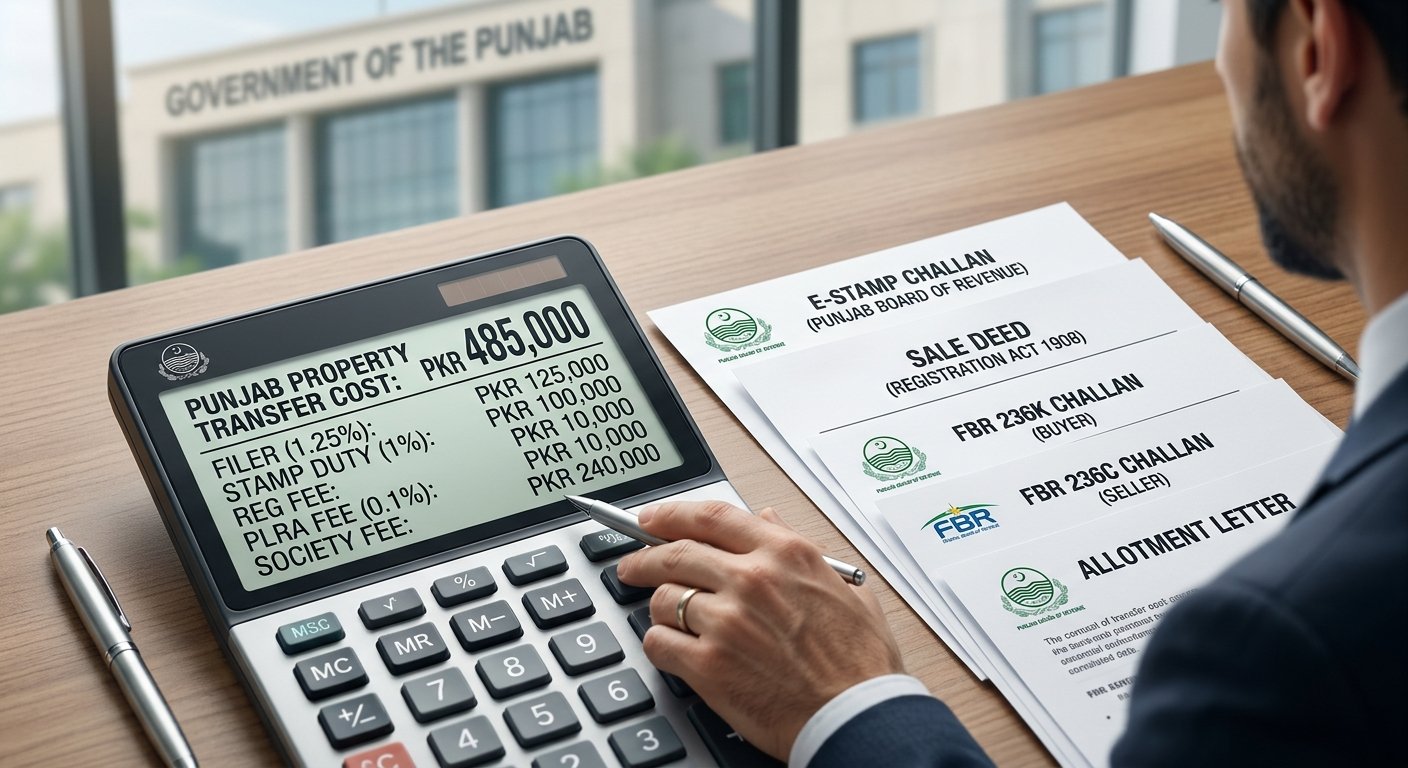
Buying or selling a property in Punjab involves more than agreeing on the sale price. Buyers and sellers may have to pay stamp duty, Federal Board of Revenue (FBR) advance tax, registration and land-record service charges, mutation fees, and other applicable government or housing society charges.
Understanding these expenses before signing a sale agreement can help you prepare a realistic budget and avoid unexpected costs. This guide explains how to calculate property transfer costs in Punjab, Pakistan, using the latest available information for 2026–27.
Important: The exact amount depends on the property location, its official valuation, transaction type, tax status of the buyer and seller, and the charges shown on the government challan. Treat the official e-Stamp and registration challan as the final calculation.
What Are Property Transfer Costs in Punjab?
Property transfer costs are the taxes, duties and service fees associated with legally transferring ownership from a seller to a buyer. The main charges may include:
- Stamp duty: A provincial government duty on the property transfer instrument.
- FBR advance tax under Section 236K: Collected from the buyer when purchasing or transferring immovable property.
- FBR advance tax under Section 236C: Collected from the seller when selling or transferring immovable property.
- PLRA e-registration service charge: A fee for processing eligible land-sale registration transactions.
- Mutation fee: A land-record service charge for recording the change of ownership.
- Other applicable charges: Registration-related government dues, local charges, capital value tax where applicable, and housing society or development authority transfer fees.
Property Transfer Charges in Punjab in 2026–27
The following table summarises commonly relevant charges. Some duties depend on the property and transaction category, so the e-Stamp system should be used to confirm the exact payable amount.
| Charge | Who generally pays | Latest available rate or basis |
|---|---|---|
| Stamp duty | Usually buyer, subject to agreement and applicable law | 1% under the 2026 Punjab amendment framework; confirm the applicable deed category on the challan |
| FBR Section 236K | Buyer | 1.25% for an ATL filer; non-ATL rates depend on property value |
| FBR Section 236C | Seller | 2.75% for an ATL filer; 11.5% for a non-ATL person under the Tax Year 2027 rate card |
| PLRA e-registration service charge | Transaction applicant, as applicable | 0.1% of land value, subject to a minimum of Rs. 3,600 for sale/purchase transactions |
| Ordinary mutation service fee | Applicant | Rs. 1,200 |
| Express mutation service fee | Applicant | Rs. 11,200 |
| Housing society transfer fee | As determined by society rules or agreement | Varies by society and property |
PLRA announced revised service charges for FY 2026–27, including the e-registration and mutation charges shown above. FBR’s Tax Year 2027 rate card should be consulted for the applicable advance tax. PLRA fee update reported by Associated Press of Pakistan and FBR withholding tax rate cards.
1. How to Calculate Stamp Duty in Punjab
Stamp duty is a provincial charge applied to property transfer documents. Under the Punjab Stamp (Amendment) Ordinance 2026, the rate was standardised at 1% for urban and rural immovable property conveyances. The amount payable should still be confirmed for the specific transaction through the official e-Stamp system, particularly where a different instrument or property category is involved.
For a simple estimate, if the applicable stamp duty is 1% and the chargeable value is Rs. 10,000,000, the calculation is:
Rs. 10,000,000 × 1% = Rs. 100,000
Do not assume that the price written in the sale agreement is automatically the value used for every government charge. The relevant valuation can depend on the declared consideration, District Collector (DC) valuation, FBR valuation and the rules applicable to each tax or duty.
2. FBR Tax on Property Purchase – Section 236K
Section 236K of the Income Tax Ordinance provides for advance tax collected from the buyer when immovable property is purchased or transferred. The applicable rate depends on the buyer’s tax status and the property’s fair market value.
| Buyer tax status | Property value | Tax rate |
|---|---|---|
| ATL filer | Applicable value bands | 1.25% |
| Non-ATL person | Up to Rs. 50 million | 10.5% |
| Non-ATL person | Above Rs. 50 million up to Rs. 100 million | 14.5% |
| Non-ATL person | Above Rs. 100 million | 18.5% |
For example, if the applicable fair market value is Rs. 10 million and the buyer is on the Active Taxpayer List (ATL), the estimated advance tax is:
Rs. 10,000,000 × 1.25% = Rs. 125,000
Check the current FBR rate card and the buyer’s status before calculating the amount. A late filer or a person not appearing on the ATL may not qualify for the ATL rate. View the FBR Tax Year 2027 rate card.
3. FBR Tax on Property Sale – Section 236C
Section 236C applies to advance tax collected from the seller when property is sold or transferred. For Tax Year 2027, the ATL rate is 2.75% of the gross consideration received. The non-ATL rate is 11.5%.
For example, if a seller transfers a property for Rs. 10 million and is on the ATL, the estimated advance tax is:
Rs. 10,000,000 × 2.75% = Rs. 275,000
This is the seller’s advance tax and should not automatically be added to the buyer’s transfer-cost total. The seller may also have a separate capital gains tax liability depending on the acquisition date, disposal date, property type and applicable tax rules. Advance tax collected at transfer and final tax liability are not necessarily the same thing.
4. PLRA E-Registration and Mutation Fees
The Punjab Land Records Authority (PLRA) manages important land-record and registration services. For FY 2026–27, the revised PLRA service schedule sets the e-registration service charge for sale and purchase transactions at 0.1% of land value, subject to a minimum of Rs. 3,600.
PLRA’s revised service charges also include:
- Ordinary mutation: Rs. 1,200.
- Mutation through banks: Rs. 2,100.
- Express mutation: Rs. 11,200.
- Property Transfer System transaction for housing societies and development authorities: Rs. 3,000.
These are PLRA service charges, not a complete list of all government taxes or duties. Visit the official Punjab Land Records Authority website for current services and procedures.
5. Other Charges You Should Check
Some property transactions may involve charges beyond stamp duty, FBR advance tax and PLRA service fees. Check the following before making payment:
- Capital Value Tax (CVT): Confirm whether it applies to your property and transaction type, and at what rate. Do not assume that it is automatically included or excluded.
- Registration fee and other government dues: These depend on the instrument and applicable provincial rules. Check the generated challan.
- Local or municipal charges: The applicable local authority may impose charges depending on the property and transaction.
- Housing society transfer fee: Private societies and development authorities may have their own transfer, membership, verification or documentation charges.
- Outstanding dues: Check property tax, utility bills, development charges and any society dues before completing the transaction.
The Punjab e-Stamp system calculates stamp duty, CVT and other applicable charges from the details entered for the transaction. Read the official PLRA e-Stamping guidance.
Example: Property Transfer Cost on a Rs. 1 Crore Property
Consider a property with an assumed chargeable value of Rs. 10 million (Rs. 1 crore). The buyer and seller are both ATL filers. For illustration, assume the 1% stamp duty applies and the PLRA e-registration charge is 0.1% of the same value.
Estimated buyer-side charges
| Charge | Calculation | Estimated amount |
|---|---|---|
| Stamp duty | 1% × Rs. 10,000,000 | Rs. 100,000 |
| FBR 236K | 1.25% × Rs. 10,000,000 | Rs. 125,000 |
| PLRA e-registration | 0.1% × Rs. 10,000,000 | Rs. 10,000 |
| Illustrative subtotal | Rs. 235,000 |
The Rs. 235,000 subtotal is an illustration, not a final payable bill. It excludes any applicable CVT, registration fee, mutation charge, local dues, society transfer fee, legal or documentation expenses, and other charges not included in the assumptions.
Estimated seller-side advance tax
| Charge | Calculation | Estimated amount |
|---|---|---|
| FBR 236C | 2.75% × Rs. 10,000,000 | Rs. 275,000 |
The seller’s advance tax is shown separately because it is not ordinarily the buyer’s transfer expense. The parties should clearly agree in writing who will bear any costs that are negotiable between them.
How to Calculate Property Transfer Costs Step by Step
- Confirm the property details: Identify the district, tehsil, location, area, property type and ownership record.
- Check the official valuation: Use the PLRA DC Valuation service and check the applicable FBR valuation where required.
- Confirm the buyer’s and seller’s tax status: Check ATL status and the relevant FBR rate for each party.
- Calculate the provincial duties: Confirm stamp duty, CVT where applicable, registration fee and other government dues.
- Add PLRA service charges: Include the applicable e-registration and mutation fees.
- Check society charges: If the property is in a private housing scheme or development authority, obtain its current transfer fee schedule.
- Generate the official challan: Enter the correct details in the relevant Punjab e-Stamp or e-Registration process and review the payable amount.
- Complete registration and mutation: Follow the Sub-Registrar and land-record process, including required identity and biometric verification.
How to Check Property Valuation in Punjab Online
The Punjab Land Records Authority provides an online DC Valuation service. The notified value can vary according to the property’s location, land type, area and category.
- Open the PLRA DC Valuation page.
- Select or enter the required location and property details.
- Provide the land type, area and category as requested.
- Review the valuation shown for the relevant property details.
- Use the applicable valuation information when checking the government charges and challan.
Documents Required for Property Transfer
Requirements can vary depending on the property, ownership record and transaction type. Commonly requested documents include:
- Original CNICs and copies of the buyer and seller.
- Current ownership record or Fard.
- Previous registered sale deed or ownership documents.
- Sale agreement or other relevant transaction documents.
- Paid e-Stamp challan and applicable tax payment evidence.
- Property details, such as Khewat, Khasra or registry information, where relevant.
- Photographs, biometric verification and witness details where required.
- Society no-objection certificate or clearance documents, if applicable.
Ask the relevant Arazi Record Center, Sub-Registrar or housing society for the complete checklist before visiting, as additional documents may be required in specific cases.
Registry vs Mutation: What Is the Difference?
A registry is the registered legal instrument recording a property transaction. Mutation, also called Intiqal, is the process of updating the relevant land record to reflect the change in ownership. They are related but are not interchangeable terms.
After completing the transaction, verify that the registered deed and the updated land record correctly show the buyer’s ownership. PLRA provides guidance about property registry and its Property Transfer System.
Important Tips to Avoid Extra Property Transfer Costs
- Verify ownership and check for disputes, mortgages, liens or other restrictions before paying an advance.
- Use official valuation and challan systems rather than relying only on verbal estimates.
- Check the ATL status of both parties before the transaction date.
- Ask the society for a written statement of all transfer and outstanding charges.
- Keep copies of paid challans, receipts, the registered deed and updated ownership record.
- Do not understate the sale price or provide incorrect property details to reduce taxes; inaccurate declarations can create legal and financial problems.
- Consult a qualified property lawyer or tax professional for high-value, inherited, gifted, jointly owned or disputed property.
Frequently Asked Questions
How much does it cost to transfer property in Punjab?
There is no single fixed amount for every property. Costs depend on the applicable stamp duty, FBR buyer tax, registration and PLRA charges, mutation fee, any CVT or local dues, and housing society fees. Generate the official challan for the exact amount.
What is the stamp duty on property in Punjab in 2026?
The Punjab Stamp (Amendment) Ordinance 2026 standardised stamp duty at 1% for urban and rural immovable property conveyances. Confirm the rate for your specific deed and transaction through the official e-Stamp system.
What is the FBR tax for a property buyer in 2026–27?
For Tax Year 2027, the FBR rate card lists 1.25% under Section 236K for an ATL filer. Non-ATL rates vary by the fair market value band of the property. Check the current FBR rate card before payment.
What is the FBR tax for a property seller in 2026–27?
The Tax Year 2027 ATL rate under Section 236C is 2.75% of the gross consideration received. The non-ATL rate is 11.5%. A separate capital gains tax liability may also need to be considered.
What is the PLRA mutation fee in Punjab?
The revised FY 2026–27 PLRA service charges list Rs. 1,200 for ordinary mutation, Rs. 2,100 for mutation through banks and Rs. 11,200 for express mutation.
Can I calculate property transfer costs online?
You can check DC valuation through the PLRA website and use the Punjab e-Stamp and e-Registration process to generate the relevant challan. The challan provides the official payable amount based on the details entered.
Does the buyer or seller pay property transfer charges?
Some charges are generally associated with the buyer, such as stamp duty and Section 236K, while Section 236C is collected from the seller. The parties may agree how certain expenses are shared, but that agreement does not change the person legally responsible for a tax.
Conclusion
Calculating property transfer costs in Punjab requires checking more than the sale price. Buyers should consider stamp duty, Section 236K, PLRA e-registration, mutation and any applicable additional charges. Sellers should separately calculate Section 236C and consider any capital gains tax liability.
For an accurate estimate, confirm the property valuation, check both parties’ tax status, obtain the current society fee schedule if applicable, and generate the official government challan before completing the transfer. This helps prevent unexpected expenses and supports a smoother property transaction.
Disclaimer
This article provides general information about property transfer costs in Punjab, Pakistan, based on publicly available information for 2026–27. Tax and provincial fee rules may change, and the applicable amount can depend on the property, location, transaction instrument and parties’ tax status. The official government challan, current law and advice from a qualified legal or tax professional should be relied on for an actual transaction. This article is not legal, tax or financial advice.
