


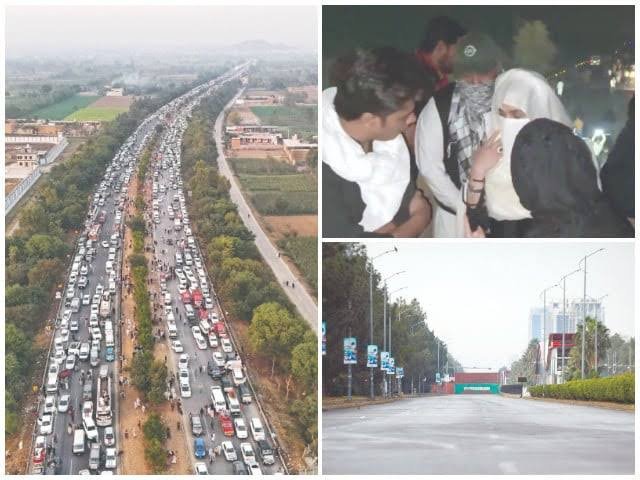
Pakistan’s government has given a strong warning: it will stop political marches from entering Islamabad “in every possible way.” The warning comes as two different parties — PTI and Jamaat-e-Islami (JI) — both plan to bring large crowds to the capital within the same week.
What the Government Said
Interior Minister Mohsin Naqvi held a press conference on Friday and did not hold back. He said the government would not let anyone “take law into hands and close federal capital.” He added: “This time, we are clearly communicating the rules of engagement to our personnel” — meaning security forces know exactly what they’re allowed to do if protesters try to force their way in.
Naqvi said protesters have every right to protest in their own cities and provinces, but said Islamabad cannot be shut down or attacked. He also gave a stern warning to whoever organizes the marches: they would be held responsible for any loss of life during the protests.
Two Marches, Same Week
| Party | March Dates | Main Demand |
|---|---|---|
| Jamaat-e-Islami (JI) | People start arriving Sept 20; march reaches Islamabad Sept 23-24 | End the petroleum levy on fuel, which JI calls a “goon tax” |
| PTI | September 27 | Release of party founder Imran Khan; what PTI calls “supremacy of the Constitution” |
| Farmers’ groups | September 25 | Protest against government agricultural policies |
JI chief Hafiz Naeemur Rehman said people will start heading to Islamabad from all four directions on September 20, with a separate train carrying supporters from Karachi. He said his party isn’t trying to cause trouble: “We are coming to get relief, not to lay hands on anyone.” He also confirmed JI supports PTI’s protest, and that PTI supporters have backed JI’s march in return — showing the two parties are coordinating, even if their specific demands are different.
What Triggered JI’s March
JI says talks with the government about removing the petroleum levy have broken down. Rehman rejected the government’s argument that fuel prices went up simply because of the world market, saying instead that the government is leaning on heavy taxes to hit its revenue targets rather than cutting its own spending. He pointed out that fuel prices in Pakistan have climbed much faster than in neighboring countries recently, hurting poorer and middle-class families who rely on smaller vehicles the most. He called the government’s recent fuel relief package “insufficient” and said it felt more like “charity” than something people are entitled to. Despite the tough talk, he said JI is ready for immediate talks if the government brings real solutions to the table — and on Saturday, the government reached out to JI for another round of negotiations.
The Court’s Ruling on PTI’s March
A day before Naqvi’s press conference, a three-judge Islamabad High Court (IHC) bench issued a detailed, 37-page ruling on PTI’s planned march. The court said:
- No political party has the legal right to block highways, interchanges, or public buildings leading into Islamabad
- Peaceful protest is a constitutional right — but it cannot be used to justify violence, weapons, or blocking roads
- Provincial governments — including chief ministers — must make sure no government vehicles, machinery, or officials are used to help any march toward Islamabad
- No public employee can be forced to take part in a march
Naqvi said the government would fully enforce this order, and warned that anyone violating it could face contempt of court proceedings.
A Difficult Backdrop: An Attack in Kohat
These press conferences happened on the same day as a serious terrorist attack at Kohat Police Lines in Khyber Pakhtunkhwa. An explosives-laden vehicle blew up near a mosque inside the police compound, and armed attackers then tried to storm the facility. Seven attackers took part; six were killed by security forces. In total, 16 people died, including five police officers, and more than 50 people were injured.
Naqvi used this attack to directly criticize PTI, which governs Khyber Pakhtunkhwa. He said security forces were “fighting a war” in the province and suggested the KP government should focus on fighting terrorism instead of “planning how to collect funds, arrange transport and gather people” for a march on Islamabad. He urged PTI’s leadership to “think like patriotic Pakistanis,” and suggested many PTI members might not even fully understand why they’re being asked to march on the capital.
Life in Islamabad During This Period
Naqvi acknowledged that security measures — like placing shipping containers on roads — will cause real inconvenience for Islamabad residents. But he said these steps are necessary to protect the public. For everyday residents, this likely means expecting road closures, traffic delays, and a heavy security presence in the run-up to both the JI march (Sept 20-24) and PTI’s planned protest (Sept 27).
Final Thoughts
With JI’s march starting this weekend, farmers planning their own protest on September 25, and PTI’s bigger march set for September 27, Islamabad is bracing for one of its busiest and most tense stretches in recent memory. The government has made its position clear through both the courts and blunt public warnings — but with JI and PTI now openly supporting each other’s protests, and fresh anger following the Kohat attack, how smoothly (or not) this all plays out over the next ten days remains very much an open question.
