


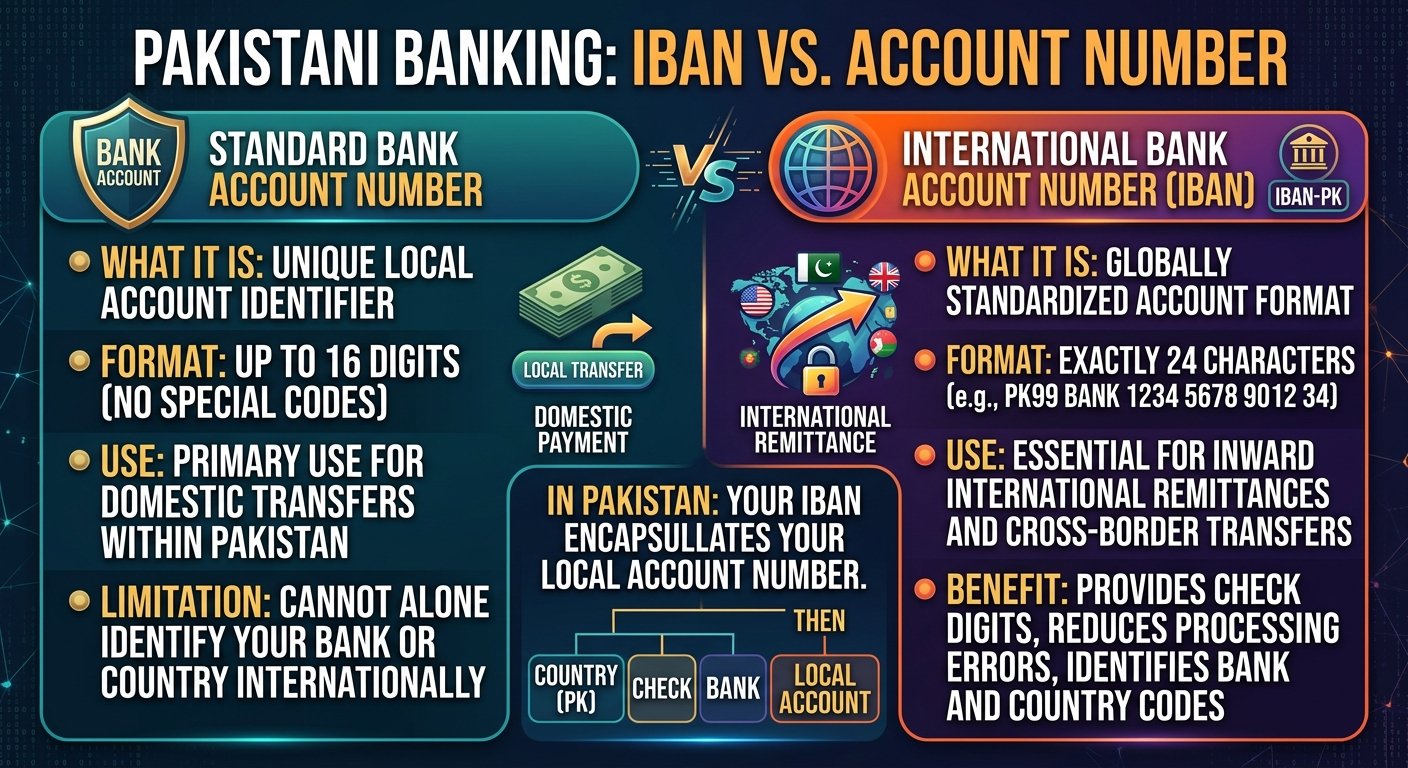
When sending or receiving money through a bank in Pakistan, you may be asked to provide your account number or IBAN. Many people think these two numbers are the same, but they are different. Although both are connected to your bank account, they have different formats and uses.
Your normal bank account number identifies your account within your bank, while an IBAN (International Bank Account Number) provides a standard format that helps banks identify accounts and process payments correctly.
In this guide, we explain the difference between an IBAN and an account number in Pakistan, show their formats, explain when to use each one and answer common questions.
What Is a Bank Account Number in Pakistan?
A bank account number is a unique number assigned to you when you open a bank account. It helps your bank identify your account and manage your money.
Every bank has its own account numbering system. For this reason, account numbers can have different lengths and formats depending on the bank.
For example, you may have an account number with HBL, UBL, Meezan Bank, MCB or Bank Alfalah. Your account number is used to identify your account when making banking transactions.
You can usually find your account number through:
- Your bank’s mobile application.
- Your internet banking account.
- Your bank statement.
- Your cheque book.
- Your bank branch or customer support.
What Is an IBAN Number in Pakistan?
IBAN stands for International Bank Account Number. It is a standard format used to identify bank accounts and make electronic payments more accurate.
In Pakistan, an IBAN contains exactly 24 characters, including letters and numbers. It starts with the letters PK, which represent Pakistan.
Here is an example of a Pakistani IBAN:
PK36SCBL0000001123456702
This is an example format, not a real bank account.
A Pakistani IBAN includes the country code, check digits, bank code and account-related information. These details help banks identify the correct receiving account when processing payments.
The State Bank of Pakistan (SBP) introduced the IBAN system to improve the accuracy and efficiency of local and international bank transfers.
Difference Between IBAN and Account Number in Pakistan
The main difference is that an account number identifies your account within the bank, while an IBAN provides a standard account identification format for electronic payments.
Here is a simple comparison:
| Feature | Account Number | IBAN |
|---|---|---|
| Full Name | Bank Account Number | International Bank Account Number |
| Purpose | Identifies your bank account | Identifies your account in a standard format |
| Length | Depends on the bank | 24 characters in Pakistan |
| Format | Usually numbers | Letters and numbers |
| Country Code | Not included | Starts with PK |
| Bank Code | Not necessarily included | Included |
| Use | Identifies your account within the bank | Used for local and international electronic transfers |
| Changes | Remains the same unless the account changes | Assigned to the corresponding bank account |
In simple words, your account number is your basic bank account identification, while your IBAN is a longer, standardised version used to make payments easier and more accurate.
What Does a Pakistani IBAN Look Like?
A Pakistani IBAN has 24 characters. It contains four main parts, each with a different purpose.
| IBAN Part | Length | Meaning |
|---|---|---|
| PK | 2 letters | Country code for Pakistan |
| Check Digits | 2 numbers | Helps verify the IBAN |
| Bank Code | 4 letters | Identifies the bank |
| Account Information | 16 characters | Contains the account-related identification |
For example, consider this sample IBAN:
PK36 SCBL 0000 0011 2345 6702
Its parts are:
- PK: Identifies Pakistan.
- 36: Check digits used to validate the IBAN.
- SCBL: Identifies Standard Chartered Bank.
- 0000001123456702: The account-related part of the IBAN.
The spaces are added to make the IBAN easier to read. When entering it into a payment form, follow the bank’s instructions. Most electronic payment forms accept the IBAN without spaces.
Why Does Pakistan Use IBAN Instead of Only Account Numbers?
Pakistan uses the IBAN system to make banking transactions more accurate and efficient. A normal account number may not provide all the information needed for a payment between different banks or countries.
An IBAN provides a standard format that helps financial institutions identify the bank and account involved in a transaction.
Here are some important benefits of using an IBAN:
- Fewer payment errors: Check digits help identify incorrect IBAN entries before a payment is processed.
- Faster processing: Standard account information makes electronic payment processing easier.
- Local transfers: IBANs are used for electronic transfers between banks in Pakistan.
- International transfers: They help overseas banks identify Pakistani receiving accounts.
- Standard format: Banks can use a common account identification system instead of relying only on different account number formats.
Do You Need an IBAN or Account Number to Receive Money in Pakistan?
It depends on the payment method and the bank involved.
If someone is sending money directly to your bank account, they may need your IBAN. For many bank-to-bank electronic transfers in Pakistan, the IBAN is the preferred account identification format.
For international payments, the sender may also need additional information, including:
- Your full account title.
- Your bank name.
- Your IBAN.
- Your bank’s SWIFT/BIC code.
- Your bank’s address, if requested.
Some payment services also support other methods, such as Raast IDs or mobile numbers. Always check the payment instructions before sharing your banking information.
Can You Use Your Account Number Instead of IBAN?
Not always. Some banking services may accept a normal account number, while others require a valid IBAN.
Your existing bank account number does not become invalid when your bank provides an IBAN. Both remain connected to the same bank account.
However, if a payment form specifically asks for an IBAN, you should enter your complete 24-character Pakistani IBAN instead of your normal account number.
If you are unsure which number to provide, contact your bank or ask the person sending the money to confirm the required details.
How to Find Your IBAN and Account Number
You can find both numbers without visiting your bank branch in most cases.
1. Through Your Mobile Banking App
Open your bank’s official mobile application and log in. Go to the Accounts or Account Details section and select your account. You may find both your account number and IBAN there.
2. Through Your Bank Statement
Download your latest bank statement. Check the account information section at the top of the statement. Many banks display the account number and IBAN together.
3. Through Your Bank’s Official Website
Some banks provide online IBAN generators. You may be able to enter your existing account details to retrieve your IBAN.
4. By Contacting Your Bank
If you cannot find either number, contact your bank’s official helpline or visit a branch. The bank can verify your identity and provide the correct information.
Important Safety Tips When Sharing Bank Details
Your IBAN and account number are used to identify your bank account. You may need to share them when receiving payments, but you should still protect your banking information.
- Share your IBAN only when necessary and with trusted people or organisations.
- Never share your ATM PIN or mobile banking password.
- Never provide an OTP to someone claiming to send you money.
- Do not share your debit or credit card security code.
- Always check the account title before confirming a transfer.
- Use official bank applications and websites.
Frequently Asked Questions (FAQs)
1. Is IBAN the same as an account number in Pakistan?
No. An IBAN is different from a normal bank account number. It contains the country code, check digits, bank code and account-related information. A normal account number is the basic number assigned to your bank account.
2. How many digits are in a Pakistani IBAN?
A Pakistani IBAN contains 24 characters, not 24 digits. It starts with PK, followed by two check digits, four letters representing the bank code and 16 account-related characters.
3. Does my account number change when I get an IBAN?
No. Getting an IBAN does not mean you have opened a new bank account. Your existing account number remains valid, and the IBAN provides a standard format for identifying the same account.
4. Can I receive money using my account number instead of IBAN?
Some payment methods and banking services accept normal account numbers, but many bank transfers require an IBAN. Always follow the instructions provided by the sending bank or payment service.
5. Does every bank account have a different IBAN?
Yes. Each bank account has its own IBAN. If you have multiple accounts, you will have a separate IBAN for each account.
6. Can I find my IBAN using my account number?
Yes, in many cases. You can use your bank’s official IBAN generator if available. Some banks may also require your branch or other account information. Do not try to create an IBAN yourself.
7. Is it safe to share my IBAN with someone?
Generally, yes. You can share your IBAN with a trusted person or organisation that needs to send you money. However, never share your banking password, ATM PIN or OTP.
8. Can I use my Pakistani IBAN for international payments?
Yes. Pakistani IBANs can be used for international bank transfers. Depending on the sending bank, you may also need to provide your bank’s SWIFT/BIC code, account title and other payment details.
Conclusion
The main difference between an IBAN and an account number in Pakistan is their format and purpose. Your account number identifies your bank account, while your IBAN provides a standard format that helps banks process local and international payments accurately.
A Pakistani IBAN contains 24 characters and starts with PK. Your normal account number remains valid even after your bank provides an IBAN.
If someone asks for your bank details to send money, check whether they need your account number or IBAN. Providing the correct information can help avoid payment delays and errors.
