


Receiving money from another country in Pakistan is easier than many people think. Whether someone is sending money from Saudi Arabia, the UAE, the United Kingdom, the United States or another country, you can receive the payment directly into your Pakistani bank account.
You can also receive money through authorised cash collection services without having a traditional bank account. However, the method, required details and processing time depend on the bank or money transfer service.
Pakistan’s banking system supports international payments through authorised banks and exchange companies. The State Bank of Pakistan (SBP) regulates these services to make sure money enters the country through legal banking channels.
In this guide, you will learn how to receive an international bank transfer in Pakistan, which details to share with the sender, how much time it takes, possible charges and what to do if your payment is delayed.
What Is an International Bank Transfer?
An international bank transfer is a payment sent from a bank account in one country to a bank account in another country.
For example, if your brother works in Saudi Arabia and wants to send money to your HBL account in Pakistan, he can arrange an international bank transfer through his bank or a supported money transfer service.
The money is sent through banking networks and correspondent banks before reaching your Pakistani bank account. The amount may arrive in Pakistani rupees or, if your bank and account support it, in a foreign currency.
International transfers are commonly used for:
- Sending money to family members in Pakistan.
- Receiving salaries from overseas employers.
- Receiving payments from foreign clients.
- Getting money from relatives living abroad.
- Receiving eligible business payments and other international funds.
How to Receive an International Bank Transfer in Pakistan
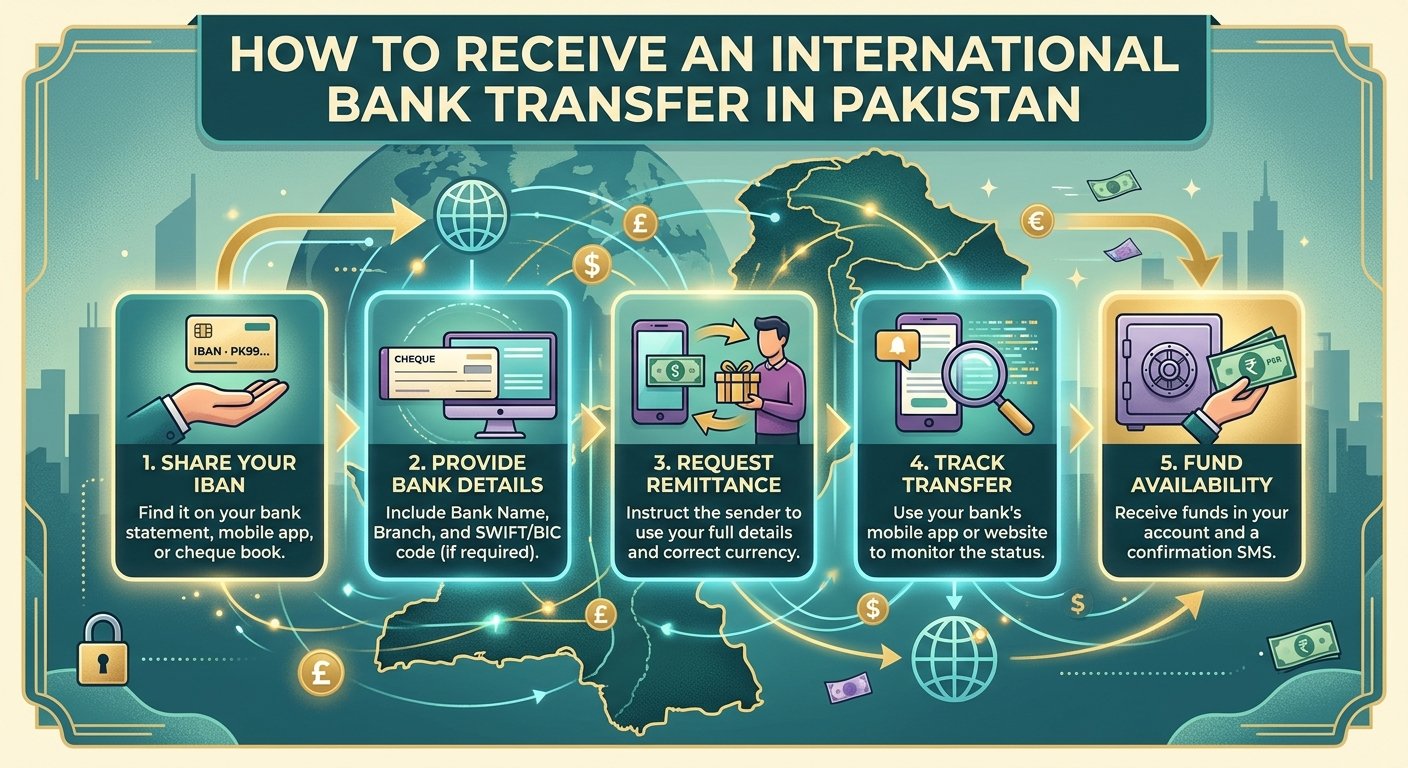
You can receive an international bank transfer by following these steps.
Step 1: Open a Bank Account in Pakistan
First, you need a Pakistani bank account if you want the money deposited directly into your account.
You can use an account with banks such as:
- HBL (Habib Bank Limited)
- UBL (United Bank Limited)
- Meezan Bank
- MCB Bank
- Allied Bank
- Bank Alfalah
- National Bank of Pakistan
- Bank of Punjab
You do not necessarily need a special international account to receive money from abroad. However, your bank must support the type of payment and currency being sent.
If you do not have a bank account, some authorised money transfer services allow you to collect money in cash from a designated bank or payment location.
Step 2: Get Your IBAN Number
Your IBAN (International Bank Account Number) is one of the most important details for receiving an international bank transfer.
A Pakistani IBAN contains 24 characters and starts with PK.
For example:
PK36SCBL0000001123456702
This is only a sample IBAN, not a real bank account.
You can find your IBAN through:
- Your bank’s mobile application.
- Your latest bank statement.
- Your bank’s official website.
- Your bank’s customer support service.
Always provide the complete and correct IBAN. A wrong number can cause payment delays or rejection.
Step 3: Get Your Bank’s SWIFT/BIC Code
A SWIFT code, also called a BIC, helps identify your bank when money is sent internationally.
The sender’s bank may ask for your Pakistani bank’s SWIFT/BIC code before processing the transfer.
You can find this code on your bank’s official website or by contacting its customer support team.
Make sure you provide the correct code for your bank and, if required, your branch. Do not use a SWIFT code from an unverified website.
Step 4: Share Your Banking Details With the Sender
Once you have your IBAN and SWIFT code, share the required information with the person or company sending the money.
For a typical international bank transfer, the sender may need:
- Your full name as registered with the bank.
- Your bank account IBAN.
- Your bank’s full name.
- Your bank’s SWIFT/BIC code.
- Your bank branch name or address, if requested.
- Your contact number and address, if requested.
- The purpose of the payment.
For some payments, the sender may also need your CNIC number, passport details or other identification information. Requirements depend on the bank, payment type and applicable regulations.
Step 5: Ask the Sender to Make the Transfer
The sender can visit their bank or use its online banking service to arrange the international payment.
They should enter your banking information carefully and select the correct destination country and currency.
Before confirming the transfer, ask the sender to check:
- Your full name and IBAN.
- Your bank’s SWIFT/BIC code.
- The amount and currency.
- Any transfer charges.
- The purpose of the payment.
After completing the transaction, the sender should share the payment receipt or transaction reference number with you.
Step 6: Wait for the Money to Arrive
Once the sender’s bank processes the payment, the money travels through the international banking network to your Pakistani bank.
Your bank may credit the amount directly to your account. In some cases, it may contact you to confirm the purpose of the payment or request supporting documents.
Check your mobile banking application or bank statement to confirm that the payment has arrived.
What Information Do You Need to Receive Money From Abroad?
Before someone sends you money, prepare the following information:
| Required Information | Purpose |
|---|---|
| Full Account Name | Identifies the receiving account holder |
| IBAN | Identifies your bank account |
| Bank Name | Identifies your Pakistani bank |
| SWIFT/BIC Code | Identifies your bank in the international banking network |
| Bank Address | May be required by the sending bank |
| Payment Purpose | Explains why the money is being sent |
| CNIC or Other Identification | May be requested for verification or regulatory requirements |
Not every transfer requires all these details. Ask your bank for its official inward remittance instructions before sharing information with the sender.
How to Receive Money From Abroad Without a Bank Account
You do not always need a Pakistani bank account to receive international money. Some authorised money transfer services allow people to collect payments in cash.
For example, a person living in the UAE, Saudi Arabia, the UK or another country may send money through a supported cash pickup service.
Here is how the process usually works:
- The sender visits an authorised money transfer service or uses its official application.
- They provide your correct name and other required information.
- They complete the payment and receive a transaction reference number.
- They share the reference number with you.
- You visit the designated payment location with your original valid CNIC or accepted identification.
- The payment provider verifies your details and releases the money.
Requirements differ between services. Some payments can be collected through partner bank branches, while others may be available through authorised exchange companies or designated agents.
How Long Does an International Bank Transfer Take in Pakistan?
The time required to receive money from abroad depends on the sending country, payment method, currency, banks involved and any required verification.
Here are general estimates:
| Transfer Method | Possible Processing Time |
|---|---|
| Bank-to-bank SWIFT transfer | Usually 1–5 business days |
| International cash pickup | Can be available within minutes or hours |
| Digital money transfer service | Can be minutes to a few business days |
| Transfer requiring additional verification | May take longer |
These are general estimates, not guaranteed delivery times. Weekends, public holidays, intermediary banks and compliance checks can delay payments.
What Are the Charges for Receiving International Money in Pakistan?
The cost of receiving international money depends on the payment channel and the terms of the sending and receiving banks.
Possible charges include:
- Sending fee: The sender’s bank or money transfer service may charge a fee.
- Intermediary bank fee: A bank involved in processing the international payment may deduct a charge.
- Receiving bank fee: The Pakistani bank may apply charges depending on the type of transfer and its applicable schedule.
- Currency conversion: If money is converted into Pakistani rupees, the exchange rate affects the final amount received.
However, qualifying home remittances sent through approved channels may be covered by special fee arrangements. Do not assume that every international transfer is free.
Before sending money, ask the service provider how much the sender will pay and how much the recipient will receive.
Will You Receive Money in Dollars or Pakistani Rupees?
This depends on the currency sent, your account type and the receiving bank’s arrangements.
For example, if someone sends you US dollars from America, your bank may convert the payment into Pakistani rupees before depositing it into your account.
If you have an eligible foreign currency account, your bank may be able to credit the funds in the relevant foreign currency, subject to its account terms and applicable foreign exchange regulations.
Before the sender makes the payment, contact your bank and confirm:
- Whether it accepts the currency being sent.
- Whether the money will be converted into Pakistani rupees.
- Which exchange rate will apply.
- Whether your account supports receiving that currency.
Do You Have to Pay Tax on Money Received From Abroad in Pakistan?
Receiving an international bank transfer does not automatically mean that you have to pay tax. However, the tax treatment depends on why you are receiving the money and the applicable tax rules.
For example, money received as a family gift, salary, freelance income, business payment or payment for services may have different tax implications.
Keep proper records of the payment, including:
- The sender’s details.
- The amount received.
- The purpose of the payment.
- Bank transfer receipts.
- Any supporting agreement, invoice or gift documentation.
For eligible foreign remittances, a bank-issued Proceeds Realization Certificate (PRC) or electronic PRC (e-PRC) can help document the receipt of funds. A PRC is not, by itself, a guarantee that the money is tax-exempt.
If you receive regular business or freelance income from abroad, consult a qualified tax professional to understand your tax obligations.
What Is a PRC or e-PRC in Pakistan?
PRC stands for Proceeds Realization Certificate. It is a document issued by an authorised bank to confirm that money has been received from abroad through the banking system.
An e-PRC is the electronic version of this certificate.
You may need a PRC or e-PRC for:
- Keeping proof of money received from abroad.
- Documenting freelance or export earnings.
- Providing payment evidence to an organisation.
- Supporting tax or financial records where applicable.
According to the State Bank of Pakistan’s Foreign Exchange Manual, authorised banks can issue electronic PRCs for qualifying inward remittances. Ask your bank how to obtain your certificate and whether it is available through digital banking.
What Is Form R and When Is It Required?
Form R is used by banks to record information about certain foreign exchange receipts, including the purpose of a payment.
Your bank may ask you to provide information about why you are receiving the money and submit supporting documents where necessary.
For example, a bank may request:
- An invoice for a freelance or business payment.
- An employment or salary document.
- An agreement explaining the purpose of the payment.
- Identification documents.
- Other supporting information requested by the bank.
Importantly, Form R is not automatically required for every small personal remittance. In April 2026, the State Bank of Pakistan revised the reporting thresholds for Form R and the Inward Remittance Voucher (IRV) to USD 25,000 or its equivalent in other currencies. Banks may still request information or documents for verification and compliance purposes.
Contact your receiving bank if it asks you to complete a form or provide supporting documents.
What to Do If Your International Bank Transfer Is Delayed
If someone has sent you money but it has not arrived in your Pakistani bank account, do not panic. International payments can sometimes take longer than expected.
Follow these steps:
- Contact the sender: Ask them to confirm that the transfer was successfully processed.
- Get the transaction reference: Request the SWIFT payment reference or transaction tracking number, such as an MT103 copy where available.
- Check your IBAN: Make sure the sender entered your correct account information.
- Contact your bank: Give your bank the transaction reference and ask it to trace the incoming payment.
- Provide documents: If the bank requests payment details or supporting documents, submit them promptly.
- Ask the sender’s bank to investigate: If your bank cannot locate the payment, the sender should contact their bank for a trace or investigation.
Never pay an unknown person an additional fee to release a payment. Verify any requested charges directly with your bank or authorised payment provider.
Important Safety Tips When Receiving Money From Abroad
Follow these safety precautions when receiving international payments:
- Use banks and payment services authorised to operate in Pakistan.
- Never share your ATM PIN, banking password or OTP.
- Double-check your IBAN before giving it to the sender.
- Do not use unofficial money transfer agents.
- Keep your transaction receipts and payment records.
- Verify unexpected payment messages directly with your bank.
- Never send money back to an unknown person who claims to have transferred too much by mistake without first confirming the transaction with your bank.
Always use legal banking channels instead of hundi or hawala operators who are not authorised to provide remittance services.
Frequently Asked Questions (FAQs)
1. Can I receive international money directly into my Pakistani bank account?
Yes. You can receive international money directly into your Pakistani bank account through an international bank transfer or a supported home remittance service. You generally need your IBAN, bank name and SWIFT/BIC code.
2. Which bank is best for receiving international money in Pakistan?
Many Pakistani banks support inward international transfers, including HBL, UBL, Meezan Bank, MCB, Allied Bank and Bank Alfalah. The best option depends on your bank’s supported currencies, charges, processing arrangements and customer service.
3. Can I receive money from Saudi Arabia in Pakistan?
Yes. You can receive money from Saudi Arabia through an international bank transfer or an authorised remittance service. The sender will need your correct receiving details or the information required by the selected service.
4. Can I receive money from the UAE in Pakistan?
Yes. People in the UAE can send money to Pakistan through supported banks and authorised exchange or money transfer services. Depending on the method, the money may be deposited into your account or made available for cash collection.
5. Can I receive international money without an IBAN?
For a direct international bank transfer, a Pakistani IBAN is generally required. However, some cash pickup services and other payment methods allow you to receive money without providing an IBAN.
6. Is receiving money from abroad free in Pakistan?
Some qualifying home remittance services are free for the sender and beneficiary under applicable arrangements. However, other international transfers may involve sending, intermediary bank, receiving or currency conversion charges. Confirm the fees before the transfer.
7. How can I track an international bank transfer?
Ask the sender for the payment reference or SWIFT transaction details. Contact your Pakistani bank and provide this information to help it trace the incoming payment.
8. Can I receive US dollars in my Pakistani bank account?
It depends on whether your bank account supports foreign currency deposits and whether the payment is eligible for credit in that currency. Ask your bank before the sender makes the transfer.
9. Do I need to visit a bank to receive international money?
No. If the money is being transferred directly to your account, it can usually be credited without visiting a branch. However, your bank may ask you to visit or submit documents if additional verification is required.
10. What is the difference between an IBAN and a SWIFT code?
An IBAN identifies your specific bank account, while a SWIFT/BIC code identifies the bank involved in an international payment. Both may be required when someone sends money directly to your Pakistani bank account.
Conclusion
Receiving an international bank transfer in Pakistan is straightforward when you have the correct banking information. Get your IBAN, SWIFT/BIC code, bank name and account title, then share them with the sender.
You can receive money directly into your bank account or use an authorised cash pickup service if you do not have an account. Always check the transfer charges, exchange rate and payment requirements before the sender completes the transaction.
Keep your payment receipts and supporting documents, and contact your bank if a transfer is delayed. Using authorised banking channels is the safest way to receive money from abroad in Pakistan.
