


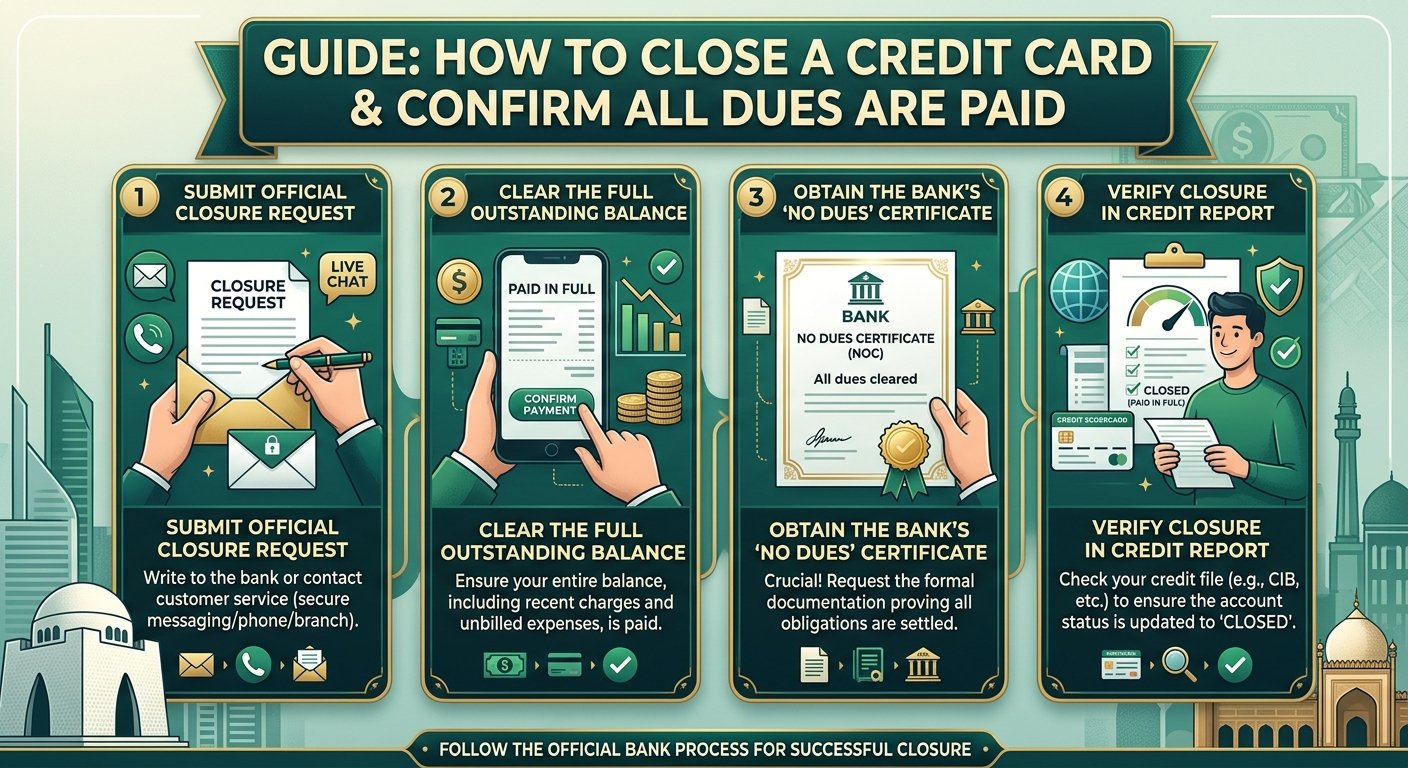
If you no longer use your credit card, closing it can help you avoid future fees and unwanted charges. However, simply cutting the card or paying the current bill does not mean your credit card account is closed.
You must contact your bank, request permanent cancellation and confirm that all outstanding amounts have been paid. You should also obtain written proof that the card account has been closed and no payment is due.
This guide explains how to close a credit card in Pakistan and how to make sure there are no remaining dues.
What Does Closing a Credit Card Mean?
Closing a credit card means permanently ending the credit card service provided by your bank. After the bank completes the closure, you can no longer use that card for shopping, online payments or cash withdrawals.
There is an important difference between blocking a card and closing a credit card account:
- Temporary blocking: The card is stopped for a short time but the account may remain active.
- Permanent cancellation: The bank permanently closes the credit card facility.
If you want to stop using your card and avoid future card-related charges, ask the bank for permanent closure rather than temporary blocking.
Step 1: Check Your Total Outstanding Balance
Before requesting closure, check how much you owe the bank. Do not rely only on the last monthly statement because some transactions or charges may not have appeared yet.
Check the following items:
- Unpaid credit card bills.
- Transactions that have not yet appeared on your statement.
- Installment plans or balance transfer payments.
- Cash advances and applicable charges.
- Annual fees and other service charges.
- Payments for supplementary cards.
- Any other amount charged by the bank.
Contact your bank and ask for the total amount required to settle the credit card account and close it permanently. Also ask whether any pending transaction or installment will remain after closure.
Step 2: Pay All Outstanding Dues
Pay the full amount confirmed by the bank. Do not pay only the minimum amount if your goal is to close the credit card account.
You can usually pay through the bank’s mobile app, internet banking, ATM, branch or another payment method accepted by the bank.
After making the payment:
- Save the payment receipt or transaction reference number.
- Check whether the payment has been credited to your card account.
- Ask the bank to confirm that the outstanding balance is zero.
- Request an updated statement if necessary.
Remember that a payment receipt proves that you made a payment. It does not, by itself, prove that the credit card account has been closed.
Step 3: Cancel Automatic Payments and Subscriptions
Before closing your card, review any services that use it for automatic payments. These may include:
- Netflix and other streaming services.
- Mobile phone and internet bills.
- Online shopping accounts.
- Software subscriptions.
- Insurance or other recurring payments.
Update these services with another payment method or cancel the subscriptions. This helps prevent failed payments and billing problems.
Step 4: Contact Your Bank and Request Permanent Closure
Once your dues have been cleared, contact your bank through its official helpline, mobile app, website or branch.
Tell the bank clearly that you want to permanently close your credit card account.
The bank may ask you to:
- Verify your identity and account details.
- Submit a credit card cancellation request.
- Provide a written application or complete a bank form.
- Return or destroy the physical credit card, depending on the bank’s instructions.
- Clear any remaining amount before the request can be completed.
Ask the bank for a complaint or service request number. Keep this number until you receive written confirmation of closure.
Step 5: Request a No-Dues Certificate or NOC
After paying the full balance, request a No-Dues Certificate or No Objection Certificate (NOC) from your bank.
This document can provide written confirmation that your credit card dues have been settled. Ask the bank to confirm the following details:
- Your name and credit card account reference.
- That the outstanding balance has been fully paid.
- That no further payment is due as of the certificate date.
- That the credit card account has been permanently closed, if closure has been completed.
Some banks may require a separate written request for an NOC. For example, JS Bank’s published credit card terms state that a customer must submit a written request to receive an NOC after permanent settlement or closure of the card amount.
Ask your own bank about its certificate process and keep the document safely. Read JS Bank’s credit card terms and conditions.
Step 6: Get Written Confirmation That the Card Is Closed
Do not finish the process after receiving only a verbal confirmation from a bank representative. Ask for an SMS, email or letter confirming permanent closure.
The State Bank of Pakistan’s Business Conduct and Fair Treatment of Consumers Regulatory Framework requires financial institutions to confirm the termination or closure of a customer contract within two working days after the termination is executed. SBP’s related FAQs specifically include credit cards in this requirement.
This two-working-day period applies to confirmation after the closure has been executed. It does not mean every credit card closure request must be fully processed within two working days, regardless of outstanding dues or other requirements.
Keep the following records:
- Credit card payment receipts.
- Final statement showing the settled balance.
- Cancellation request number.
- No-Dues Certificate or NOC, if issued.
- Written confirmation of permanent closure.
Step 7: Check for Any Remaining Charges
After receiving the closure confirmation, review your final statement and contact the bank if you notice an unexpected amount.
Ask the bank to explain any remaining fee, interest, installment or transaction. If the bank confirms that the account is permanently closed, request written clarification about any amount that appears afterward.
Under SBP’s regulatory framework, banks cannot deduct charges for debit or credit card services after permanent blocking of the card. A permanently closed card should therefore not continue attracting card-related charges. Read the SBP Business Conduct Framework.
Sample Application to Close a Credit Card
If your bank requires a written request, you can use the following application:
To: The Branch Manager / Credit Card Department
Subject: Request for Credit Card Cancellation and No-Dues Certificate
Dear Sir/Madam,
I am writing to request the permanent closure of my credit card account. I have paid all outstanding dues and request you to verify my account balance.
Please permanently cancel my credit card and confirm that no outstanding payment remains against my account. I also request you to issue a No-Dues Certificate or NOC confirming the settlement of all dues and provide written confirmation of the card closure.
My details are provided below:
- Account Holder Name: __________________
- Credit Card Number (Last Four Digits): __________________
- CNIC Number: __________________
- Registered Mobile Number: __________________
- Payment Date: __________________
Thank you for your assistance.
Regards,
Your Name
Your Signature
Date: __________________
Important: Do not write your full credit card number, CVV or PIN in an unsecured email or ordinary application. Follow your bank’s secure submission instructions.
What If the Bank Does Not Close Your Credit Card?
If you have paid all dues but the bank does not process your cancellation request, first contact its Complaint Management Unit (CMU).
Explain the issue and provide copies of your payment receipts, cancellation request and any communication from the bank. Ask for a written response and keep the complaint reference number.
If the bank does not resolve the issue within the applicable period or you are unhappy with its response, you can use the State Bank of Pakistan’s Sunwai complaint portal.
For eligible complaints against scheduled banks, you may also approach the Banking Mohtasib Pakistan. SBP says customers can approach the Banking Mohtasib if the bank’s Complaint Management Unit fails to respond within 45 days or the customer remains dissatisfied with the outcome. Different rules may apply to microfinance banks and other institutions.
You can read the SBP consumer protection guidance for complaint options.
Does Closing a Credit Card Affect Your Credit History?
Closing a credit card does not automatically remove your previous payment history from the banking system.
Banks and financial institutions report relevant credit information to the State Bank of Pakistan’s Electronic Credit Information Bureau (eCIB). If you had late payments or overdue amounts before closing the card, that history may continue to appear in your credit information record for the applicable reporting period.
According to SBP, the overdue history of an individual consumer borrower can remain visible for 12 months after settlement, while the current status is updated to show the revised position. Therefore, closing a credit card does not erase an earlier payment default.
Read SBP’s eCIB frequently asked questions.
Important Things to Remember Before Closing Your Credit Card
- Pay the full outstanding balance, not just the minimum payment.
- Ask the bank about unbilled transactions and installment plans.
- Cancel automatic payments linked to the card.
- Submit a formal permanent cancellation request.
- Request a No-Dues Certificate or NOC in writing.
- Get written confirmation that the card account is permanently closed.
- Keep payment and closure documents for future reference.
- Cut the physical card through the chip and magnetic strip after following the bank’s return instructions.
Frequently Asked Questions (FAQs)
1. Can I close my credit card without paying the full balance?
You can ask your bank to block or cancel the card, but any outstanding debt must still be settled. Ask the bank how it will handle the remaining balance and any installment payments.
2. How long does it take to close a credit card in Pakistan?
The time depends on the bank, your outstanding balance and its cancellation process. Under SBP’s framework, the bank must confirm the executed termination or closure within two working days. This is the confirmation period, not necessarily the total time needed to complete the request.
3. How can I confirm that my credit card has been closed?
Ask your bank for written confirmation by email, SMS or letter. The confirmation should clearly state that your credit card account has been permanently closed.
4. What is a No-Dues Certificate for a credit card?
A No-Dues Certificate is a document issued by a bank to confirm that the customer has settled the outstanding amount. Ask the bank to include the account closure status as well if you need proof that the card has been permanently cancelled.
5. Will the bank charge an annual fee after closing my credit card?
SBP’s regulatory framework does not allow banks to deduct card-related charges after permanent blocking of a debit or credit card. Make sure the bank has permanently closed or blocked the card rather than only temporarily blocking it.
6. Can I close my credit card through a phone call?
Some banks accept cancellation requests through their helplines, while others may require a written application or branch visit. Contact your bank and follow its official process. Always ask for a request number and written closure confirmation.
7. Does closing a credit card remove my eCIB record?
No. Closing a credit card does not automatically remove your previous credit history. Any overdue payment history may remain visible for the applicable reporting period under SBP’s eCIB rules.
Conclusion
Closing a credit card in Pakistan requires more than paying the outstanding bill. You should check all pending charges, settle the full balance, submit a permanent cancellation request and obtain written confirmation from your bank.
For extra protection, request a No-Dues Certificate or NOC and keep all payment and closure records. These documents can help you resolve future disputes and prove that your credit card dues have been settled.
