


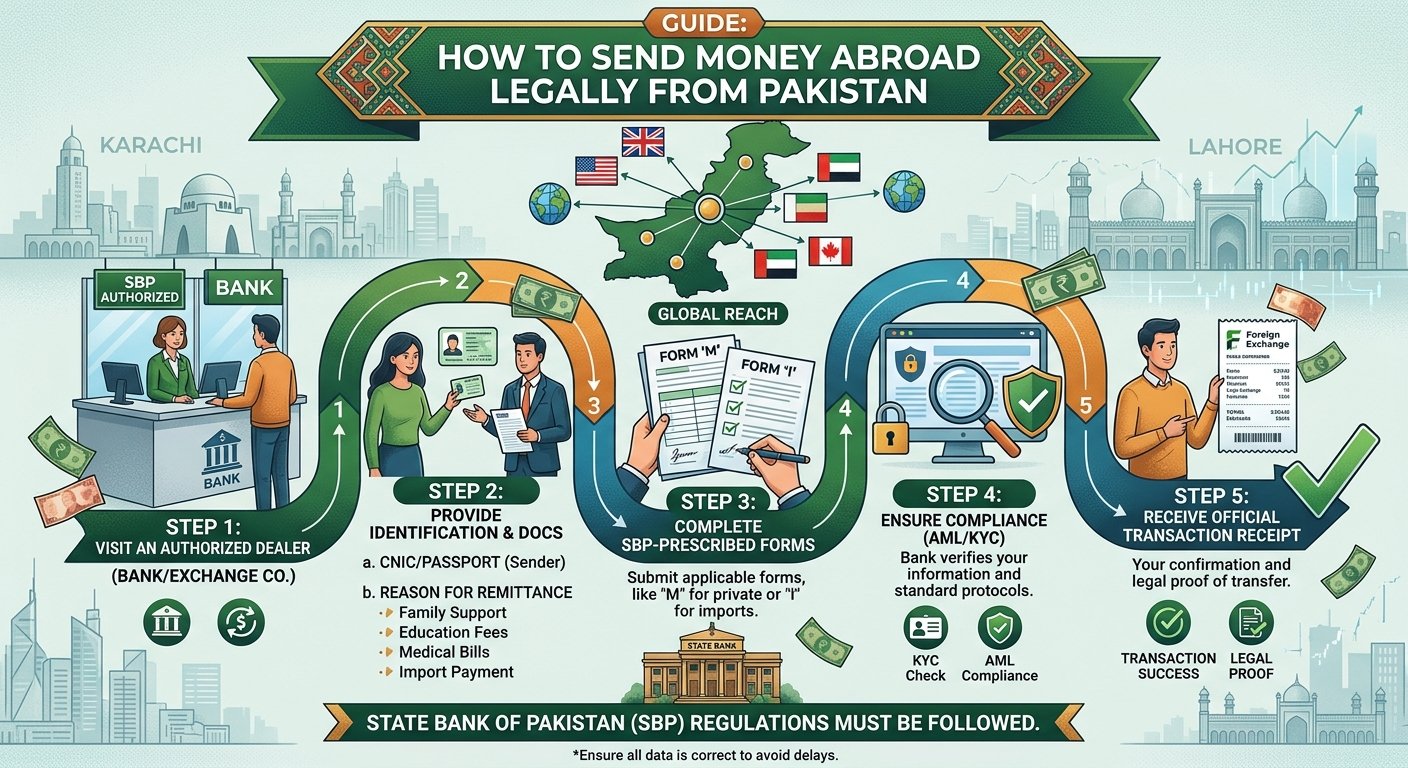
Sending money from Pakistan to another country is possible through authorised banks and licensed exchange companies. However, you cannot send money abroad for every purpose without following the rules set by the State Bank of Pakistan (SBP).
Whether you want to pay foreign university fees, cover medical expenses, support a family member or make another personal payment, you must use an approved payment method and provide the required documents.
In this guide, you will learn how to send money abroad legally from Pakistan, which banks and exchange companies can help, what documents you need, applicable limits and how to avoid illegal money transfer services.
Can You Legally Send Money Abroad from Pakistan?
Yes. Pakistani residents can send money abroad through authorised banks and approved exchange companies for permitted purposes.
The State Bank of Pakistan regulates foreign currency transactions under the Foreign Exchange Regulation Act, 1947, and its Foreign Exchange Manual.
However, there are rules about why you can send money, how much you can transfer and which documents you must provide.
Common permitted purposes include:
- Paying university and college fees abroad.
- Paying for medical treatment in another country.
- Sending money for permitted personal expenses.
- Paying eligible travel-related expenses.
- Sending money for other transactions allowed under foreign exchange regulations.
Business payments, investments and commercial transactions may have different requirements. You should confirm the applicable rules with your bank before making a payment.
How to Send Money Abroad Legally from Pakistan
The easiest way to send money abroad is usually through a bank that is authorised to deal in foreign exchange. Follow these steps to start the process.
Step 1: Decide Why You Want to Send Money
First, identify the purpose of your payment. Your bank needs to know why you are sending money outside Pakistan.
For example:
- If you are sending money for education, you will need admission and fee documents.
- If you are paying for medical treatment, you may need a hospital invoice and medical documents.
- If you are sending money for an eligible personal expense, the bank may ask for information about the recipient and purpose.
- If you are paying a foreign business, you may need an invoice, contract or other commercial documents.
The documents and approval process depend on the type of payment.
Step 2: Visit an Authorised Bank
Visit a bank that provides foreign exchange and outward remittance services.
Several Pakistani banks offer foreign payment facilities, including:
- HBL (Habib Bank Limited)
- UBL (United Bank Limited)
- MCB Bank
- Allied Bank
- Bank Alfalah
- National Bank of Pakistan
- Meezan Bank
- Bank of Punjab
Not every branch handles foreign currency transactions. Contact your bank first and ask for a branch that deals with outward remittances.
You can also ask whether the bank accepts applications through its online foreign exchange portal.
Step 3: Prepare Your Documents
Your bank will ask for documents based on the purpose of the transfer.
Generally, you may need:
- Your original CNIC or other accepted identification.
- Your bank account details.
- The recipient’s full name and address.
- The recipient’s bank account number or IBAN, where applicable.
- The recipient bank’s SWIFT/BIC code, if required.
- An invoice, admission letter or other proof of payment.
- Information about the source of funds, if requested.
Additional documents may be required for education, medical treatment, travel or commercial payments.
Step 4: Complete the Bank’s Remittance Application
Your bank may ask you to complete a foreign exchange remittance application and provide details about the payment.
Form M is used to record information about applicable outward remittance transactions under the State Bank of Pakistan’s reporting system.
In April 2026, SBP revised Form M along with Form R and the Inward Remittance Voucher (IRV). Banks have been instructed to use the revised forms for applicable transactions.
Provide accurate information about the recipient, payment amount and purpose. Your bank will guide you through the required application and documentation.
Step 5: Pay the Required Amount and Charges
After checking your documents, the bank will explain the exchange rate, transfer charges and payment process.
You may need to deposit Pakistani rupees into your bank account or provide funds through another approved banking method.
Before confirming the transaction, check:
- The exchange rate being offered.
- The total transfer fee.
- The amount the recipient will receive.
- Any intermediary bank charges.
- The estimated delivery time.
Step 6: Track Your International Transfer
After approval, the bank will process the payment through an international banking channel, such as SWIFT, where applicable.
Ask your bank for a transaction receipt or reference number. You can use this information to follow up if the payment is delayed.
The receiving bank may also need to complete its own verification before releasing the money.
Which Banks Allow You to Send Money Abroad from Pakistan?
Several Pakistani banks provide outward remittance services for permitted purposes. The available services and documents depend on each bank’s foreign exchange arrangements.
| Bank | Available Foreign Exchange Services |
|---|---|
| HBL | Foreign exchange and eligible international payments |
| UBL | Outward remittance and foreign payment services |
| MCB Bank | Foreign exchange services and eligible remittances |
| Allied Bank | Education, medical and travel-related foreign exchange services |
| Bank Alfalah | Foreign exchange and international payment facilities |
| National Bank of Pakistan | Foreign exchange and authorised remittance services |
| Meezan Bank | Foreign exchange services for permitted transactions |
| Bank of Punjab | Foreign exchange services for eligible payments |
Contact the bank before visiting a branch because some transactions can only be processed through designated foreign exchange branches.
Can You Send Money Abroad Through an Exchange Company?
Yes. SBP-authorised exchange companies can also process certain outward remittances for individuals.
However, their services have specific restrictions. Under the SBP’s Regulatory Framework for Exchange Companies, outward remittances are permitted only for personal financial transactions of individuals.
Exchange companies cannot use this facility to process trade or commercial payments, including payments for services or commissions.
For an eligible personal transfer, the exchange company may ask you for:
- Original CNIC or another accepted identification document.
- Biometric verification.
- Recipient’s name and address.
- Details of the receiving bank or payment service.
- Purpose of the transfer.
- Supporting documents, depending on the amount.
- Proof of the source of funds, where required.
Always check that the company is authorised by SBP and use one of its approved outlets.
What Are the Money Transfer Limits in Pakistan?
There is no single limit that applies to every type of international payment from Pakistan. The permitted amount depends on the payment purpose, transfer method and applicable SBP regulations.
However, SBP has specified important limits for certain transactions.
1. Exchange Company Foreign Currency Limits
Under the SBP Regulatory Framework for Exchange Companies, the maximum foreign currency sale to an individual through exchange companies is:
| Limit | Amount |
|---|---|
| Per person per day | USD 10,000 |
| Per person per calendar year | USD 100,000 |
These limits apply across exchange companies and cover foreign currency sales through cash, account transfers and outward remittances. Purpose-specific restrictions may also apply.
These are not universal limits for all outward transfers through Pakistani banks. Bank transfers are subject to the relevant rules for each payment category.
2. Education Payment Limit
Pakistani banks can remit up to USD 70,000 or its equivalent in other currencies per student per calendar year for eligible foreign education expenses.
This can include:
- University tuition fees.
- Admission and application charges.
- Living expenses.
- Other eligible university charges.
If the required amount exceeds the permitted limit, your bank can forward the case to SBP for consideration with supporting documents.
3. Medical Treatment Payment Limit
For eligible medical treatment abroad, authorised banks can remit up to USD 50,000 or its equivalent in other currencies per invoice, after checking the documents and genuine need for treatment.
The payment is generally sent directly to the foreign hospital or medical institution.
If the amount exceeds the prescribed limit, the bank can refer the case to SBP for approval.
What Documents Are Required to Send Money Abroad?
The required documents depend on why you are sending money. Here is a general guide.
| Payment Purpose | Possible Required Documents |
|---|---|
| Education | Admission letter, university fee invoice, student CNIC or Form B, passport and application form |
| Medical Treatment | Hospital invoice, medical estimate, declaration and relevant medical documents |
| Personal Expenses | CNIC, recipient details and supporting documents requested by the bank |
| Travel | Passport, visa, air ticket and other documents required by the bank |
| Business Payment | Invoice, contract, import or service documents and applicable regulatory approvals |
This is a general list. Your bank may request additional documents depending on the transaction and applicable regulations.
How to Send University Fees Abroad from Pakistan
If you are planning to study in another country, you can use an authorised Pakistani bank to pay your university fees.
Follow these steps:
- Get an admission letter from your foreign university.
- Request an official fee invoice or cost breakdown.
- Visit a bank that handles foreign education payments.
- Complete the required education remittance application.
- Provide your CNIC, passport and other required documents.
- Ask the bank to remit the approved amount directly to the university.
- Keep the payment receipt for your records.
Under the applicable SBP rules, authorised banks can remit up to USD 70,000 per student per calendar year for eligible education expenses. The bank must verify the institution and supporting documents.
How to Send Money Abroad for Medical Treatment
If you or a family member needs medical treatment outside Pakistan, an authorised bank can facilitate eligible payments to a foreign hospital.
You may need the following documents:
- Medical invoice or treatment estimate from the foreign hospital.
- Completed medical remittance application.
- Declaration explaining the foreign currency required.
- Patient’s CNIC or other identification.
- Additional medical documents requested by the bank.
Under SBP rules, banks can remit up to USD 50,000 per invoice for eligible medical treatment abroad, subject to verification.
The payment should generally be sent directly to the concerned hospital through an approved banking channel.
Can You Send Money Abroad for Family Members?
Sending money to family members living in another country depends on the purpose of the payment and the applicable foreign exchange rules.
For example, a person may need to support a dependent family member living abroad. The bank will check whether the payment is permitted and may request proof of the relationship, the recipient’s details and supporting documents.
Do not assume that every family transfer can automatically be processed. Explain the purpose to your bank and ask which rules apply before arranging the payment.
How Much Does It Cost to Send Money Abroad from Pakistan?
The cost depends on your bank, exchange rate, destination country, currency and transfer method.
You may have to pay:
- Bank transfer fee: A charge for processing the international payment.
- SWIFT charges: Charges for sending the payment through the international banking network, where applicable.
- Intermediary bank charges: Fees deducted by banks involved in processing the transfer.
- Currency conversion charges: The difference between the applicable exchange rate and the rate you may expect.
Before making a transfer, ask your bank for the complete charges and the expected amount the recipient will receive.
Is It Legal to Send Money Abroad Through Hundi or Hawala?
No. Using unauthorised hundi or hawala operators to transfer money outside Pakistan is illegal.
These informal systems operate outside the authorised banking and foreign exchange framework. They do not provide the same legal protection and transaction records as approved financial institutions.
Using such services can expose you to:
- Loss of your money.
- Fraud and scams.
- Legal problems.
- Difficulty proving the source and purpose of a payment.
- Financial investigations and possible penalties.
Always use an SBP-authorised bank or licensed exchange company. Ask for an official receipt whenever you make an international payment.
What Is the Difference Between a Bank and an Exchange Company?
Both authorised banks and exchange companies can provide certain foreign exchange services, but their permissions are different.
| Feature | Authorised Bank | Exchange Company |
|---|---|---|
| Regulation | Regulated by SBP | Authorised and regulated by SBP |
| Education Payments | Can process eligible payments | Not a general route for university fee payments |
| Medical Payments | Can process eligible payments | Subject to its permitted personal transaction activities |
| Commercial Payments | Can process permitted commercial payments with required documents | Cannot process trade or commercial outward remittances |
| Personal Remittances | Subject to applicable foreign exchange rules | Permitted within applicable rules and limits |
For education, medical and commercial payments, an authorised bank is generally the appropriate starting point.
What Should You Check Before Sending Money Abroad?
Before making an international payment, follow these important tips:
- Confirm that your payment purpose is permitted under SBP regulations.
- Use an authorised bank or licensed exchange company.
- Check the recipient’s name and bank account details carefully.
- Verify the recipient bank’s SWIFT/BIC code and IBAN where applicable.
- Ask about exchange rates and all transfer charges.
- Keep copies of invoices, contracts and supporting documents.
- Get an official transaction receipt.
- Never send money through an unknown agent or informal transfer service.
Frequently Asked Questions (FAQs)
1. Can I send money abroad directly from my Pakistani bank account?
Yes. You can send money abroad through an authorised Pakistani bank for permitted purposes. You may need to provide your CNIC, recipient details, payment information and supporting documents.
2. Can I send money from Pakistan to the USA?
Yes. Eligible payments can be sent from Pakistan to the United States through authorised banks and permitted exchange company services. The bank will check the payment purpose and required documents.
3. Can I send money from Pakistan to the UK?
Yes. You can make eligible international payments to the United Kingdom through an authorised bank. You may need the recipient’s account details, IBAN and SWIFT/BIC code.
4. What is the maximum amount I can send abroad from Pakistan?
There is no single maximum amount for every type of international transfer. Exchange company transactions have a USD 10,000 daily and USD 100,000 yearly limit per person, while bank payments have purpose-specific rules. Some payments may require additional SBP approval.
5. Can I send money abroad using JazzCash or Easypaisa?
JazzCash and Easypaisa offer different financial services, but you should not assume that their normal domestic wallet transfers allow direct international bank transfers. Check their official services and applicable payment arrangements before using them.
6. Can I send university fees abroad from Pakistan?
Yes. Authorised banks can send eligible university fees directly to foreign educational institutions. Under SBP rules, the permitted amount is up to USD 70,000 per student per calendar year, subject to the required documents and verification.
7. Can I send money abroad for medical treatment?
Yes. Authorised banks can remit up to USD 50,000 per invoice for eligible medical treatment abroad, subject to verification and supporting medical documents.
8. How long does an international bank transfer take?
International bank transfers commonly take around one to five business days, but the actual time depends on the destination, banks involved, payment method and verification requirements.
9. Do I need an IBAN to send money abroad?
It depends on the destination country and receiving bank. Many international bank transfers require the recipient’s IBAN, while other countries use different account number formats. The recipient’s SWIFT/BIC code may also be required.
10. Is it legal to send money abroad through an exchange company?
Yes, if the company is authorised by SBP and the transaction is within its permitted activities. Exchange companies can process eligible personal outward remittances, but they cannot process trade or commercial payments through this facility.
Conclusion
Sending money abroad legally from Pakistan is possible through authorised banks and licensed exchange companies. However, the payment must follow State Bank of Pakistan rules and fall within a permitted category.
For education and medical expenses, banks provide specific remittance facilities with defined limits and documentation requirements. For other personal or business payments, you should first confirm the applicable regulations with your bank.
Avoid hundi, hawala and other unauthorised money transfer services. Always use approved financial channels, keep your payment records and check all charges before sending money abroad.
