


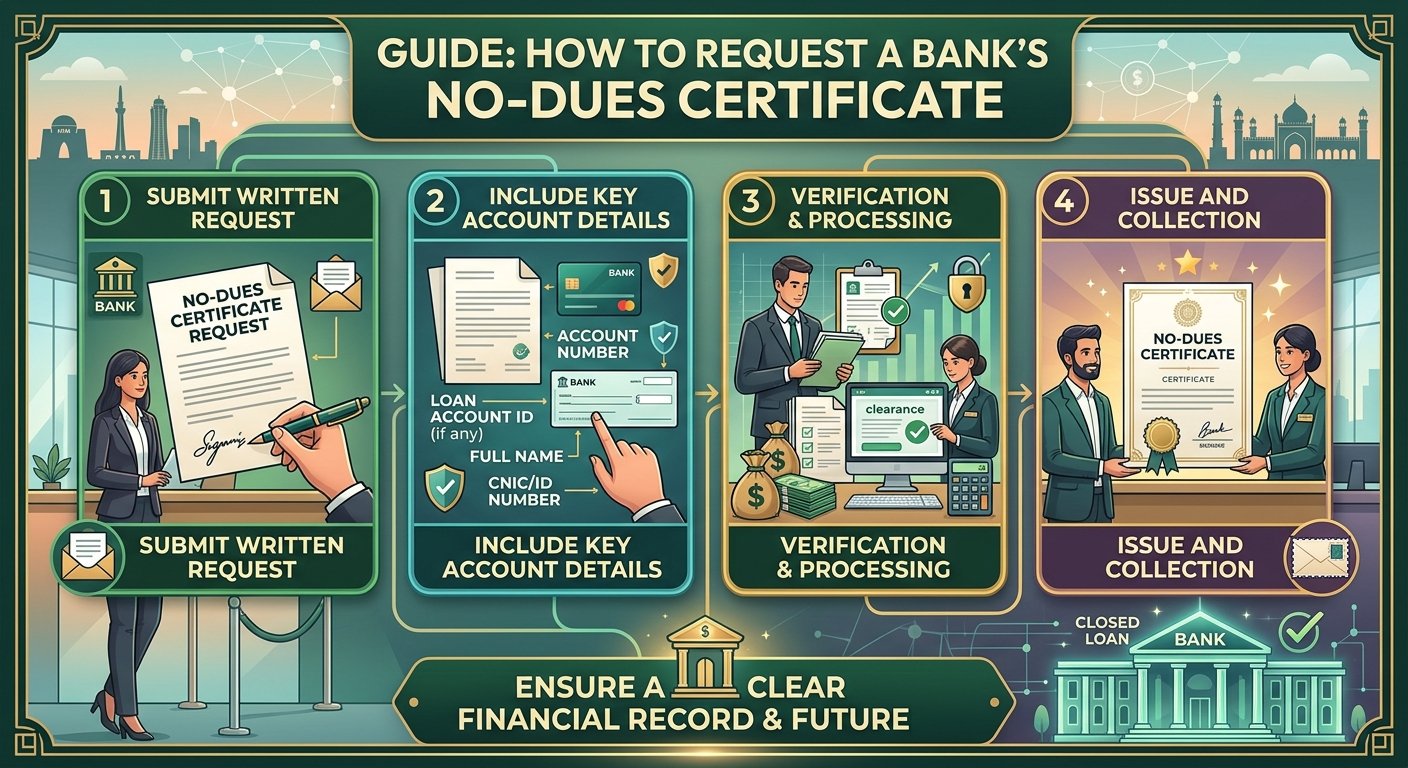
If you have paid off your bank loan, cleared your credit card balance or settled all outstanding payments, you may need a No-Dues Certificate from your bank. This document confirms that you have cleared your financial obligations for a particular loan or banking facility.
A No-Dues Certificate is also known as a Loan Clearance Certificate, No Liability Certificate or No Objection Certificate (NOC). It can be useful when applying for another loan, selling a financed vehicle, releasing property documents or keeping proof that your payments are complete.
In Pakistan, you can request this certificate from your bank after settling the outstanding amount. In this guide, we explain how to apply, which documents you need, how long the process may take and what to do if your bank delays issuing the certificate.
What Is a Bank No-Dues Certificate?
A No-Dues Certificate is an official document issued by a bank confirming that a customer has no outstanding payment against a particular loan or banking facility as of the certificate date.
For example, if you borrowed Rs. 2 million from a bank to purchase a car and have paid all instalments, you can request a No-Dues Certificate after the bank confirms that the loan has been fully settled.
The certificate generally includes:
- Your full name.
- Your CNIC number or other customer identification.
- Bank name and branch details.
- Loan or financing account number.
- Confirmation that the outstanding amount has been cleared.
- Loan settlement or closure date.
- Certificate issue date and reference number.
- Authorised bank signature or electronic verification.
The exact format depends on the bank and type of financing.
Why Do You Need a No-Dues Certificate from Your Bank?
A No-Dues Certificate provides written proof that you have completed your payment obligations for a particular banking facility.
Here are some common situations in which you may need this certificate:
1. After Paying Off a Bank Loan
If you have completed all instalments of a personal loan, car financing or home financing facility, you should request written confirmation from your bank.
This document can help prevent confusion about your remaining balance or payment history.
2. When Selling a Financed Vehicle
If you purchased a car through bank financing, the bank may have a lien or other security interest over the vehicle.
After completing the payments, you may need a loan clearance certificate and separate documents confirming that the bank’s claim or charge has been released.
Check the vehicle registration record and complete any required transfer or lien-removal process with the relevant excise and taxation authority.
3. When Applying for Another Loan
Some banks may ask for proof that an earlier loan has been settled before processing a new financing application.
A No-Dues Certificate can help confirm that you have cleared the previous facility. However, it does not guarantee approval for another loan.
4. After Closing a Credit Card
If you have paid your complete credit card balance and requested cancellation of the card, you may ask the bank for written confirmation of the outstanding balance and card closure.
Make sure that pending transactions, annual charges and other amounts have also been settled.
5. When Releasing Property Documents
If you purchased a house or property through bank financing, the bank may hold original property documents or maintain a registered charge as security.
After settling the financing, request the relevant clearance documents and ask the bank about the procedure for returning original documents and releasing its security interest.
How to Request a Bank’s No-Dues Certificate in Pakistan
You can request a No-Dues Certificate by contacting your bank’s branch or customer support department. The process may differ between banks, but the following steps generally apply.
Step 1: Clear All Outstanding Payments
Before requesting the certificate, make sure you have paid the complete outstanding amount.
This may include:
- Remaining loan principal.
- Outstanding profit or interest.
- Late payment charges, if applicable.
- Other amounts payable under your financing agreement.
Ask your bank for a final settlement statement if you are unsure about the remaining amount.
Step 2: Collect Your Payment Proof
Keep copies of your payment receipts and other documents showing that you have cleared your outstanding balance.
Useful documents include:
- Final loan instalment receipt.
- Bank transaction confirmation.
- Loan settlement statement.
- Account statement showing the cleared balance.
These documents can help the bank verify your payment history.
Step 3: Visit Your Bank Branch
Visit the branch that manages your loan or financing account. Ask the relevant officer or customer service representative how to apply for a No-Dues Certificate.
Some banks may accept requests through email, internet banking or customer support channels. However, others may require a signed written application or an in-person identity verification process.
Step 4: Submit a Written Application
Write an application requesting the bank to issue your No-Dues Certificate.
Include the following information:
- Your full name.
- Your CNIC number.
- Your loan or financing account number.
- Your contact number.
- The date of your final payment.
- Your request for a No-Dues Certificate.
Attach copies of the required documents and keep a receiving copy or application reference number for future follow-up.
Step 5: Complete Bank Verification
After receiving your application, the bank will check your payment records and outstanding balance.
If any amount remains unpaid, the bank may ask you to clear it before issuing the certificate.
If your account is fully settled, the bank can process your request according to its internal procedures.
Step 6: Collect Your No-Dues Certificate
Once the bank completes its verification, ask for the certificate in printed or electronic form.
Check that the document includes your correct name, loan details, settlement date and confirmation that no outstanding liability remains against the specified facility.
Keep the original certificate and a digital copy for your records.
Documents Required to Get a No-Dues Certificate
The documents required depend on your bank and the type of financing. However, you may generally need the following:
| Document | Purpose |
|---|---|
| CNIC Copy | Verifies your identity. |
| Loan Account Number | Identifies the financing facility. |
| Payment Receipts | Provides proof of completed payments. |
| Final Settlement Statement | Shows the remaining amount and settlement details. |
| Written Application | Officially requests the certificate. |
| Bank Statement | May help verify the final payment. |
Your bank may request additional documents depending on its verification requirements.
Sample Application for a Bank No-Dues Certificate
If your bank requires a written application, you can use the following format.
To,
The Branch Manager
[Bank Name]
[Branch Name and City]
Subject: Request for Issuance of No-Dues Certificate
Dear Sir/Madam,
I am writing to request the issuance of a No-Dues Certificate for my loan/financing account maintained with your bank.
I have completed all payments against the above-mentioned facility, and the outstanding amount has been fully settled.
My details are as follows:
- Name: [Your Full Name]
- CNIC Number: [Your CNIC Number]
- Loan Account Number: [Your Loan Account Number]
- Contact Number: [Your Mobile Number]
- Final Payment Date: [Date]
I kindly request you to verify my payment records and issue the No-Dues Certificate confirming that no outstanding amount remains against this financing facility.
Please let me know if any additional documents or information are required.
Thank you for your assistance.
Yours sincerely,
[Your Full Name]
[Signature]
[Date]
How Long Does a Bank Take to Issue a No-Dues Certificate?
The processing time depends on the bank, financing type and verification requirements.
Some banks may issue the certificate within a few working days, while other cases may take longer, especially when property documents, vehicle security or outstanding payment reconciliation is involved.
There is no single processing time that applies to every Pakistani bank and every type of No-Dues Certificate.
When submitting your application, ask the bank for:
- The expected processing time.
- Your application or complaint reference number.
- Any additional documents required.
- The method of collecting the certificate.
If the bank does not provide a clear response, follow up through its official customer complaint department.
Do Banks Charge a Fee for a No-Dues Certificate?
Charges depend on the bank, type of certificate and applicable Schedule of Bank Charges.
Some banks may issue certain clearance documents without a fee, while others may have charges for specific certificates, duplicate documents or related services.
Before submitting your application, ask your bank:
- Whether the certificate is free.
- Whether any processing or documentation fee applies.
- Whether a duplicate certificate has a separate charge.
Always ask for an official receipt if the bank collects a fee.
What Should You Do If the Bank Refuses to Issue a No-Dues Certificate?
If you have fully settled your loan but the bank refuses to issue a No-Dues Certificate, first ask for the reason in writing.
Follow these steps to resolve the issue:
- Check your outstanding balance: Ask the bank for a complete statement showing whether any amount remains payable.
- Provide payment proof: Submit your final payment receipt and settlement documents.
- Submit a written complaint: Contact the bank’s Complaint Management Unit (CMU).
- Keep your reference number: Save the complaint number and all communication with the bank.
- Escalate the matter: If the issue remains unresolved, approach the relevant banking complaint forum.
According to the State Bank of Pakistan, customers should first approach their bank to resolve banking complaints. If the bank does not respond within the applicable period or the customer is not satisfied with the response, the matter may be referred to Banking Mohtasib Pakistan or SBP, depending on the type of institution and complaint.
You can submit banking complaints through the official SBP Sunwai Complaint Portal.
For complaints against eligible scheduled banks, you can also visit the Banking Mohtasib Pakistan website.
Does a No-Dues Certificate Clear Your Credit History?
No. A No-Dues Certificate confirms that you have settled the specified financial obligation, but it does not automatically remove your previous repayment history from the banking system.
For example, if you made late payments during your loan period, that history may continue to appear in your credit information records even after the loan has been fully paid.
According to the State Bank of Pakistan:
- Banks and financial institutions are responsible for reporting accurate borrower information.
- After settlement of overdue liabilities, banks must make an online interim update immediately and no later than 10 days.
- The previous overdue history can continue to appear in the eCIB record for the applicable retention period.
SBP’s current FAQ explains that overdue history remains visible for 12 months after settlement. The treatment of older records and other private credit bureau information may differ under the applicable rules.
If your bank has not updated your settled loan information correctly, contact the reporting bank and request a correction.
What Is the Difference Between a No-Dues Certificate and an NOC?
People often use the terms No-Dues Certificate and NOC interchangeably. However, their exact meaning can depend on the document and purpose.
| Document | Purpose |
|---|---|
| No-Dues Certificate | Confirms that no outstanding payment remains against a specified facility. |
| Loan Clearance Certificate | Confirms that a particular loan has been fully settled. |
| No Objection Certificate (NOC) | Confirms that the bank has no objection to a specified action or transaction. |
| Security Release Letter | Confirms the release of the bank’s security interest, subject to the required formalities. |
For example, paying off a car loan may allow you to obtain a loan clearance certificate. You may still need separate documents or formalities to remove the bank’s lien from the vehicle registration record.
Important Things to Check After Receiving Your No-Dues Certificate
After receiving the certificate, carefully check the information before storing it.
- Make sure your name is spelled correctly.
- Check your CNIC or customer identification details.
- Verify the correct loan or financing account number.
- Confirm that the certificate states the facility has been fully settled.
- Check the issue date and reference number.
- Confirm whether any separate security release process is required.
- Keep a scanned copy and the original document safely.
If you notice an error, contact the bank immediately and request a corrected certificate.
Frequently Asked Questions (FAQs)
1. How can I get a No-Dues Certificate from my bank in Pakistan?
First, clear all outstanding payments. Then contact your bank, submit a written application with your CNIC and loan details, and request a No-Dues Certificate. The bank will verify your payment records before issuing the document.
2. Can I request a No-Dues Certificate online?
Some banks accept certificate requests through email, mobile banking or internet banking. Other banks require a written application or branch visit. Contact your bank to confirm the available options.
3. Can I get a No-Dues Certificate after paying my car loan?
Yes. After completing all car financing payments, you can request a loan clearance certificate from your bank. You may also need separate documents to release the bank’s lien or security interest over the vehicle.
4. Is a No-Dues Certificate the same as a loan closure letter?
They may serve a similar purpose, but the exact wording can differ. Both documents may confirm that a loan has been settled. Check that your certificate clearly identifies the facility and confirms that no outstanding liability remains.
5. How many days does a bank take to issue a No-Dues Certificate?
There is no single fixed timeline for all Pakistani banks. Some banks may issue the certificate within a few working days, while other cases may require additional verification. Ask your bank for its expected processing time.
6. Is a No-Dues Certificate free in Pakistan?
Charges depend on the bank and type of certificate. Ask your bank for its latest Schedule of Bank Charges before submitting your request.
7. Can I get a No-Dues Certificate if I have missed loan instalments in the past?
Yes, you can request a certificate after fully settling the loan. However, previous late payments may continue to appear in your credit information history for the applicable reporting period.
8. What should I do if my bank does not issue my certificate?
Submit a written complaint to your bank’s Complaint Management Unit and provide proof of your final payment. If the issue remains unresolved, you may approach Banking Mohtasib Pakistan or the relevant SBP complaint channel.
9. Does a No-Dues Certificate remove my name from eCIB?
No. The certificate confirms settlement of your loan, but it does not automatically erase previous repayment history. Your bank is responsible for updating the relevant credit information accurately.
10. Do I need a No-Dues Certificate after closing a credit card?
It is useful to obtain written confirmation that your outstanding balance has been cleared and the credit card account has been closed. This can help prevent future disputes about unpaid amounts or pending charges.
Conclusion
Getting a No-Dues Certificate from a bank in Pakistan is an important step after completing your loan payments or settling a credit facility. It provides written proof that you have cleared your outstanding financial obligations.
To request the certificate, settle your balance, collect your payment receipts, submit a written application and complete the bank’s verification process. Always check the certificate carefully and keep a copy for future use.
If your bank delays or refuses to issue the document despite full settlement, raise a written complaint and follow the official banking complaint procedure.
