


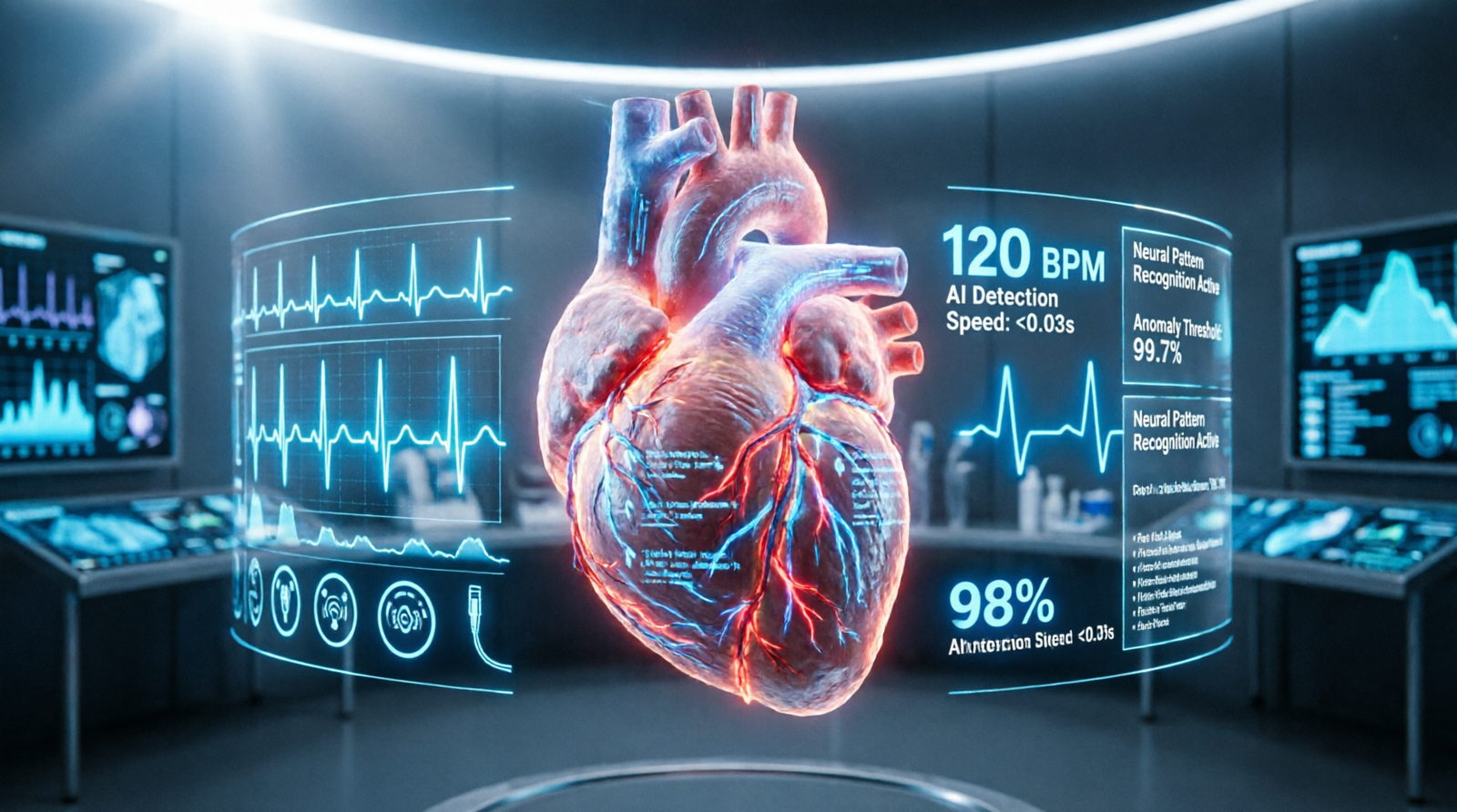
A routine test that’s been around for a century just got a serious upgrade. Researchers have unveiled a superhuman AI heart disease detection tool capable of spotting warning signs from a standard electrocardiogram (ECG) in under two seconds — reading details in the heart’s electrical activity that are effectively invisible to the human eye. Unveiled at the European Society of Cardiology’s annual congress in Munich, the world’s largest heart conference, the breakthrough could reshape how millions of people are screened for two of the most common forms of heart disease.
Why This Matters: A Gap Standard ECGs Couldn’t Fill
An ECG has been a cornerstone diagnostic tool for a century, recording the heart’s electrical activity, including its rate and rhythm, to help diagnose heart attacks and abnormal rhythms. But on its own, a standard ECG can’t detect heart disease itself — that has traditionally required an echocardiogram, an ultrasound scan of the heart that patients often wait months to access after being referred. This new AI tool closes that gap by extracting far more diagnostic information from the same routine ECG than a doctor could typically see, allowing it to flag two of the most common forms of heart disease directly from a test most patients have already had.
The Science: What the AI Model Actually Does
Developed by a team including researchers at Imperial College London, the model was trained on millions of hospital ECG recordings and then tested on tens of thousands of patients. In one trial involving 67,000 patients in the United States, the tool correctly identified up to 81% of patients who had heart failure and up to 90% of those with heart valve disease — both from nothing more than a routine ECG trace. Dr. Ahmed El-Medany, a British Heart Foundation clinical research fellow who led the Imperial College London analysis, described the tool as “superhuman AI,” noting that the next major challenge is designing handheld AI-led ECG readers healthcare professionals could use directly at the point of care.
Not a One-Off: Part of a Broader Research Program
This latest tool builds on a longer running body of work from the same Imperial College London group, rather than representing a single sudden breakthrough. The team has previously demonstrated that AI can read an ECG to estimate a patient’s future risk of valve leaks, complete heart block, and even early death — work detailed in a study published in the European Heart Journal, which found the AI could correctly identify the risk of a future leaky heart valve in roughly 69–79% of cases, with patients flagged as “high-risk” going on to be up to 10 times more likely to actually develop the disease. That earlier research has since been spun out into a company, Cardiovolt.ai, aimed at bringing these AI-powered readings to wider clinical use.
The approach isn’t unique to this one team either. A separate model developed in New York, called EchoNext, was evaluated in a Nature study and similarly detected multiple forms of structural heart disease from ECG traces — reportedly outperforming cardiologists in controlled testing.
Why “Opportunistic” Screening Could Be the Real Game-Changer
Beyond speeding up diagnosis for patients already suspected of having heart problems, researchers see an even bigger potential use: catching disease in people who had no reason to suspect anything was wrong. Professor Fu Siong Ng, a professor of cardiology at Imperial College London, explained that the AI model could theoretically be run on every ECG performed in a hospital, regardless of the original reason for the test, to flag patients at the highest risk of heart failure or valve disease so they can be diagnosed earlier. Given that roughly a billion ECGs are performed worldwide each year, that kind of large-scale, opportunistic screening could meaningfully shift how early heart disease gets caught — well before symptoms like breathlessness, dizziness, or palpitations become severe enough to prompt a specialist referral.
Why Early Detection Matters So Much Here
Heart failure and heart valve disease are notoriously difficult to catch early because their symptoms are easy to mistake for other, less serious causes, and some patients show no symptoms at all until the disease has already progressed significantly. Globally, an estimated 41 million people live with heart valve disease, including around 1.5 million people in the UK alone. Since Professor Ng noted that patients can often wait several months for an ultrasound scan after a referral, a tool that instantly flags who needs to be prioritized could meaningfully shorten that wait for the people who need it most — potentially getting life-saving medication to patients sooner, before their condition becomes dangerously advanced.
What’s Next
Munich delegates also heard about a related, parallel development: AI-based analysis of facial videos that can rapidly and accurately detect undiagnosed high blood pressure, suggesting this broader wave of AI-assisted cardiac screening extends beyond ECGs alone. For the heart disease detection tool specifically, the next step researchers are targeting is developing handheld, AI-led ECG devices that could bring this kind of rapid screening directly into routine clinical settings, rather than requiring specialized equipment or lengthy analysis.
Frequently Asked Questions
How accurate is the new AI heart disease detection tool?
In a trial of 67,000 patients in the US, the tool identified up to 81% of patients with heart failure and up to 90% of those with heart valve disease, using only a standard ECG.
What is the difference between an ECG and an echocardiogram?
An ECG records the heart’s electrical activity and rhythm, while an echocardiogram is an ultrasound scan that images the heart’s structure. Traditionally, only an echocardiogram could detect heart disease itself, which is why this new AI tool — working from a standard ECG — is significant.
Is this AI tool available to patients now?
Not yet for widespread clinical use. It was presented as research findings at a major cardiology conference, and researchers are still working toward developing practical tools, like handheld AI-led ECG readers, for real-world clinical settings.
Who developed this technology?
Researchers including a team at Imperial College London, building on a longer research program that has also produced a related company, Cardiovolt.ai, focused on bringing AI-powered ECG analysis into wider use.
This is a promising area of ongoing medical research rather than an available clinical test, so anyone with concerns about their heart health should speak with a doctor about standard diagnostic options rather than waiting for this technology to become widely available.
