


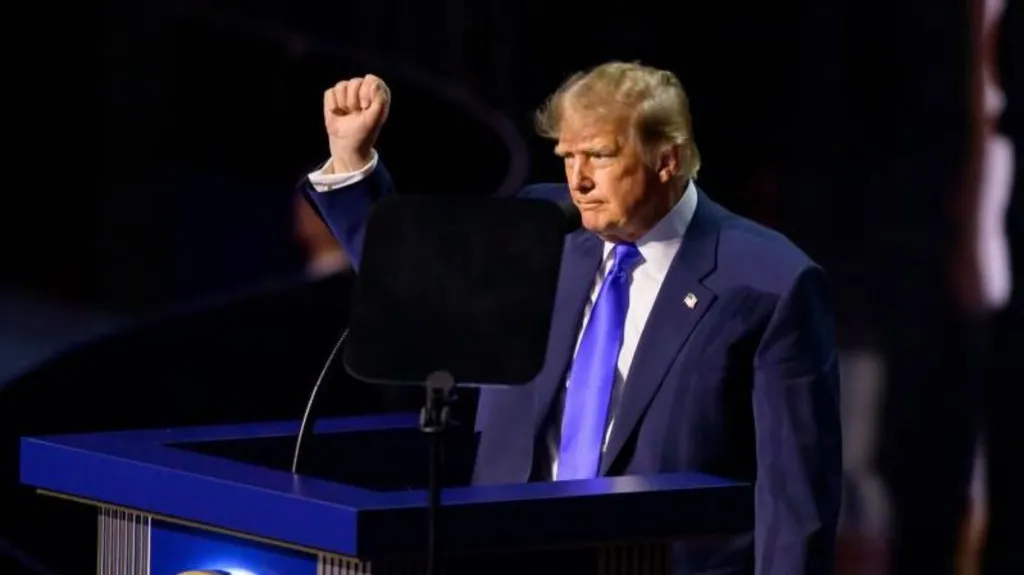
President Donald Trump has promised a $5,000 “dividend” to every adult American citizen if Republicans hold onto control of both chambers of Congress in November’s midterm elections — a pledge he unveiled during a high-profile speech that immediately drew questions about its legality and funding.
What Trump Said
Speaking at the Republican Party’s midterm convention in Dallas, Trump laid out the offer directly: if Republicans win both the House of Representatives and the Senate, he said he would issue a $5,000 dividend to every adult citizen, comparing it to a successful company distributing cash to its shareholders. He dubbed it the “Trump Dividend” and told the crowd the money would need to be spent inside the United States, specifically naming Canada, China, and Germany as places the money shouldn’t go — though he didn’t explain how that restriction would actually be enforced.
Trump framed the payment as something the country could afford because of what he described as strong economic performance and tariff revenue, contrasting it with Democratic policies he characterized as leading to poverty.
Key Unanswered Questions
- Legal authority: A payment of this scale would almost certainly require congressional approval, meaning Trump can’t simply order it into existence even if Republicans do win control of Congress
- Funding source: Vice President JD Vance suggested the payments could be financed through tariff revenue, which totaled around $154.5 billion over the first 10 months of fiscal 2026 through July — a figure that would need to stretch across roughly 270 million American adults if the payment were truly universal
- Who actually qualifies: Despite Trump’s “every adult citizen” framing, Vance later narrowed the proposal, suggesting wealthy Americans would not be eligible — a detail that contradicts the blanket promise made on stage
- Enforcement of the spending condition: There’s no clear mechanism described for ensuring recipients actually spend the money domestically as instructed
A Pattern of Unfulfilled Payment Promises
This isn’t the first time Trump has floated a large direct payment to Americans without it materializing. Earlier this year, he repeatedly promised $2,000 “tariff dividend” checks to working- and middle-class Americans, writing on social media that the payments would exclude “high income people.” Those checks never went out, and Republican lawmakers — including Rep. David Schweikert of Arizona — publicly questioned whether the math behind the proposal even worked. Trump also previously endorsed a $5,000 “DOGE dividend” floated by Elon Musk during the administration’s government-spending-cuts push last year, which similarly never came to fruition.
Reaction From Republican Lawmakers
The response from within the GOP has been mixed in tone. Sen. Bernie Moreno of Ohio publicly endorsed the dividend proposal and said he would prepare legislation to pursue it after the election — offering at least one concrete legislative commitment tied to the pledge. Other Republican voices have been more cautious, given the unresolved questions around funding and legal authority that surrounded Trump’s earlier, similarly unfulfilled payment promises.
The Political Context
The pledge came during Trump’s keynote address on the first night of the Republican National Committee’s first-ever midterm convention, an event aimed at rallying support for GOP candidates roughly two months ahead of the November 3 midterms. Throughout the speech, Trump framed the election in high-stakes terms, telling the audience that a Democratic win would cost Americans their border security, tax cuts, and financial security. Current polling and projections cited in coverage of the speech suggest Democrats are favored to win control of the House, adding pressure to the GOP’s messaging heading into the final stretch of the campaign.
Final Thoughts
Whether the “Trump Dividend” becomes a genuine legislative push or joins the list of previously announced payments that never reached Americans’ bank accounts will depend heavily on the midterm results themselves, and on whether congressional Republicans — who ultimately control the purse strings — decide to turn the pledge into an actual bill. With basic details like eligibility, funding, and enforcement still unresolved just hours after the announcement, the proposal remains, for now, a campaign promise rather than a policy.
