


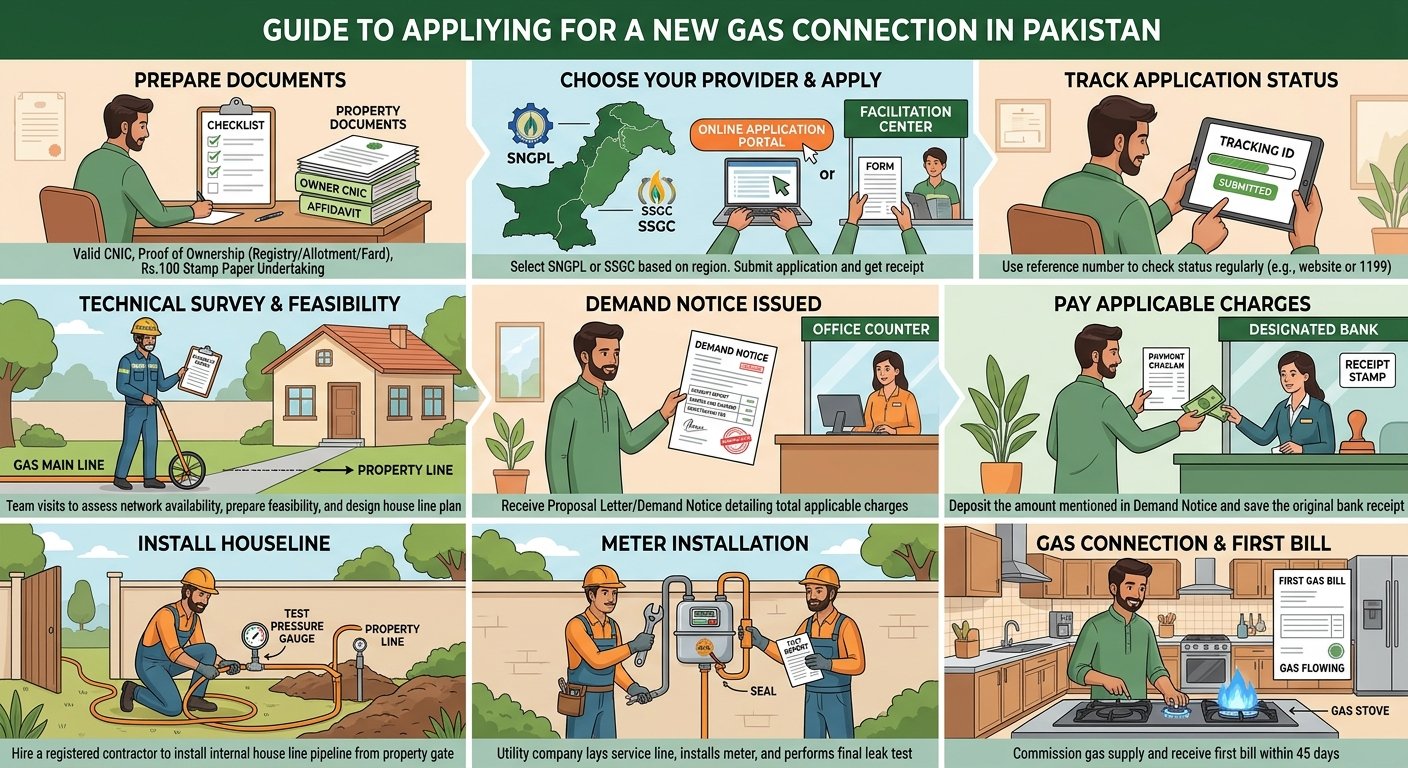
For years, getting a new Sui gas connection in Pakistan was almost impossible because of a ban on new domestic connections. That has changed, but the process is not the same as before. This guide explains how to apply for a new gas connection in Pakistan: which company serves your area, what the RLNG rule means for you, what documents to prepare, and what the fees look like.
Is the Ban on New Gas Connections Over?
Mostly, yes, with a big change. Reports say the government lifted the long-standing ban on new domestic connections in September 2025 and told SNGPL and SSGC to start giving connections again. The catch is that new domestic connections are now given on imported gas, called RLNG (re-gasified liquefied natural gas), and not on the old “system gas”. One guide says RLNG usually costs more per month than the older connections your neighbours may have.
Several guides also say old system-gas applications and merit-list positions were cancelled, so people who applied years ago need to apply again. Check the status in your own area, because capacity differs.
SNGPL or SSGC: Who Serves You?
| Feature | SNGPL | SSGC |
|---|---|---|
| Area | Punjab, Khyber Pakhtunkhwa, and Islamabad | Sindh and Balochistan |
| Application fee | Free, according to guides | Free, according to guides |
| How to apply | Online portal, or at a regional office | Guides disagree. One says there is an online page, another says applications must be made in person |
| Fast-track option | Guides say yes, with an extra urgent fee of about Rs. 25,000, though amounts differ | One guide says it is not offered on the domestic form |
First check which company owns the pipeline on your street. Then follow that company’s own process on its website.
Documents You Will Probably Need
- Your CNIC, front and back
- Proof of ownership: a registry, Fard, allotment letter, or sale deed
- A neighbour’s recent gas bill, or the neighbour’s consumer or meter number, to show that gas is nearby
- A completed RLNG contract form, available on the SNGPL or SSGC website
- An affidavit on stamp paper, where required
- An approved building plan with a QR code, if you live in a development scheme
- A society NOC, if your house is inside a housing society
- For a rented house: the landlord’s CNIC and NOC, and your tenancy agreement
Tenants can apply too, according to the guides, if they have the landlord’s NOC. Use the checklist on your gas company’s website, since requirements can change.
Step by Step: How to Apply
- Confirm your gas company and check that a gas pipeline exists near your house.
- Get the form. Download the domestic RLNG connection form from the SNGPL or SSGC website, or collect it from the regional office. Fill it in using capital letters.
- Attach your documents. Use clear copies.
- Submit the application, online or in person, depending on your company.
- Wait for the survey. The company checks the site and decides if a connection is possible.
- Receive the demand notice. If your application is approved, you get an official notice that shows exactly what you must pay and the deadline. It may include the service line, meter, security deposit, and taxes.
- Pay at the bank named on the demand notice.
- Installation. The company lays the service line and installs the meter. Do not let a private plumber connect gas without the company’s approval.
If there is no gas network in your area, the company may ask you to request a network extension before a connection can be given.
How Much Does It Cost?
Applying is reported to be free. Costs come after approval, and sources do not agree:
- A Pakistan Observer report on the decision to lift the ban listed a security deposit of Rs. 20,000, and a connection fee of Rs. 21,000 for houses up to 10 marla and Rs. 23,000 for larger ones.
- Other guides give slightly different totals, such as fees starting from Rs. 21,500 or Rs. 23,000, and an urgent fee of about Rs. 25,000 for SNGPL’s fast track.
These figures are not a quote. Your demand notice will show the actual amount, so use it instead of any blog figure. Never pay anyone other than the bank listed on the notice.
How Long Does It Take?
There is no fixed time. One guide says SSGC takes 3 to 6 months officially, but a more realistic 6 to 12 months in practice, and that fast-track SNGPL cases are quicker. Delays can happen if documents are incomplete or if the area has gas pressure problems.
Can You Check Your Application Status?
Some guides say you can check SNGPL application status online using your CNIC or application number. Use only the official SNGPL or SSGC website. Do not enter your CNIC on lookalike “gas bill” or “status check” sites.
Common Mistakes to Avoid
- Applying for system gas when only RLNG is being given
- Missing documents, such as the neighbour’s bill, NOC, or building plan
- Paying agents who promise a quick connection
- Connecting gas through a neighbour or a private fitter, which is unsafe and illegal
- Using a lookalike website instead of the official one
Frequently Asked Questions
Can I get a new gas connection in 2026?
Yes, reports say new domestic connections reopened in September 2025, under the RLNG policy. Availability depends on your area.
What is RLNG?
Imported liquefied natural gas that is turned back into gas. New domestic connections are given on it, and it is reported to cost more per month than system gas.
Is there a fee to apply?
Guides say the application is free. Charges come after approval, on your demand notice.
Can a tenant apply?
Guides say yes, with the owner’s NOC and CNIC.
What is a demand notice?
It is the official document the company issues after approving your application. It shows what you must pay, where, and by when.
Getting a new gas connection is possible again, but it takes preparation. Pick the right company, gather your documents, and pay only what the demand notice asks for.
