


Why is your electricity bill so high? Before you blame the meter, find out which appliances use the most power. You can calculate electricity usage yourself with one simple formula and the wattage printed on each appliance. This guide explains the steps, gives Pakistan-based examples, and shows how to turn units into rupees.
The Basic Formula to Calculate Electricity Usage
Your electricity bill is charged in units. One unit equals one kilowatt-hour (kWh). Appliances are labelled in watts, so you need to convert.
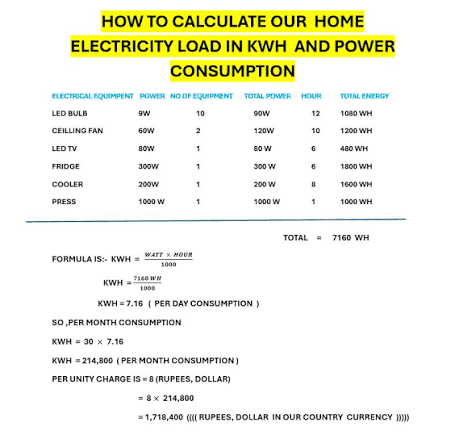
Units (kWh) = Watts × Hours used ÷ 1,000
For example, a 100-watt TV used for 5 hours uses 100 × 5 ÷ 1,000 = 0.5 units. If you use it every day for a month, multiply by 30 and you get 15 units.
Step-by-Step Method
- Find the wattage. Look at the label on the back or bottom of the appliance, or in the manual.
- Estimate the daily hours. Be honest about how long it really runs.
- Calculate daily units. Multiply watts by hours and divide by 1,000.
- Calculate monthly units. Multiply daily units by 30.
- Calculate the cost. Multiply monthly units by your price per unit.
What If the Label Shows Amps, Not Watts?
Some labels show current in amps and voltage. In that case, use this formula:
Watts = Volts × Amps
Pakistan’s household supply is about 230 volts. So a pump labelled 3.2 amps uses roughly 230 × 3.2 = 736 watts.
Typical Appliance Usage Examples
The wattages below are typical values only. Always check your own appliance label, because models differ a lot. The table assumes 30 days a month.
| Appliance | Typical Watts | Hours per Day | Units per Month |
|---|---|---|---|
| LED bulb | 10 W | 6 | 1.8 |
| Ceiling fan | 75 W | 10 | 22.5 |
| LED TV | 100 W | 5 | 15 |
| Refrigerator (average running) | 150 W | 8 | 36 |
| Washing machine | 500 W | 1 | 15 |
| Electric iron | 1,000 W | 0.5 | 15 |
| Water pump (1 hp) | 750 W | 1 | 22.5 |
| 1.5-ton air conditioner | 1,400 W | 8 | 336 |
This table shows why air conditioners matter so much. One AC running 8 hours a day can use more than all the other appliances put together.
Refrigerators and ACs: Use Running Hours, Not 24 Hours
Fridges and air conditioners do not run at full power all day. Their compressors switch on and off. Therefore, estimate the hours the compressor actually runs. A fridge may run for about a third of the day, and an inverter AC often draws far less than its maximum once the room cools. For a more accurate figure, use a plug-in energy meter.
How to Turn Units Into Rupees
Multiply units by the price of one unit. Pakistan’s base tariff depends on your category and slab. Reported 2026 base rates for unprotected homes run from about Rs22.44 per unit for the first 100 units up to Rs47.20 above 700 units. Protected homes using 200 units or fewer pay about Rs10.54 and Rs13.01 per unit. Fixed charges, fuel adjustments, and taxes come on top.
For a sample calculation, take a fan that uses 22.5 units a month. If your slab rate is Rs33.10 per unit, the fan costs about 22.5 × 33.10 = Rs745 a month before taxes.
The simplest way to find your real cost per unit is to divide your total bill by the units on it. Use that all-in figure for your estimates, because it already includes taxes and charges.
Check Your Estimate Against Your Bill
- Add up the monthly units for all your appliances.
- Compare the total with the units shown on your bill.
- A large gap means your hours are off, or an old appliance uses more power than its label says.
- Check standby power too. TVs, routers, and chargers draw a small amount all day.
Simple Ways to Cut Your Units
- Replace old bulbs with LED lights.
- Use inverter air conditioners and set the thermostat higher.
- Choose energy-efficient DC fans for long hours.
- Run washing machines and pumps with full loads and for shorter times.
- Unplug chargers and devices you do not use.
- Keep fridge doors closed and the coils clean.
If you plan solar panels, these numbers also help you size the system. See our guide to applying for solar net metering for the steps.
Frequently Asked Questions
How do I convert watts to units?
Multiply watts by hours used, then divide by 1,000. The result is in units, also called kilowatt-hours.
How many units does a 1,000-watt appliance use in one hour?
It uses exactly 1 unit (1 kWh).
Which appliance uses the most electricity at home?
Air conditioners and electric geysers usually use the most, followed by water pumps and fridges.
How can I find the wattage of an appliance?
Check the label or manual. You can also multiply volts by amps, or use a plug-in watt meter.
Why does my bill show more units than my calculation?
You may have underestimated the hours, forgotten standby power, or have an old appliance that draws more power than the label says.
Conclusion
To calculate electricity usage, multiply an appliance’s watts by the hours it runs, divide by 1,000, and multiply by 30 for the month. Then multiply by your price per unit to estimate the cost. Do this for your biggest appliances first, usually the AC, fridge, and pump. Tariffs and charges can change, so use the figures on your own bill for the final amount. For more guides on public services and daily costs, keep following Pakistan Post. You can also check official tariff notices on the NEPRA website.
