


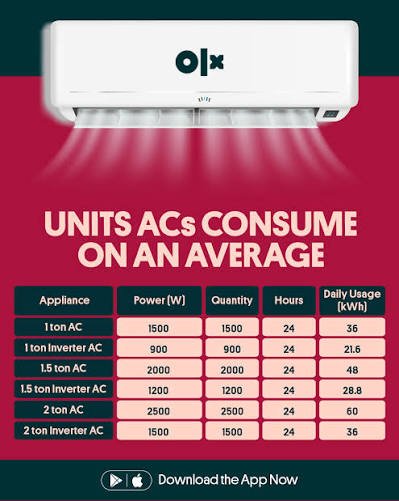
An inverter AC is cheaper to run than an old fixed-speed AC, but it can still add thousands of rupees to your summer bill. The good news is that you can estimate your inverter AC electricity cost before the bill arrives. This guide shows a simple method, realistic units-per-hour figures for Pakistan, and a worked example that uses the tariff slabs.
Why an Inverter AC Has No Single Wattage
A normal AC compressor runs at one fixed speed. An inverter AC changes speed. It works hard at the start to cool the room, then slows down and draws far less power. Therefore, the wattage on the label is only the maximum, not what the AC uses on average.
Reports for Pakistan suggest a 1.5-ton inverter AC can draw around 1,500 to 1,800 watts when it starts and settle to roughly 500 to 900 watts once the room is cool. Your real figure depends on room size, sunlight, insulation, and temperature setting.
Units Per Hour for a 1.5-Ton Inverter AC
Many Pakistani guides use about 1 unit (1 kWh) per hour as a rough average. The thermostat setting changes this a lot. The table below shows planning estimates for a 1.5-ton unit running 8 hours a day for 30 days.
| Thermostat Setting | Estimated Units per Hour | Units per Month (8 hours a day) |
|---|---|---|
| 18 to 20°C (high demand) | About 1.8 | About 432 |
| 22 to 24°C (moderate) | About 1.1 | About 264 |
| 26°C (eco style) | About 0.65 | About 156 |
These are estimates, not measurements. Other sources give averages between 0.9 and 1.5 units per hour. A 1-ton unit uses less, roughly 0.7 units per hour, and a 2-ton unit uses more.
Step-by-Step Method to Estimate the Cost
- Find the rated input power. Check the label on the outdoor unit or the manual. A 1.5-ton inverter often shows around 1,200 to 1,500 watts.
- Estimate average load. Assume the AC averages about 70 percent of its rated input once it settles. For 1,450 watts, that is roughly 1,000 watts, or 1 unit per hour.
- Count your hours. Decide how many hours a day you run it.
- Calculate monthly units. Units per hour × hours per day × 30.
- Calculate the cost. Use your slab rate, as shown in the example below.
For example, 1 unit per hour × 8 hours × 30 days = 240 units a month.
Why the AC Costs More Than You Expect
Pakistan’s tariff uses slabs. For unprotected homes, once your total units cross a slab line, all units are charged at the higher rate. Therefore, an AC does not just add its own units. It also pushes your whole bill into a more expensive slab.
Reported 2026 base rates for unprotected homes are about Rs33.10 per unit for 201 to 300 units, Rs36.46 for 301 to 400, Rs38.95 for 401 to 500, and Rs40.22 for 501 to 600 units. These do not include fixed charges, fuel adjustments, or taxes.
Worked Example
Suppose a home uses 300 units a month without the AC, and the AC adds 240 units.
| Case | Total Units | Slab Rate | Base Energy Charge |
|---|---|---|---|
| Without AC | 300 | Rs33.10 | About Rs9,930 |
| With AC | 540 | Rs40.22 | About Rs21,719 |
| Extra cost from the AC | 240 | About Rs11,789 |
Taxes and charges are extra, so the real extra is higher. This also shows why raising the thermostat matters. If the same AC used only 156 units, the home would total 456 units at Rs38.95, which is about Rs17,761. That is about Rs3,958 less than in the first case, before taxes.
A Simple Check Using Your Own Bills
The most reliable method uses your actual bills.
- Compare a summer month with a winter month that has similar usage otherwise.
- Subtract the winter units from the summer units. The difference is mostly your AC and fans.
- Divide that difference by the hours you ran the AC to get units per hour.
You can also use a plug-in energy meter or a clamp meter. Read the amps once the room is cool, then multiply by 230 volts to get watts.
How to Reduce Your Inverter AC Cost
- Set the thermostat at 24 to 26°C. Each degree higher can cut consumption noticeably.
- Keep doors and windows shut, and use curtains to block the afternoon sun.
- Clean the filters every few weeks.
- Use a ceiling fan to spread the cool air.
- Avoid switching the AC on and off, because the restart draws the most power.
- Service the unit before summer, and check the outdoor unit for dust and blocked airflow.
- Choose the right size for the room, because a unit that is too small runs at full power all day.
To understand the rest of your bill, read our guide on how to calculate electricity usage from appliance wattage.
Frequently Asked Questions
How many units does a 1.5-ton inverter AC use per hour?
It varies between about 0.65 and 1.8 units per hour, depending on the setting and the room. About 1 unit per hour is a common average.
How many units does it use in a month?
At 8 hours a day, roughly 156 to 432 units, with about 240 units at a typical average.
Why does my bill jump so much in summer?
The AC adds units and can push your total into a higher slab, which raises the rate on all your units.
Is an inverter AC cheaper than a non-inverter AC?
Yes. Reports suggest it uses roughly 30 to 50 percent fewer units, since a non-inverter 1.5-ton unit draws around 1.8 to 2.0 units per hour.
What is the best thermostat setting to save money?
Between 24 and 26°C gives a good balance between comfort and cost.
Conclusion
To estimate your inverter AC electricity cost, multiply units per hour by your daily hours and 30, then price those units using your slab rate. Remember that an AC can push your whole bill into a higher slab, so the real cost is more than its own units. Use your bills and a plug-in meter to check your estimate. Tariffs can change, so confirm rates on your bill. For more guides on daily costs, keep following Pakistan Post. You can also check tariff notices on the NEPRA website.
