


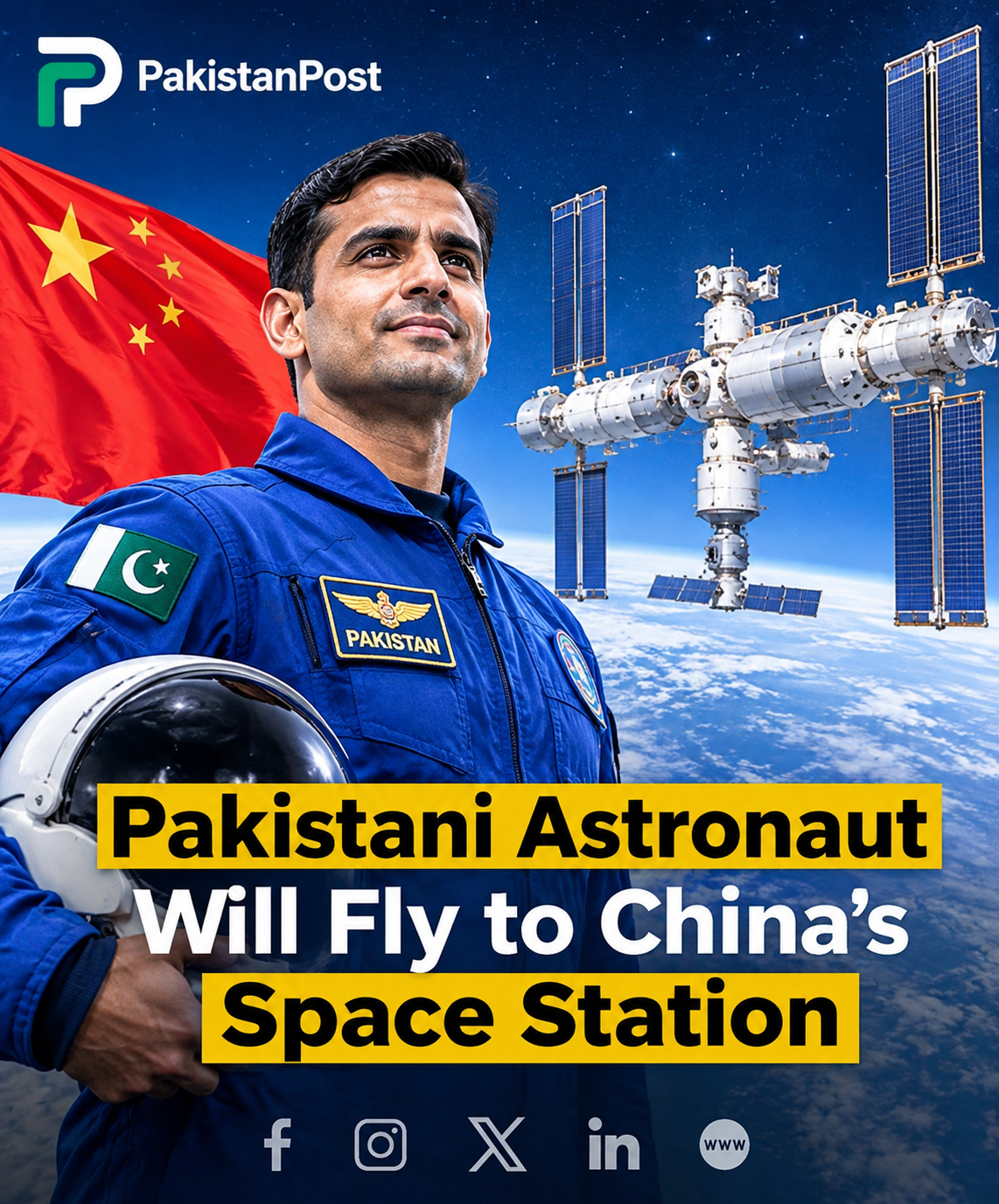
China has announced that a Pakistani astronaut will fly to its Tiangong space station on the Shenzhou-24 mission. He will be the first foreign visitor to the station. China has not named him, and no launch date has been given. Here is what is known, who the two candidates are and what is still unclear.
What Was Announced
Chinese state media reported the news on Saturday, 7 November 2026. Reuters says the broadcaster CCTV cited the China Manned Space Agency (CMSA). The Pakistani astronaut will go as a payload specialist on a short flight. This would be the first time a foreign national visits China’s space station. The AP and Reuters both call it the first joint flight of Chinese and foreign astronauts in China’s crewed space programme.
Who Is the Astronaut?
The CMSA has not named the person. Two Pakistani candidates have been training in China:
- Muhammad Zeeshan Ali
- Khurram Daud
AFP, in Arab News, says the CMSA said in April that these two had been chosen to begin training in China. None of the reports I read say which one will fly. Reuters says the two spent months at the China Astronaut Research and Training Centre in Beijing. The AP says their training included hands-on operational skills and intensive Chinese-language lessons.
When Will It Happen?
- Launch date: Not announced, according to Reuters.
- Timing: AFP says the mission is expected by the end of 2026.
- Length of stay: Not stated. Reuters, AP and AFP all describe a “short” flight. Wikipedia says one week, but I could not confirm that from an official source.
- Return: Reuters, AP and AFP say he will return to Earth aboard the Shenzhou-23 spacecraft. Shenzhou-23 docked at Tiangong in May. So he flies up on Shenzhou-24 and comes back with the Shenzhou-23 crew’s spacecraft. This is my reading of the reports, and none of them explain it.
The Shenzhou-24 Mission
Wikipedia lists Shenzhou-24 as planned, on a Long March 2F rocket from Jiuquan, with three Chinese astronauts who are not yet named. It gives a planned stay of 180 days. It also lists October 2026 as the launch date, which does not match the news reports, so that date appears to be out of date. I did not confirm the crew or the date from the CMSA.
Why Pakistan Is Flying
AP and AFP say the flight comes from an agreement between Pakistan and China signed in February 2025. AFP says the deal set up a Chinese government training programme for Pakistani astronauts. Under it, Pakistani astronauts will do short missions with Chinese counterparts over the “next few years,” according to Xinhua. Reuters describes the flight as cooperation under China’s Belt and Road Initiative and part of China’s “space diplomacy.” The terms of the agreement are not given in these reports.
Wider Context
AP says China plans to land astronauts on the Moon by 2030, while NASA aims to land astronauts there in 2028. AP calls the United States China’s main space rival. AFP notes that China is Pakistan’s largest trading partner and a major foreign investor.
What I Could Not Confirm
- Which candidate will fly.
- The launch date and the length of the stay.
- The names of the Chinese crew.
- The terms of the 2025 agreement, including who pays.
- The CMSA’s own statement. I read it only through Reuters, AP and AFP.
The information comes from Chinese state media and official announcements, and the reports do not check the schedule independently.
Frequently Asked Questions
Who is the Pakistani astronaut going to the Chinese space station?
China has not said. The two candidates are Muhammad Zeeshan Ali and Khurram Daud.
What will he do on the station?
He will go as a payload specialist on a short flight, according to Reuters and AFP.
When is Shenzhou-24 launching?
No date has been announced. AFP says it is expected by the end of 2026.
Is he the first foreigner on China’s space station?
Yes, he would be the first foreign national to visit it, according to the AP and Reuters.
How did Pakistan get this chance?
Through a February 2025 agreement between Pakistan and China.
How will he come back?
On the Shenzhou-23 spacecraft, according to Reuters, AP and AFP.
Wait for the CMSA to name the astronaut and announce the launch date.
