


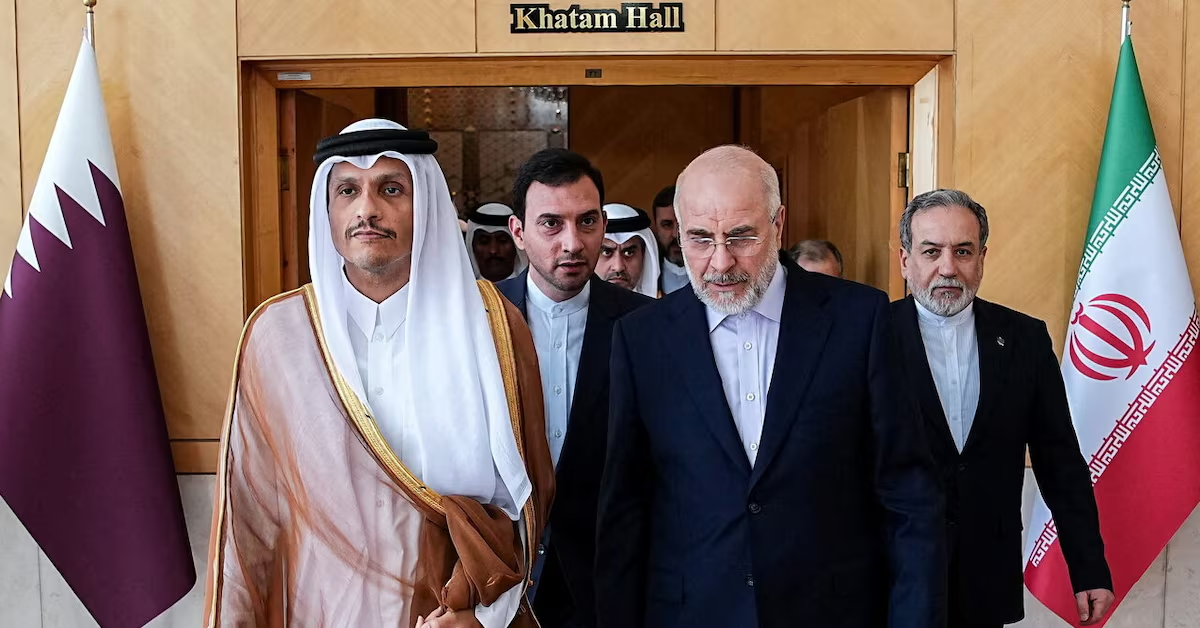
Qatar says its mediators are working “around the clock” to bring the United States and Iran back to the negotiating table, as the six-month war between them grinds on in stalemate — with drone shootdowns over the Strait of Hormuz, Houthi strikes on Saudi Arabia, and a sharply contracting Iranian economy all unfolding in the same 24-hour stretch.
Qatar’s Renewed Push for Diplomacy
Qatar’s foreign ministry confirmed Monday that mediators are working continuously to restart stalled talks between Washington and Tehran. The push comes as Iranian President Masoud Pezeshkian prepares to travel to New York on Tuesday to address the UN General Assembly, and as Iranian Foreign Minister Abbas Araghchi heads to the US for the same summit, stopping in Qatar along the way. Pakistan’s Interior Minister Mohsin Naqvi has also departed for Iran, according to Iranian media, for talks that were originally scheduled for Sunday.
Qatar’s Prime Minister and Foreign Minister, Sheikh Mohammed bin Abdulrahman Al Thani, framed the broader stakes at the Qatar Economic Forum, calling the war a “wake-up call” for the region and calling for a new regional security framework bringing Gulf states and Iran together. “We are hoping that this war is a wake-up call for everyone that it’s time for it to happen,” he said, adding that the crisis had tested long-held assumptions about regional security and stability.
Where the War Actually Stands
Despite the renewed diplomatic push, fighting continues on multiple fronts. Iran’s military shot down a US drone over the Strait of Hormuz on Monday — the second such interception reported within roughly two hours, following a similar claim overnight. Tehran has also warned it’s prepared to escalate further if attacked again: Revolutionary Guards spokesperson Hossein Mohebbi said Iran would deploy new weapons and strike previously untouched locations in response to any fresh US offensive, adding that Tehran is prepared for a prolonged conflict.
Shipping through the Strait of Hormuz remains severely disrupted. Only 12 commodity vessels transited the strait over the weekend, down sharply from 35 the previous weekend, while US Central Command says it has “redirected” 109 commercial vessels since reinstating its blockade of Iranian ports in July.
The Saudi-Houthi Front Adds Pressure
Yemen’s Houthi movement claimed 28 separate strikes by Saudi Arabia across Yemen within a 24-hour period, hitting Taiz, Al-Jawf, and Marib. Oil prices rose Monday after the Houthis separately launched missile and drone strikes toward Riyadh, with Brent crude climbing to around $104.68 a barrel and US crude to roughly $101.06. The US State Department has responded by restricting government employee travel to the Saudi cities of Taif and Yanbu, citing the deteriorating security situation.
The Toll So Far
| Metric | Figure |
|---|---|
| Iran’s GDP contraction (Mar-Jun quarter) | -10.1% year-on-year |
| Europe’s projected Q4 jet fuel deficit | 510,000 barrels/day |
| Share of Europe’s jet fuel imports cut by the war | Nearly half |
| Vessels through Hormuz, this weekend vs. last | 12, down from 35 |
Iran’s Statistical Center confirmed the country’s economy contracted more than 10% year-on-year in the quarter running late March to late June — official, government-published data reflecting the direct economic cost of the war on Iran itself. The disruption is being felt well beyond the immediate region too: Europe is facing a projected fourth-quarter jet fuel shortfall of 510,000 barrels per day, even as South Korea has ramped up jet fuel exports to Europe to their highest level since October 2022 to help offset the gap.
Washington’s Position
US envoy to the UN, Mike Waltz, said President Trump remains determined to ensure Iran never acquires a nuclear weapon and would maintain “maximum pressure” toward that goal, while stating the door remains open for Iran to return to talks “if they do so in good faith.” Iran has consistently denied seeking nuclear weapons and was party to a 2015 agreement curbing its nuclear program in exchange for sanctions relief — an agreement the US withdrew from during Trump’s first term.
A War of Words, Too
Beyond the battlefield, Iran’s parliament speaker and top negotiator, Mohammad Bagher Ghalibaf, has continued using social media to frame the standoff, referencing Schrödinger’s cat in a post arguing the crisis “cannot be modelled” and that Iran’s “hand is already on the lever” regarding the Strait of Hormuz — a response to a JPMorgan analysis that said its own analysts couldn’t model an endgame for the oil market crisis either.
Final Thoughts
Qatar’s renewed mediation push arrives at a moment when the war shows every sign of continuing rather than winding down — drones being shot down on both sides, Houthi attacks on Saudi Arabia intensifying, and Iran’s own economy absorbing a double-digit contraction. With Pezeshkian and Araghchi both headed to the UN General Assembly this week, and Pakistan’s interior minister already in Tehran for talks, the coming days may offer the clearest test yet of whether renewed diplomatic engagement can actually translate into a real de-escalation, or whether it remains, for now, activity happening alongside an unresolved war rather than a path out of it.
