


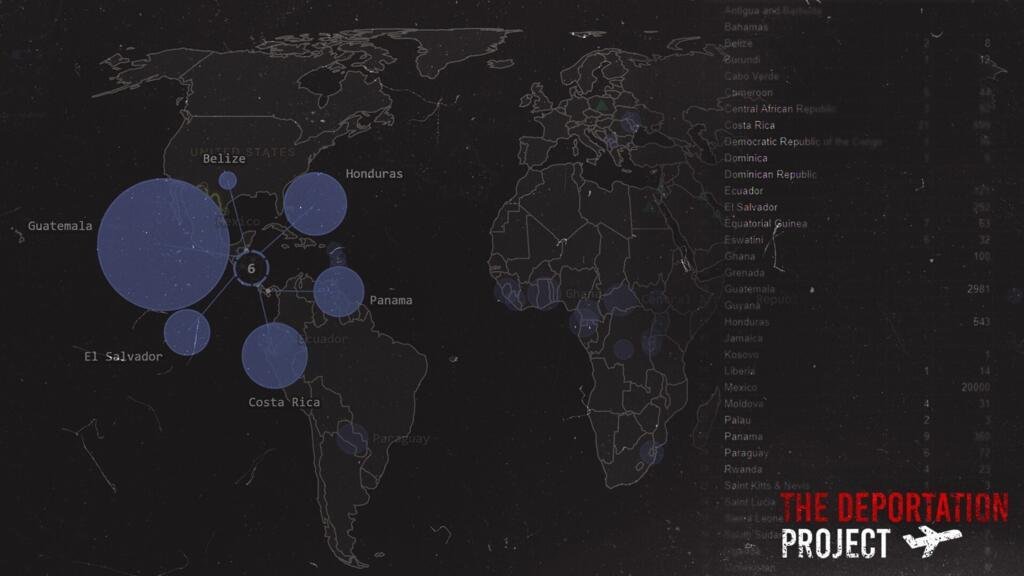
The United States has sent more than 25,000 migrants to countries they have no connection to at all — not their home country, not anywhere they’ve ever lived — under secret deals with 35 different nations, according to a new investigation published Monday.
What the Investigation Found
The investigation, carried out by Forbidden Stories along with a group of international journalists, found that at least 25,447 people had already been sent to these “third countries” by August 31, 2026. This has been happening since President Donald Trump took office in January 2025, as Washington began signing deals with developing countries willing to accept migrants who can’t legally be sent back to their actual home countries.
Where People Have Been Sent
| Detail | Figure |
|---|---|
| Total deported to third countries | 25,447+ (as of Aug 31, 2026) |
| Sent to Mexico | ~20,000 (the large majority) |
| Remaining countries involved | 27 more countries across Latin America, Africa, and the Pacific |
| Additional deals finalised | 7 more countries |
| Total countries with agreements | 35 |
These deals aren’t all the same — some allow only certain nationalities to be sent, and some accept people with criminal records while others don’t.
Money Behind the Deals
The US has set aside $410 million for these agreements. According to internal State Department records seen by investigators, $81 million of that is meant to go directly to the governments accepting deportees, while the rest is meant for aid organizations — including $178 million for the UN’s International Organisation for Migration, and $123 million for the UN refugee agency, UNHCR.
Some individual deals show just how this works in practice. Palau, a tiny Pacific island nation with fewer than 18,000 people, agreed in December 2025 to take up to 75 people in exchange for $7.5 million — though only three people have actually been sent there so far. In Eswatini, 32 people have arrived since July 2025 out of a possible 160 spots, under a deal worth more than $5 million; Eswatini has also accepted people with criminal records, the investigation found.
How Africa Fits Into This
Africa has become a major part of this program. According to Forbidden Stories, 49 of Africa’s 54 countries have been approached about accepting third-country deportees. The first plane carrying deportees landed in Cameroon on January 14. Separately, Rwanda recently became the third African nation to sign such a deal, agreeing to accept up to 250 people, though details on what Rwanda receives in return haven’t been made public. The US has also already sent eight men it described as dangerous criminals to South Sudan, and five more to Eswatini.
A separate AFP investigation earlier this year found that Washington has been using visa bans and other restrictions on African countries as leverage — essentially pressuring them into accepting deportees.
What Happens to the People Sent There
Lawyers who spoke to AFP described deportees as being thrown into a “legal black hole” — held without charge in countries where they have no personal ties and few, if any, rights. This is one of the central concerns raised by rights groups: these are people being sent to countries they’ve never lived in, with limited legal protection once they arrive.
Why This Program Exists at All
Third-country deportation deals exist because some migrants can’t legally be returned to their actual home countries — sometimes because that country refuses to take them back, sometimes because of safety or diplomatic reasons. Rather than leaving these individuals in the US indefinitely, the Trump administration has been striking deals with other countries willing to accept them instead, in exchange for money or other consideration.
What’s Still Unclear
- The full list of all 35 countries with active agreements
- What some countries — like Rwanda — are actually receiving in exchange for taking deportees
- Long-term legal status and rights for people sent to countries with no connection to them
- Full details behind many of the deals, since both the State Department and Department of Homeland Security haven’t responded to requests for more information
Final Thoughts
With over 25,000 people already relocated under these secretive agreements — and more deals still being finalized — this program represents a significant, and largely opaque, shift in how the US handles migrants it can’t legally deport to their home countries. With human rights lawyers describing the situation as a “legal black hole” for those affected, and key details of many deals still unknown to the public, this is a story likely to draw continued scrutiny as more agreements come to light.
